
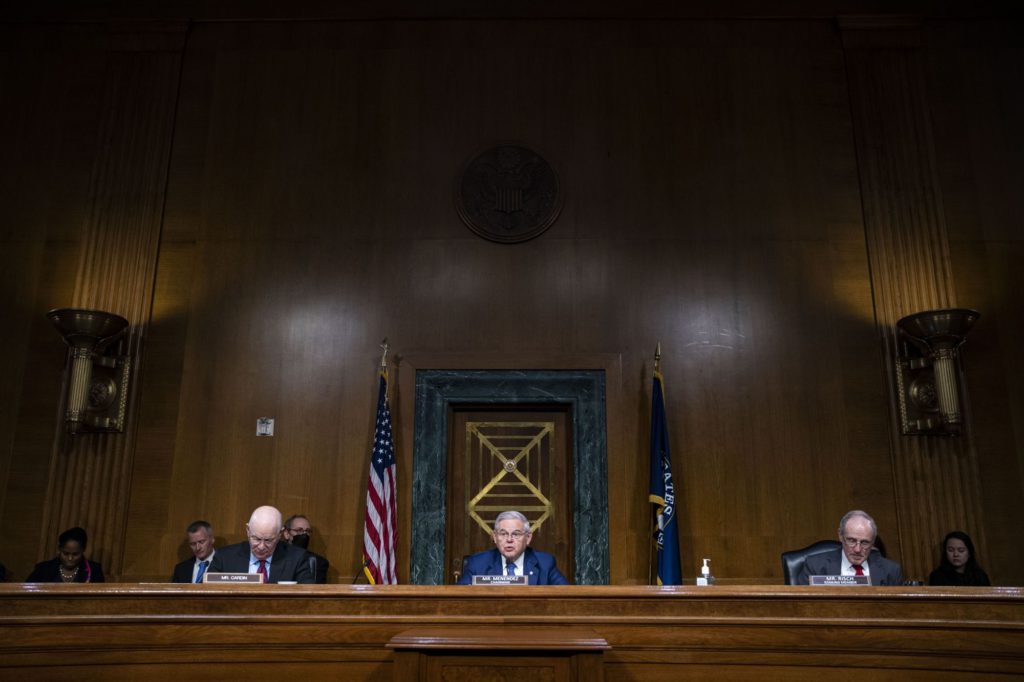
(Bloomberg) — The Senate Foreign Relations Committee was set to take up a bill Wednesday to boost ties with Taiwan and give it more military hardware to deter a Chinese invasion, though the final legislation will need to address White House objections if it has any chance of becoming law.
(Bloomberg) — The Senate Foreign Relations Committee was set to take up a bill Wednesday to boost ties with Taiwan and give it more military hardware to deter a Chinese invasion, though the final legislation will need to address White House objections if it has any chance of becoming law.
The Taiwan Policy Act would give Taipei $4.5 billion for defense over four years, recognize its democratically elected government as the “legitimate representative of the people of Taiwan,” and give the president the power to levy sanctions on Chinese officials and financial institutions involved in actions against the island.
“We need to be clear-eyed about what we are facing,” said Senator Robert Menendez, the New Jersey Democrat who chairs the committee and cosponsored the bill. “We are not seeking war with China.”
While the White House says it supports some parts of the bill, Biden administration officials have said the bill risks upending the US’s carefully calibrated “one China” policy, under which the US has for more than 40 years built ties with Beijing by avoiding formally stating its position on Taiwan’s sovereignty. They also fear it takes policy-making out the president’s hands and gives it to Congress.
The bill’s proponents argue that President Xi Jinping is moving China in a more authoritarian, militaristic direction, and the US must bolster Taiwan’s defenses in response.
China views the bill as another step in a campaign to undermine the “one China” agreement and move toward formal recognition of Taiwan. China’s military fired ballistic missiles over Taiwan last month to protest Nancy Pelosi’s visit to the island, the first such trip by a House speaker in a quarter century.
China’s Taiwan Affairs Office spokeswoman Zhu Fenglian told reporters Wednesday that the Taiwan Policy Act “severely violates” US-China agreements and accused the government in Taipei of wooing US lawmakers to aid in “separatism.”
The White House has been engaged in talks with the committee to change some aspects of the legislation, arguing that the US’s longstanding policy is still working. Officials in President Joe Biden’s administration also say the legislation would take policy direction out of the president’s hands.
One concern focuses on Title 2 of the act, which includes a section to amend previous Taiwan legislation, the Taiwan Relations Act, by expanding the terms under which the US might supply weapons to Taiwan. The Taiwan Relations Act, enacted in 1979, is a cornerstone of US policy toward Taiwan, and revamping it could upend the delicate architecture by which the US and China have peacefully agreed to disagree over Taiwan’s status for decades.
Prospects for the bill’s passage in the full Senate are difficult to handicap given the huge amount of other business lawmakers will have to handle before midterm elections in November. While Senate Majority Leader Chuck Schumer is known to be hawkish on issues related to China, he has to use floor time to pass a continuing resolution to fund the government and is weighing action on a bill codifying gay marriage into law. But the Senate can move quickly if no senator objects to swift action. And a more skeptical view on China is the closest thing to a consensus issue in Washington today.
One prospect for moving the bill forward is to attach it to the spending bill, which must be passed before Congress breaks for the campaign season.
“If we want to ensure Taiwan has a fighting chance, we must act now,” said Senator James Risch of Idaho, the senior Republican on the committee.
More stories like this are available on bloomberg.com
©2022 Bloomberg L.P.