
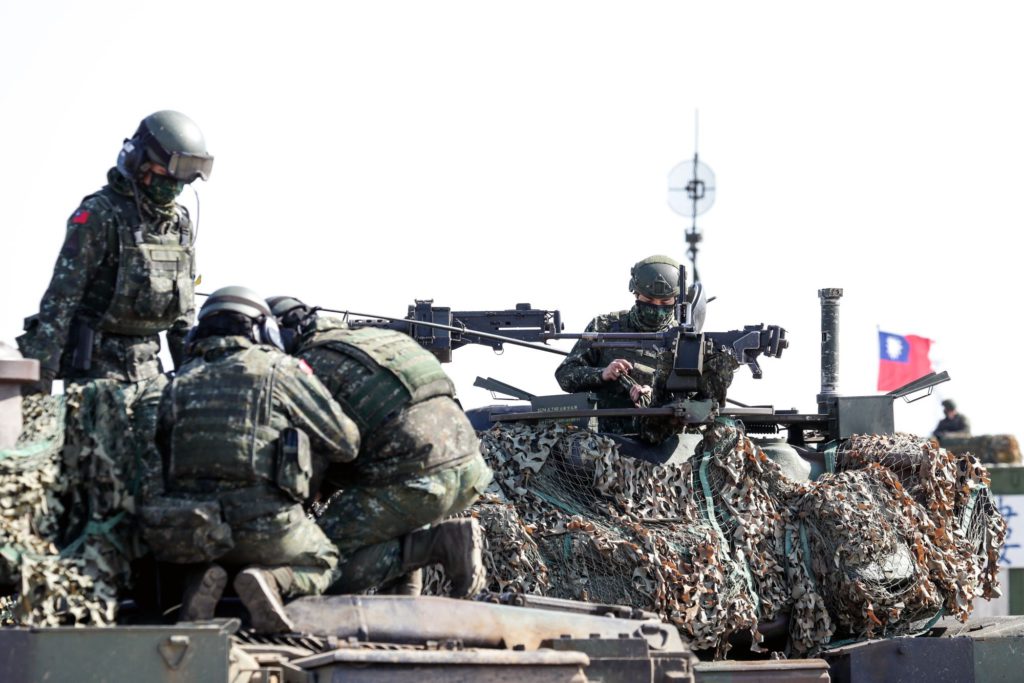
US lawmakers will debate a bill Wednesday to boost ties with Taiwan and give it more military hardware to deter a Chinese invasion. In Washington, where politicians often jockey to show who’s toughest on Beijing, the legislation is making the White House queasy.
(Bloomberg) — US lawmakers will debate a bill Wednesday to boost ties with Taiwan and give it more military hardware to deter a Chinese invasion. In Washington, where politicians often jockey to show who’s toughest on Beijing, the legislation is making the White House queasy.
What: The Taiwan Policy Act would, among other things, give Taipei $4.5 billion for defense over four years, recognize its democratically elected government as the “legitimate representative of the people of Taiwan,” and formally designate the island as a “major non-NATO ally.”
When: The Senate Foreign Relations Committee takes initial action — known as a markup — at 2:30 p.m. Wednesday local time.
So What: The bill in its original form could upend the US’s carefully calibrated “one China” policy, under which the US has for more than 40 years built ties with Beijing by avoiding formally stating its position on Taiwan’s sovereignty. As part of that, the US has tried to maintain “strategic ambiguity” about how much it would help Taipei if the People’s Liberation Army attacked.
Understanding between the two sides has begun to break down amid a growing belief in Washington that President Xi Jinping is moving China in a more authoritarian, militaristic direction. That’s led to bipartisan efforts to bolster Taiwan’s defenses, roll back market access for Chinese companies and sanction officials for crackdowns in Hong Kong and Xinjiang.
Where They Stand
In favor: Senator Robert Menendez, a New Jersey Democrat, called the bill a statement of the US’s “absolute commitment” to stand with Taiwan against China.
Senator Marco Rubio, a Florida Republican and member of the committee, said he thinks the bill will pass in a close vote. “I think we’ll be OK,” Rubio said. “The language I think is pretty well understood, so I feel pretty good about it.”
Opposed: China views the bill as another step in a campaign to undermine the “one China” agreement and move toward formal recognition of Taiwan. The PLA fired ballistic missiles over Taiwan last month to protest Nancy Pelosi’s visit to the island, the first such trip by a house speaker in a quarter century.
Taiwan Affairs Office spokeswoman Zhu Fenglian told a regular news briefing Wednesday in Beijing that the Taiwan Policy Act “severely violates” US-China agreements and accused the government in Taipei of wooing US lawmakers to aid in “separatism.”
Zhu Feng, a professor of international relations at Nanjing University said “a treaty-ally relationship” between Taiwan and the US “would completely damage the US’ ‘one-China’ policy and of course will cause major damage to US-China relations.”
The White House is nervous, too. It argues that the US’s longstanding policy is still working. Officials in President Joe Biden’s administration also say the legislation would take policy direction out of the president’s hands.
“There are elements of that legislation with respect to how we can strengthen our security assistance for Taiwan that are quite effective and robust that will improve Taiwan security,” National Security Adviser Jake Sullivan told “The David Rubenstein Show: Peer-to-Peer Conversations” on Bloomberg Television last week. “There are other elements that give us some concern.”
Critics have highlighted the proposal to formally dub Taiwan a major non-NATO military ally, which would — among other things — ease access to American weapons. They argue that the move would be largely symbolic because Taiwan has been legally “treated as though it were” having that status for two decades.
Senator Chris Murphy, a Connecticut Democrat who also sits on the Foreign Relations Committee, questioned whether the bill would antagonize China and upset regional allies that don’t want to see a war. The US voided its formal security pact with Taiwan as part of the deal to formally establish relations with Beijing in 1979.
National Security Council spokesman John Kirby told a briefing Tuesday the Biden administration was talking to Congress about its concerns. In a sign of how little appetite there is in Washington for a conciliatory approach, he tried to pre-empt criticism that opposing the bill meant being weak on China.
“We’ve been adamant about being committed to Taiwan’s self-defense,” Kirby said, citing hundreds of millions of dollars in recent arms sales.
What Happens Now?
Menendez wants the Foreign Relations Committee to vote on the bill by the end of the day Wednesday. What seems certain is that senators will offer numerous amendments, meaning it could be a long afternoon and the final bill could look a lot different from the current version.
Even if the committee does pass the bill, the Senate must vote on a final version. There’s still no companion bill in the House of Representatives. Biden could then use his veto if he decides it goes too far.
(Updates with comment from academic in 10th paragraph.)
More stories like this are available on bloomberg.com
©2022 Bloomberg L.P.