
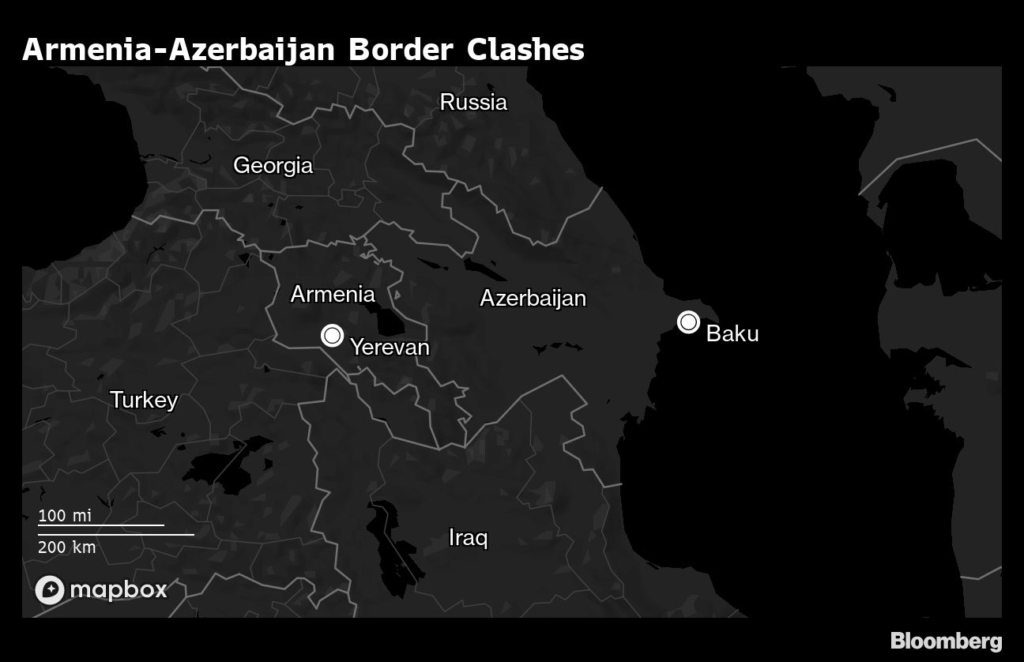
Azerbajian and Armenia resumed fighting at their border despite appeals from the US and France for them to respect a Russia-brokered cease-fire amid the worst death toll since a 2020 war.
(Bloomberg) — Azerbajian and Armenia resumed fighting at their border despite appeals from the US and France for them to respect a Russia-brokered cease-fire amid the worst death toll since a 2020 war.
Azerbaijani forces fired artillery and other large-caliber weapons toward southern Armenian towns including Jermuk starting from the early morning, Armenia’s Defense Ministry said Wednesday. Armenia targeted troop positions in the Kalbacar and Lachin districts of Azerbaijan, the Defense Ministry in Baku said.
At least 99 soldiers on both sides were reported killed on Tuesday in fighting that the Caucasus states blamed each other for starting. The clashes are the worst since thousands of troops died in a 44-day war over the disputed territory of Nagorno-Karabakh that was halted in November 2020 when Russian President Vladimir Putin negotiated a truce.
The conflict has erupted with Russia distracted by Putin’s invasion of Ukraine, where his troops have been forced to retreat under pressure from a Ukrainian counteroffensive. While Azerbaijan and Armenia have held talks to try to delineate their common border and open up transport routes as part of the truce, they have yet to reach a final peace agreement.
French President Emmanuel Macron told Azerbaijani leader Ilham Aliyev there’s an urgent need to end the hostilities and respect the cease-fire in a phone call late Tuesday, according to an Elysee statement. France intends to raise the crisis at the United Nations Security Council, where it’s the current president, the statement said.
Aliyev replied that Azerbaijan is responding to Armenian provocations, according to his presidential website. He also held phone talks Tuesday with Turkish President Recep Tayyip Erdogan, which has a defense pact with Azerbaijan and whose military helped Aliyev’s army to win the 2020 war.
The US State Department called for an immediate cease-fire while pointing the finger at Azerbaijan for attacks on Armenian territory. “We have seen significant evidence of Azerbaijani shelling inside Armenia and significant damage to Armenian infrastructure,” spokesman Ned Price told reporters at a briefing, adding that the US was urging Russia to use its influence with both states to halt the fighting.
Russia’s Foreign Ministry announced early Tuesday that it had negotiated a cease-fire between Azerbaijan and Armenia. But the deadline to halt hostilities was apparently ignored.
Defense Pact
Armenian Prime Minister Nikol Pashinyan has appealed to Moscow for support under a 1997 defense pact and also asked the Russian-led Collective Security Treaty Organization to provide assistance at an emergency meeting with Putin and other leaders by videoconference Tuesday. The mutual-defense body said its secretary-general would go to Armenia to assess the situation on the border.
So far, though, neither Russia nor the CSTO have indicated they’re willing to send forces to bolster Armenia’s territorial integrity. When Kazakh President Kassym-Jomart Tokayev asked for assistance to put down violent protests in January, Putin immediately ordered troops to lead a CSTO peacekeeping operation.
Azerbaijani soldiers seized 100 square kilometers (39 square miles) of territory from Armenians along the non-delineated border on Tuesday, the pro-government Caliber news service in Baku reported.
Aliyev has demanded the establishment of a corridor through southern Armenia to an Azerbaijani exclave bordering Turkey. That’s been rejected by Pashinyan, who’s said the truce brokered by Putin only provides for the opening of transport links between the two states, which he’s prepared to implement.
Azerbaijan took control of part of Nagorno-Karabakh, which is mostly populated by Armenians but internationally recognized as part of its territory, in the 2020 conflict and regained seven surrounding districts that Armenian troops had occupied since the early 1990s.
More stories like this are available on bloomberg.com
©2022 Bloomberg L.P.