
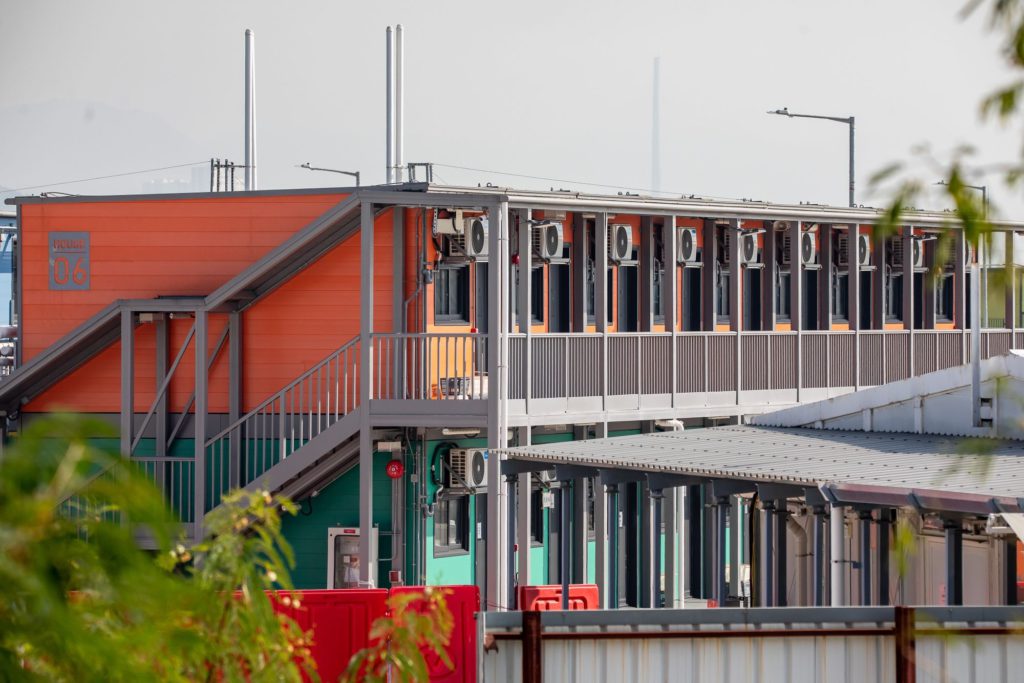
Hong Kong will allow incoming travelers who test positive for Covid-19 to remain in their designated quarantine hotels instead of being transferred to isolation hotels or community facilities like the infamous Penny’s Bay.
(Bloomberg) — Hong Kong will allow incoming travelers who test positive for Covid-19 to remain in their designated quarantine hotels instead of being transferred to isolation hotels or community facilities like the infamous Penny’s Bay.
The move, which will begin Nov. 1, comes as Hong Kong prepares for a series of high-profile events including a summit for global bankers and an international rugby tournament aimed at reviving its business-friendly reputation after more than two years of isolation. Some potential visitors have said they won’t attend if there is a chance they could get sent to quarantine facilities.
Between 100 and 300 new arrivals in Hong Kong test positive for Covid every day. While many are transferred to a basic quarantine hotel to isolate for about a week, others are sent to the makeshift government-run camps known as Penny’s Bay or Kai Tak, the site of the former airport. The risk has made people dread arriving in one of the world’s richest cities, even after it cut hotel quarantine times from seven days to three.
The change won’t reduce the time infected travelers need to isolate before being let out into the community — only allow them to avoid the uncomfortable, government-run facilities. They will be released from their quarantine hotels only after submitting negative tests on the sixth and seventh days of isolation, a spokesperson for the Health Bureau said on Wednesday.
“The arrangement will save confirmed cases from traveling and enable better utilization of manpower and vehicles originally deployed for transporting confirmed cases, while reducing the transmission risk during the transportation process,” the government said in a statement.
It’s the latest in a series of measures to ease travel rules that have been implemented by Chief Executive John Lee since he was sworn into office on July 1. The city removed flight suspensions that imposed snap bans on routes that brought in too many people with Covid, cut the length of hotel quarantine and ended temperature screening for transit passengers that could have led some to government-managed virus facilities.
The city hasn’t decided whether to further cut hotel quarantine times, and will make the call based on the Covid situation closer to the high-stake events, Lee said this week. Residents who become infected have been allowed to remain at home since an outbreak slammed the city this spring, provided they had room to isolate.
While new arrivals have stricter isolation rules than those infected locally, they account for a fraction of the city’s total daily case load as omicron subvariants drive another outbreak. Hong Kong reported more than 7,000 local infections on Wednesday, compared with just 161 coming from abroad.
Details of the new program are still being worked out and more information will come in time, said Chuang Shuk-kwan, head of communicable diseases at in Hong Kong’s Centre for Health Protection at a briefing.
The number of daily imported cases may put stress on the hotels. They have been asked to hold back either eight rooms or 3% of their total available, whichever is less, to accommodate guests who turn out to be carrying Covid, Ovolo Hotels said in an emailed statement.
Detailed Breakdown
Of the 161 imported infections reported on Wednesday, 85 were detected at the airport or within the first three days of arrival, Chuang said. That is the group that could be eligible to stay at a pre-booked quarantine hotel, potentially including some families or groups.
There are 62 hotels now participating in the quarantine program, which equates to more than one infection every day on average per hotel. The cases may not be spread evenly, however, and it’s unclear how hotels will accommodate the last-minute maneuvering required as guests need to extend their stays from three to at least seven days.
Some travelers may choose to go to the government-run facilities. Those who elect to remain in their quarantine hotels must pay for the full stay on their own.
Participating hotels must arrange specific floors or rooms for isolation purposes, add air purifiers and ensure their workers are properly garbed, the government said.
Good News
Nevertheless, hotels, especially smaller ones, will still find that income from the quarantine business outweighs demand from local customers and welcome changes that allow more people to visit the city, said Winnie Chan, association manager at the Federation of Hong Kong Hotel Owners.
“It’s good news for travelers because they can now quarantine at a comfortable place even if they test positive,” she said. “The policy has provided them with more options.”
(Adds infection details starting in the 11th paragraph. An earlier version of this story corrected the seventh paragraph to note the outbreak began in the spring.)
More stories like this are available on bloomberg.com
©2022 Bloomberg L.P.