
The yen slid for a fourth day after Japan’s strongest hint yet at possible direct market intervention failed to generate a change in sentiment from traders.
(Bloomberg) — The yen slid for a fourth day after Japan’s strongest hint yet at possible direct market intervention failed to generate a change in sentiment from traders.
The currency fell 0.1% to 143.91 per dollar in a fourth day of declines, despite Japan’s top foreign exchange official warning that he won’t rule out any options if needed should recent moves in the currency market continue.
“In the two days of Sept. 6-7, the currency has fallen by around 5 yen to the dollar. Fundamentals alone can’t justify these moves,” said Masato Kanda, vice finance minister of international affairs at the finance ministry.
He spoke after a meeting with his counterparts at the Bank of Japan and the Financial Services Agency, a gathering typically used to show a united front in voicing concern over markets.
Still, the lack of a written statement backing up the warning and a comment that their stance remained unchanged left investors unswayed. At the June meeting, when the yen was at 134 against the dollar, a written statement was issued.
“Japan’s foreign exchange authorities are in a extremely tough spot,” said Takahiro Sekido, chief Japan strategist at MUFG Bank, suggesting the warning was largely an attempt to buy time and that intervention was not imminent.
“They are surely aware that the worst case is to intervene and then find it’s not effective enough to stop the yen falling,” he said.
A Trader’s Guide to Japanese Policy Makers’ Language on the Yen
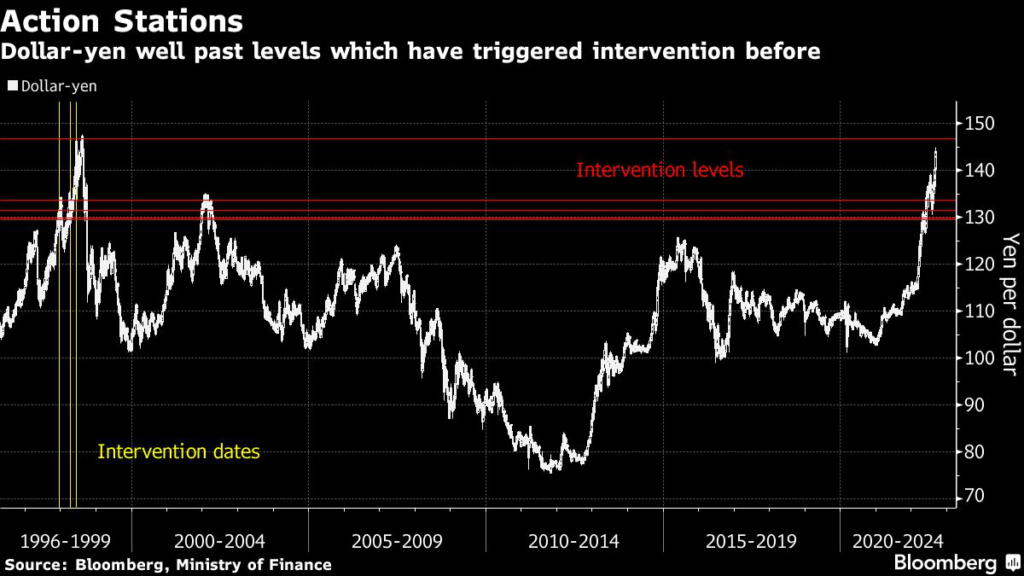
The yen had touched 144.99 Wednesday and traders were watching for a break of 145. They were also keeping an eye on 146.78, the level reached before joint Japan-US intervention to support the yen back in 1998.
Previous unilateral interventions by Japan before Washington’s help proved ineffective, but the bar for winning US support this time round is much higher.
The US Treasury Department on Wednesday stuck by its reluctance to support any potential intervention in currency markets.
“So far the Japanese officials have been reluctant to act unilaterally and instead preferred to talk up the currency,” said Valentin Marinov, head of G-10 currency research at Credit Agricole in London before the meeting. “Given that the US has so far refused to even discuss the possibility to intervene to cheapen the dollar, I think that a concerted intervention is still some ways off.”
Cornered FX Traders Brace for Dollar to Smash More Asia Records
With the dollar gaining not just against the yen but also a broad swathe of currencies worldwide, traders say it’s difficult to see where its decline halts. The pair has closely tracked moves in Treasury yields, which retreated Thursday.
The yen has slumped to levels that leave it on track for its worst year on record as the divergence between US and Japanese monetary policy widens. The BOJ is resolutely keeping policy loose to bolster the economy, while the Federal Reserve has been aggressively hiking rates to beat back surging inflation.
“I don’t think the BOJ is going to move, but if Japan really wants to initiate a change in the trend, it would make sense to change monetary policy,” said Daisuke Karakama, chief market economist at Mizuho Bank in Tokyo.
He noted that the government and central bank work in tandem on a policy mix to support the economy while providing aid for businesses and households suffering from higher bills amplified by the yen.
BOJ Governor Haruhiko Kuroda in July ruled out an option to raise rates to counter weakening of the yen as it would take a big rate hike that would end up breaking Japan’s economy.
Still, the cheaper the yen gets, the greater the risk of an eventual whiplashing of the currency.
“From here, yen weakness seems likely to persist as long as US bond yields are rising and equity markets aren’t rolling over too violently,” said Kit Juckes, chief foreign-exchange strategist at Societe Generale SA. “But the cheaper the yen gets, the greater the danger that when the yield cycle does turn around, the yen will rally very sharply.”
(Updates with comment.)
More stories like this are available on bloomberg.com
©2022 Bloomberg L.P.