
Gilt investors are bracing for details of Prime Minister Liz Truss’s new economic package, with some warning that a new wave of debt issuance to fund the spending risks roiling markets.
(Bloomberg) —
Gilt investors are bracing for details of Prime Minister Liz Truss’s new economic package, with some warning that a new wave of debt issuance to fund the spending risks roiling markets.
The new government hasn’t confirmed yet how it plans to pay for an economic package that could run to as much as £200 billion ($230 billion), but there’s widespread speculation that the UK will have to sell more bonds.
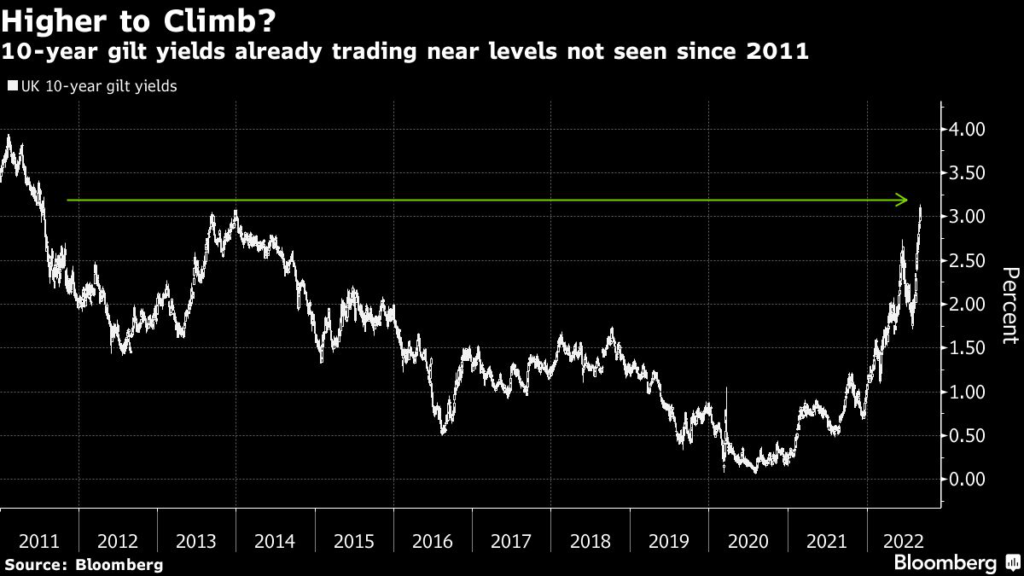
That additional supply could drive up UK yields and add to worries about a widening deficit. Britain’s gloomy growth outlook and double-digit inflation has already driven the pound to the lowest level against the dollar since 1985. Ten-year yields are near 3% and have increased about 120 basis points since the beginning of August.
“It doesn’t feel like yields are high enough or curves are steep enough for the market to be really pricing in this boatload of issuance coming in over the next year,” said Imogen Bachra, head of UK rates strategy at NatWest Markets. If Truss’s plan is significantly funded by bond issuance, 10-year rates may jump to 3.5%, she added.
Truss Rules Out Funding UK Energy Support With Windfall Tax
Truss is expected to make the announcement on Thursday. Her government is planning on capping average annual household energy bills at or below the current level of £1,971, and include extra support for businesses, according to policy documents seen by Bloomberg. Truss has ruled out windfall tax on companies as a way to fund the extra spending.
Bank of America Corp. strategists have also warned that increasing strains on the government finances is one of their concerns for the pound. The currency traded around $1.15 on Thursday.
Orla Garvey, a portfolio manager at Federated Hermes Limited, pointed out that unlike when Covid-19 aid measures were introduced, the gilt market won’t have the support of Bank of England buying up debt to suppress yields.
“If this is directly funded through gilt issuance, that could have a big market impact,” she said.
Garvey expects the yield curve to steepen, with long-dated gilts feeling the biggest hit from the additional supply. Meanwhile, short-dated bonds could outperform because the energy-price caps will cut inflation in the short-term and give the BOE some space to avoid more aggressive rate hikes, she said.
Some of those moves have already started to happen. On Wednesday, two-year gilt yields fell as much as 25 basis points after BOE officials sounded a more dovish tone. The gap between two- and 10-year gilt yields, which inverted to minus 35 basis points in August, has turned positive again as longer-dated bonds underperform.
“Ordinarily, we would not be concerned by the prospect of increased supply,” wrote Daniela Russell, UK rates strategist at HSBC Holdings Plc, in a note. “But significant fiscal loosening and the possibility of unfunded tax cuts comes at a time when the outlook for gilt demand has become more challenging.”
More stories like this are available on bloomberg.com
©2022 Bloomberg L.P.