
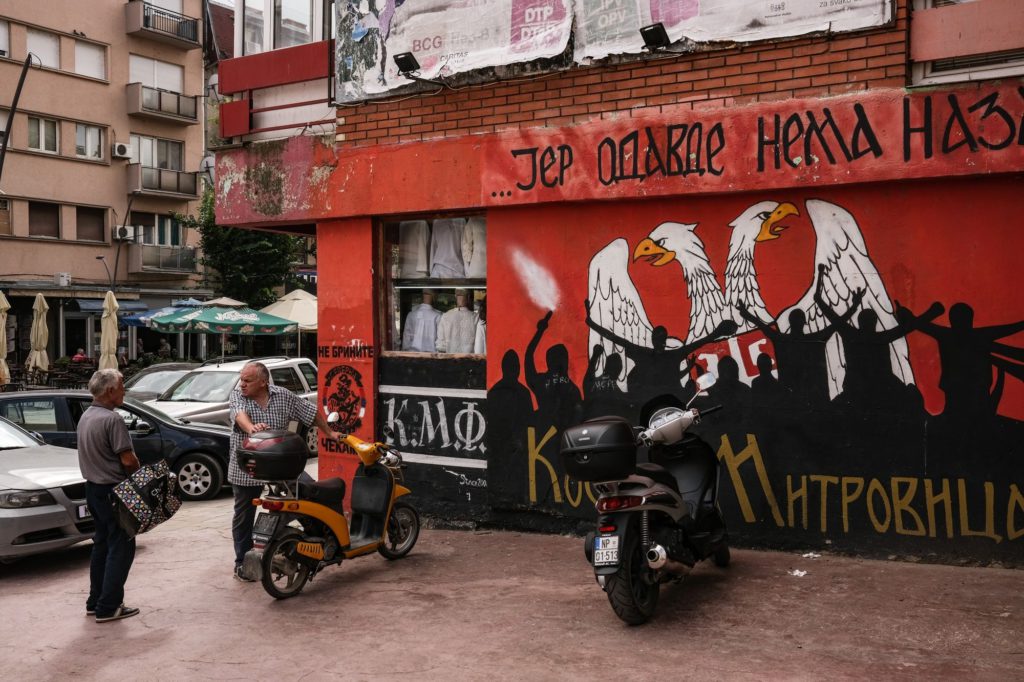
Still scarred by division more than two decades after a fragile peace, Kosovo is a worrying omen for Europe mired in conflict again.
(Bloomberg) — It takes just a minute to walk over the bridge linking either side of the Ibar River in the city of Mitrovica, and yet it’s a journey that takes you back years.
Renovated following NATO’s intervention to end the ethnic conflict in Kosovo, the hope was that the bridge would turn into a symbol of unity in the divided country. More than two decades later, it remains the boundary between worlds that have collided again in recent weeks.
To the south lies the vibrant part of Mitrovica that’s home to the ethnic Albanian majority, supported by remittances from a diaspora that fled the war. There are new stores, apartments being built and busy restaurants where you pay in euros. In the north, mainly ethnic Serb citizens live in limbo, paralyzed by the region’s intransigent politics. They are neither part of Serbia nor — in practice — part of Kosovo.
“In 23 years, they did very little to bring the two communities together,” Veroljub Petronic, a security analyst in the Serb area of the city, said in his first-floor office located in a run-down apartment building off the main square. “One side doesn’t want us; the other side must not take us.”
The latest flare-up is over Kosovo’s push this summer to standardize identity cards and car license plates, something that may look relatively trivial to outsiders given Russia’s brutal war in Ukraine. But on a continent that’s being haunted by proxy struggles between east and west, the failure of the tiny nation of 1.8 million people to move on carries an ominous warning for Europe.
The de-facto carve up of Kosovo followed Serbia’s enforced withdrawal of forces in 1999 and the list of unfinished business is long, from basic functions like issuing paperwork such as passports to ethnic Serbs to documenting war casualties.
Serbia views Kosovo as its own, the cradle of the Orthodox nation, with echoes of Vladimir Putin’s stance on Ukraine. Along with ally Russia (and five European Union members, among others), Serbia refuses to recognize the mainly Muslim Kosovo as a sovereign state.
Mitrovica encapsulates how the standoff between the Serb and Kosovar leaderships has prevented the two countries from agreeing a final postwar deal, a prerequisite for any chance of the EU membership both sides covet, along with Ukraine.
Read More: Kosovo Learns to Live With Rolling Blackouts Again
The pedestrian bridge, guarded around-the-clock by Italian carabinieri, is open for all citizens. The flow of people, though, is so thin that it doesn’t even rouse stray dogs lying in the sun. Most young people born after the war who were interviewed throughout Kosovo over a recent week have never been to the other side of their national divide. Those who did, said they went surreptitiously.
“You never know what will happen here,” Branko Milosavljevic, a 70-year-old retiree, said as he walked past the bridge on the north side. “The situation is not better, everything stays the same. There is no progress.”
Overall, about 100,000 Serbs still live in Kosovo, with a vast majority of them in the north of the country. Heavily supported by Serbia, they still use its currency and adorn their towns and villages with Serb flags. Most political parties are loyal to Serb President Aleksandar Vucic.
But that has also turned the Serb-populated north into a gray zone, an area backed by what the Kosovo government sees as the aggressor and without clearly defined jurisdiction as both sides assert authority over the territory.
In the Serb area of Mitrovica, kids play soccer among stray dogs in the main square because there’s no money for a playground to serve the population that’s slowly disappearing. Newcomers are viewed suspiciously and even locals still keep looking over their shoulder. When driving to the next town of Zvecan, about five minutes from Mitrovica, the advice is to keep a steady speed and not do anything to draw attention.
Tensions flared up again last month after Kosovo’s prime minister, Albin Kurti, pushed through a demand that Serbs living in the country have to hold documents issued by his government rather than Serbia. That was enough to put police and NATO’s 3,800-strong KFOR peacekeeping force on standby and western leaders called for a de-escalation.
Police patrols were visibly increased in Mitrovica and KFOR set up checkpoints in the area, raising the risk of an incident that could trigger violence, according to Milica Andric Rakic, a policy analyst in Mitrovica’s north. “It’s a matter of time before they stop a radical guy,” she said. “If we have a major incident between the police and locals, it will unravel.”
Locals from the capital Pristina to Mitrovica blamed Kurti and Vucic for inflaming the situation with their rhetoric about war and ethnic cleansing. In the Serb-dominated region, some have sent their children away for the first time in a decade as they grew nervous.
Serbia’s prime minister, Ana Brnabic, made a rare visit to northern Kosovo on Tuesday. She pledged to keep financial and other support for the community as her country encourages them to stay put and not abandon their homes.
Politicians on both sides are debating how they can mend ties. All past efforts have failed, including a 2018 proposal that included a land swap. That ran into pushback from European leaders because of the risks.
Read More: How Russia’s War on Ukraine Is Stoking Tension in Kosovo
Then there’s how to document the past, such as addressing the issue of missing victims during the conflict that lasted for nearly 16 months and left over 10,000 dead, mainly ethnic Albanians.
To this day, Serb and Kosovar leaders quarrel about the numbers of dead, displaced or those subjected to sexual violence. That has led to embarrassing exchanges at international events such as the security conference in Munich in 2019.
But it’s not just the numbers. Lack of willingness to cooperate to identify victims has made it impossible to bring a closure for many families hurt by the war, fostering further resentment. Experts are still trying to rectify mistakes made when evidence was collected and victims were identified.
“We’re still dealing with the consequences of that,” said Lars-Gunnar Wigemark, the head of the EU’s Rule of Law Mission in Kosovo. “It’s essential now that in Ukraine, evidence is collected properly. That’s a big test for Ukraine, on top of fighting a war.”
The leaderships in Kosovo and Serbia are under increased pressure on them from Washington to Brussels to deliver on their pledges to reconcile after cementing their power. Kurti won 50% of the votes in the last election, while Vucic’s party got nearly 60% of ballots in Serbia.
But their mandates have also enabled them to increase their rhetoric against each other and silence opposition, making coexistence more difficult on the ground.
“If you want my cynical comment, it looks like we have Vucic who is little Putin wannabe, we’re having Kurti who is little Zelenskiy wannabe and we’re having the West who is trying to perform trans-Atlantic unity of the 1990s,” said Ylber Hysa, a former Kosovo diplomat now back in Pristina.
Despite the unresolved differences among the war-time foes, the western international community has largely supported Kosovo’s unilateral declaration of independence from Serbia in 2008. Offering diplomatic, financial help and security via the NATO force has been key for Kosovo’s progress and elements of that may also be the case for Ukraine.
Premier Kurti said in an interview on Aug. 24 he thinks he can reach a deal with Serbia during his term in power. He also believes that economic development is what’s “going to integrate all the citizens,” but didn’t specify any investment drives for the less-developed north.
Kurti’s election pledge was to uproot corruption, a phenomenon that has also plagued Eastern Europe for decades. He managed to improve Kosovo’s Transparency International ranking last year, moving to the 87th spot in its Corruption Perceptions Index from 104th place in 2020.
But what worried citizens interviewed last month on both sides of the ethnic divide in Kosovo was the legacy of the conflict for the next generation in a country with Europe’s youngest population. They cited the complete lack of interaction among young people who have grown up separated by language, territory and an interpretation of history passed on by their elders.
“Older people are telling them stories of the conflict and that creates hate,” Petronic said. “They were told a part of history. There were some attempts to bring people closer together in reconciliation, but it didn’t happen.”
More stories like this are available on bloomberg.com
©2022 Bloomberg L.P.