
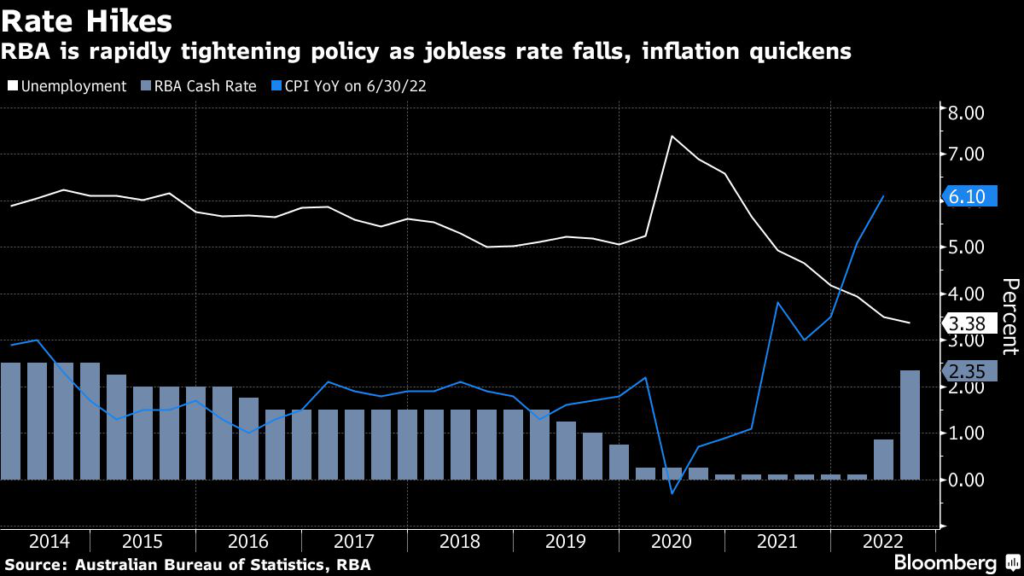
Australia’s central bank chief signaled a potential end to outsized interest rate hikes, saying the case for a slower pace of tightening becomes stronger as the cash rate moves higher. The currency and bond yields fell.
(Bloomberg) — Australia’s central bank chief signaled a potential end to outsized interest rate hikes, saying the case for a slower pace of tightening becomes stronger as the cash rate moves higher. The currency and bond yields fell.
In a speech in Sydney Thursday, Reserve Bank Governor Philip Lowe reiterated that further rate rises were required to cool the hottest inflation in decades, having hiked by 2.25 percentage points since May.
“We are conscious that there are lags in the operation of monetary policy and that interest rates have increased very quickly,” said Lowe, who hiked by a half-percentage point Tuesday to take the cash rate to 2.35%.
“We recognise that, all else equal, the case for a slower pace of increase in interest rates becomes stronger as the level of the cash rate rises.”
His remarks contrasted with global counterparts, resulting in the Australian dollar extending losses to trade at 67.25 U.S. cents at 1:13 p.m. in Sydney. Government bond yields slumped, with the three-year extending declines to 21 basis points.
The governor did not specify how high rates will need to go, saying only that the level and pace of tightening would be “guided by the incoming data and the evolving outlook for inflation and the labor market.”
His speech comes after central bankers including the Federal Reserve’s Jerome Powell warned at last month’s Jackson Hole meeting that borrowing costs are headed even higher and will remain elevated for some time.
Lowe warned a sharp slowing in global growth would make the job of delivering a soft landing in Australia “much harder.”
He highlighted three uncertainties for policy makers:
- A global environment where the Fed has indicated a period of tight policy and below-trend growth will be required to get inflation under control and a slowdown in China
- How inflation expectations in Australia adjust to a period of surging prices
- How households respond to rising borrowing costs
Economists expect the RBA will shortly slow the pace of increases to quarter-point moves after four successive half-point hikes. Money markets reckon the RBA will remain aggressive, pricing in a cash rate of 3.2% by year’s end, and a peak of 3.75% in 2023.
The central bank is relying on the tightest labor market in half a century and still-strong household spending to keep the economy ticking over during the rapid tightening.
Figures out Wednesday showed gross domestic product powered ahead in the three months through June, expanding 3.6% from a year earlier underpinned by household spending and high export prices.
Lowe also spoke about an ongoing independent review of the RBA, which is looking into the efficacy of its board, governance and mandate.
He reiterated that he didn’t see a strong case to move away from the RBA’s flexible inflation targeting approach. It “is not a perfect monetary policy regime, but it is hard to do better,” he said.
The governor did however signal openness to reviewing the 2-3% inflation target, noting many other countries had chosen 2% for their goal.
“As part of the review, it is worth examining the arguments for and against a change to the nominal anchor,” Lowe said.
(Updates with market reaction.)
More stories like this are available on bloomberg.com
©2022 Bloomberg L.P.