
The yen’s decline continued for a fourth day as traders took stock of key levels to watch after the strongest warnings to date from senior officials failed to stem its slide.
(Bloomberg) — The yen’s decline continued for a fourth day as traders took stock of key levels to watch after the strongest warnings to date from senior officials failed to stem its slide.
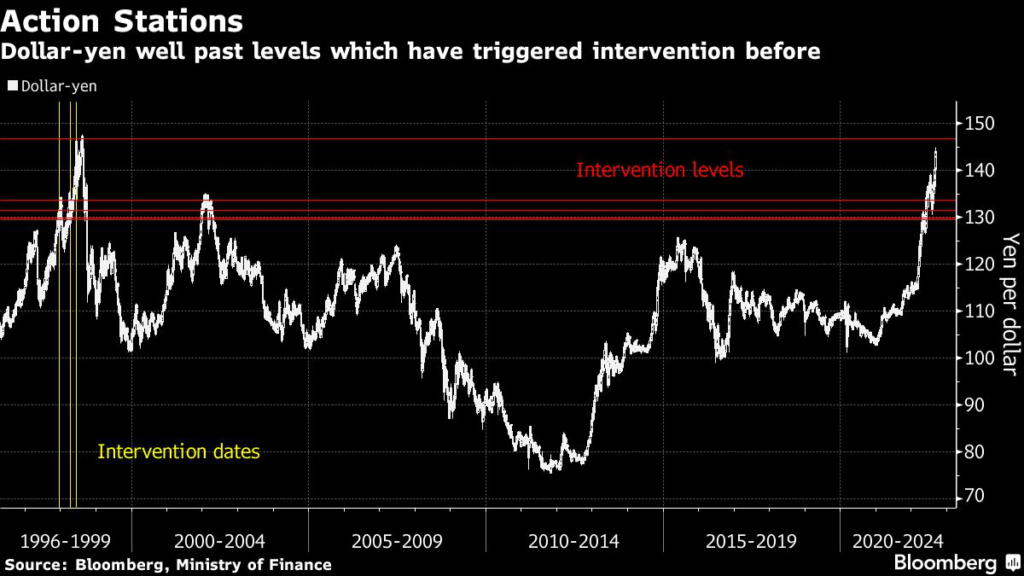
The yen was 0.2% lower in afternoon trading in Tokyo around the 144 per dollar level. It had touched 144.99 Wednesday before a modest recovery, making 145 the next focal point for chart lovers. Traders are also keeping an eye on 146.78, the level reached before joint Japan-US intervention to support the yen back in 1998.
The US Treasury Department on Wednesday stuck by its reluctance to support any potential intervention in currency markets, after Japanese Finance Minister Shunichi Suzuki said he was concerned about very sudden and one-sided moves.
A breach of 147.66 would bring the beleaguered currency back to levels last seen 32 years ago.
Given the fact that the dollar is gaining not just against the yen but also a broad swathe of currencies worldwide, traders say it’s difficult to see where its decline halts. The pair has closely tracked moves in Treasury yields which retreated overnight.
Cornered FX Traders Brace for Dollar to Smash More Asia Records
“The dollar/yen may hit 145 during Tokyo hours today even without any fresh catalyst as moves are driven by flows these days,” said Akira Moroga, manager of currency products at Aozora Bank in Tokyo. “Given that the speed has been rapid, people should be mindful of the risk of an actual intervention just as a show of resolve notwithstanding its effectiveness. But even so, it won’t change the trend.”
The yen has slumped to levels that leave it on track for its worst year on record as the divergence between US and Japanese monetary policy widens. The Bank of Japan is resolutely keeping policy loose to bolster the economy, while the Federal Reserve has been aggressively hiking rates to beat back surging inflation.
“From here, yen weakness seems likely to persist as long as US bond yields are rising and equity markets aren’t rolling over too violently,” said Kit Juckes, chief foreign-exchange strategist at Societe Generale SA. “But the cheaper the yen gets, the greater the danger that when the yield cycle does turn around, the yen will rally very sharply.”
(Updates levels.)
More stories like this are available on bloomberg.com
©2022 Bloomberg L.P.