
Federal Reserve Vice Chair Lael Brainard said the US central bank will have to raise interest rates to restrictive levels, while cautioning risks would become more two-sided in the future.
(Bloomberg) — Federal Reserve Vice Chair Lael Brainard said the US central bank will have to raise interest rates to restrictive levels, while cautioning risks would become more two-sided in the future.
“We are in this for as long as it takes to get inflation down,” Brainard said Wednesday at a conference hosted by The Clearing House and Bank Policy Institute in New York. “Monetary policy will need to be restrictive for some time to provide confidence that inflation is moving down to target.”
Brainard’s remarks, a day before an address by Chair Jerome Powell, came as other officials including Vice Chair for Supervision Michael Barr and Cleveland Fed President Loretta Mester voiced their commitment to fighting inflation.
Policy makers are using the time before their pre-meeting blackout, which starts midnight Friday, to assure investors they won’t blink. But they are also taking care not to declare how big they want to go when they gather Sept. 20-21 as they wait for a key reading on consumer prices due Tuesday.
US central bankers are raising interest rates rapidly to counter red-hot inflation after being slow to respond as prices began to surge in late 2021. They hiked by 75 basis points at their meetings in June and July and have left the same again on the table when they next gather, or a smaller half-point move, depending on the data.
While Brainard gave no indication about her preference for the size of the next rate hike, she noted that there will be a stage where risks will increase with further tightening.
“At some point in the tightening cycle, the risks will become more two-sided,” she said. “The rapidity of the tightening cycle and its global nature, as well as the uncertainty around the pace at which the effects of tighter financial conditions are working their way through aggregate demand, create risks associated with over-tightening.”
At the same time, “it is important to avoid the risk of pulling back too soon,” she said.
“Fed vice-chair Brainard struck a balanced tone in her first policy speech in some months,” Evercore ISI’s Krishna Guha and Peter Williams wrote in a note to clients. “There was no strong lean in favor of a 75 basis-point rather than 50 basis-point hike in September, cautioning against the notion that 75 basis points is a done deal.”
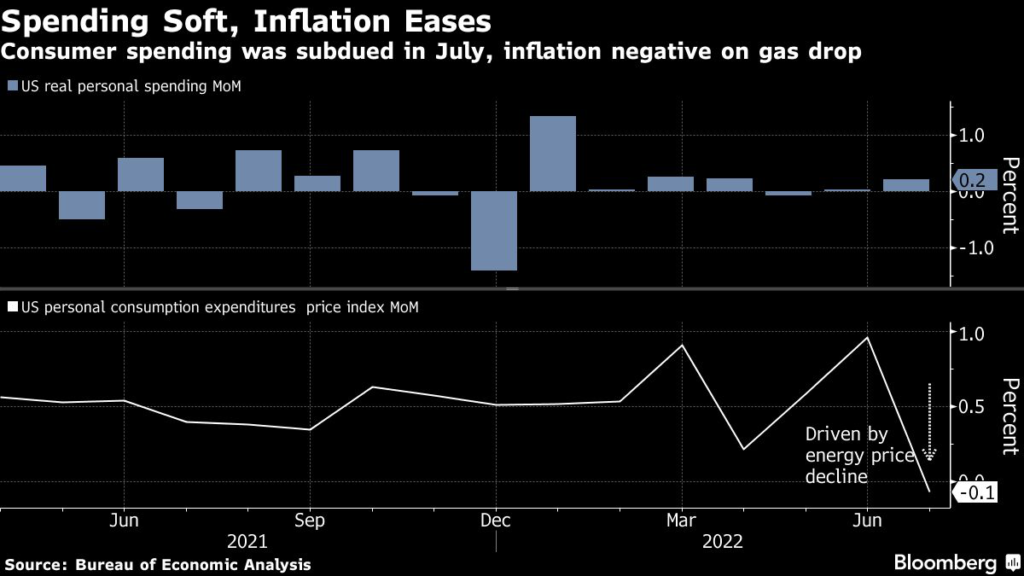
The US economy has fared well on the back of steady consumer spending even as higher rates bite down on housing and investment. The labor market remains strong with unemployment at 3.7%.
The Fed vice chair struck an optimistic note on some supply constraints, noting improvements in delivery times for some goods and a rise in labor force participation in August. She said that while there are reports of businesses discounting to move excess inventories, there is no “hard data at an aggregate level suggesting that businesses are reducing margins in response to more price sensitivity among customers.”
Inflation was 6.3% for the 12 months ending July, according to the Commerce Department gauge targeted by the Fed, which aims for 2% inflation. While measures are showing some moderation, Brainard said it “will be necessary to see several months of low monthly inflation readings to be confident that inflation is moving back down to 2%.”
A separate Labor Department measure of consumer prices will be released on Sept. 13. Economists surveyed by Bloomberg expect it to moderate to 8.1% in the year through August, from 8.5% the month before.
Brainard said the disinflation in the U.S. “should be reinforced by weaker demand and tightening in many other countries.”
Europe, China
“This is particularly the case as Europe contends with downside risks to activity and a severe energy shortage caused by Russia’s war against Ukraine, and as China maintains its zero-Covid approach against a backdrop of weaker consumption,” she said.
The dollar has risen by more than 10% against other major currencies this year, reflecting a US outlook that looks more promising that many other major economies. A stronger dollar helps to dampen American inflation by making imports cheaper, but weaker global economic growth could also become a headwind for the US.
Despite Europe’s woes, and more Covid-19 lockdowns in China, Fed officials have been single-minded in their inflation fight.
Speaking Aug. 26 at the Kansas City Fed’s annual conference in Jackson Hole, Wyoming, Powell said another “unusually large increase” in the benchmark lending rate could be appropriate this month, depending on the “totality” of incoming data.
(Updates with analyst reaction in ninth paragraph.)
More stories like this are available on bloomberg.com
©2022 Bloomberg L.P.