
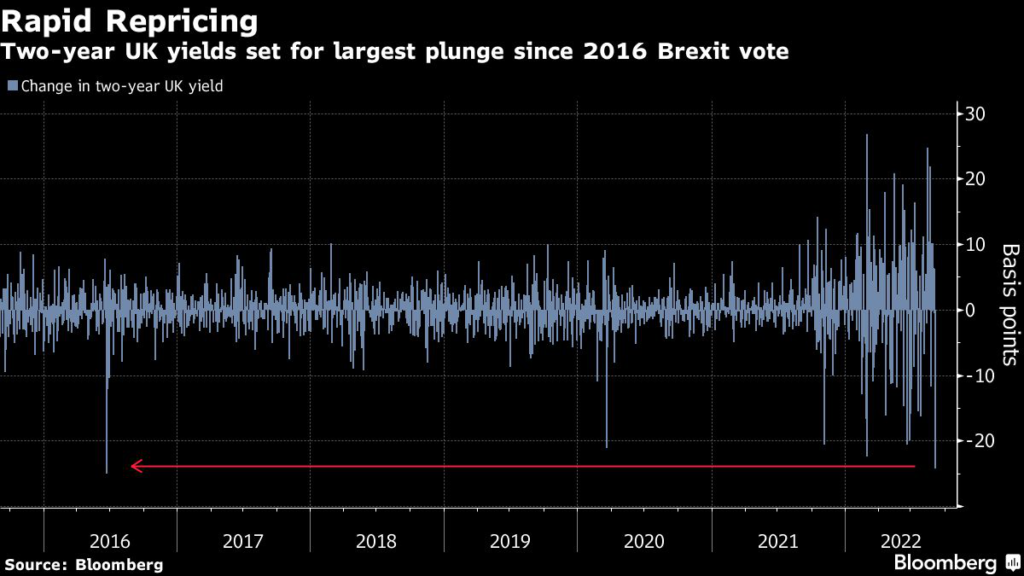
UK bonds rallied, briefly sending the two-year yield down by the most since the 2016 Brexit referendum as Bank of England officials said the government’s proposed energy-price cap may curb soaring inflation, potentially reducing the urgency of interest-rate hikes. The pound slumped toward its weakest since 1985.
(Bloomberg) — UK bonds rallied, briefly sending the two-year yield down by the most since the 2016 Brexit referendum as Bank of England officials said the government’s proposed energy-price cap may curb soaring inflation, potentially reducing the urgency of interest-rate hikes. The pound slumped toward its weakest since 1985.
Two-year yields — which are among the most sensitive to changes in monetary policy — slid as much as 25 basis points to a one-week low of 2.95%, while traders placed even odds on a 50- or 75-basis point rate hike when policy makers meet next week to set rates. That compares with an 80% chance of a three-quarter point increase as recently as Tuesday.
Freezing energy bills at current levels for consumers may well have a downward effect on inflation in the short term relative to current forecasts, BOE’s Huw Pill told Parliament. Price growth accelerated to the fastest pace in 40 years last month amid rising energy costs fueled by Russia’s war in Ukraine.
“It did feel like the market had got a bit ahead of itself in pricing in a high likelihood of a 75 basis-point hike next week, particularly when we had heard so little from the Bank of England since the last meeting,” said Imogen Bachra, head of UK rates strategy at NatWest Markets. “I am not that surprised to see the front-end repricing to a certain extent.”
Yields tumbled six years ago in the wake of the Brexit vote on expectations the Bank of England would be forced to slash rates to cope with the market turmoil of leaving. Ultimately, officials held rates steady after a 25 basis-point cut.
The pound slid as much as 0.9% against the dollar to $1.1417, close to the lowest level since 1985.
“The pound is hurting in the wake of the BOE testimony to Parliament,” said Valentin Marinov, head of G-10 FX strategy at Credit Agricole. “While the pound hasn’t been really trading in sync with the market BOE rate hike expectations in recent weeks, the latest developments are adding yet another reason to be bearish.”
(Updates with quotes and context throughout)
More stories like this are available on bloomberg.com
©2022 Bloomberg L.P.