
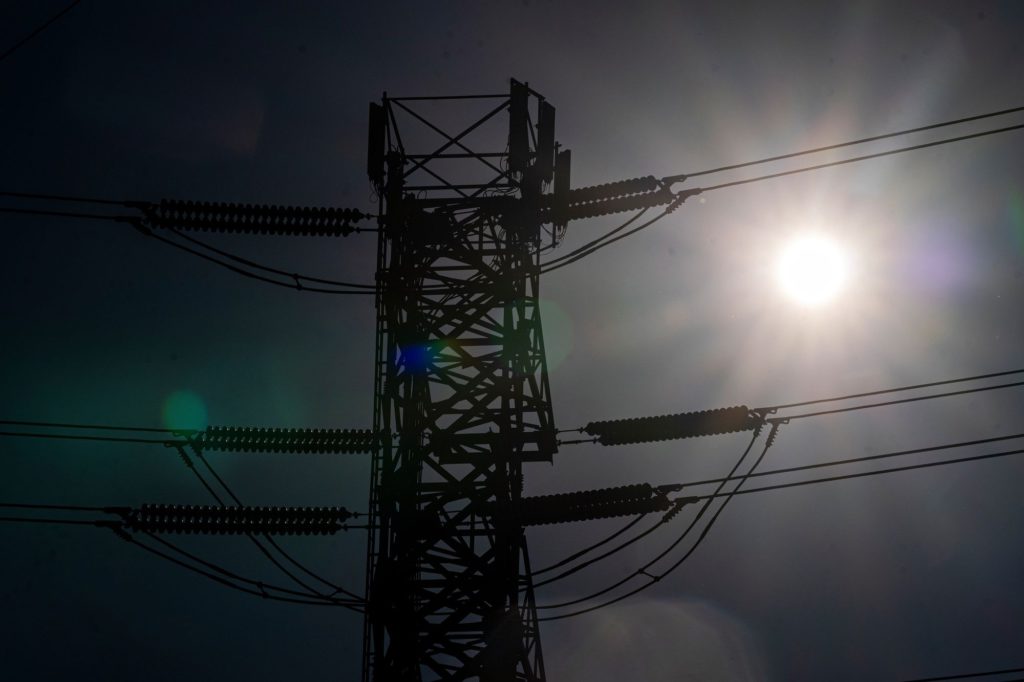
Power use in California surged to an all-time high as officials warn residents to prepare for rolling blackouts Tuesday evening amid a blistering heat wave.
(Bloomberg) — Power use in California surged to an all-time high as officials warn residents to prepare for rolling blackouts Tuesday evening amid a blistering heat wave.
Electricity use reached 50.6 gigawatts at 3:15 p.m. local time, according to the state’s grid operator, surpassing the previous record set in 2006. The surge in demand comes amid a punishing and lengthy heat wave that has sent temperatures soaring past 110 degrees Fahrenheit (43 Celsius), prompting officials to plead for conservation and warn rolling outages may be necessary to prevent the system from overloading.
The state’s largest power company, PG&E Corp., said in a statement that it had notified about 525,000 homes and businesses that they could lose power for up to two hours.
“We are heading into the worst part of this heat wave, and the risk for outages is real and it’s immediate,” Governor Gavin Newsom said in a video posted Tuesday on Twitter.
For a second consecutive day, the state’s grid operator issued a level-2 energy emergency alert. Officials expect to ratchet that emergency up to level 3 at 5:30 p.m. local time — which would mean blackouts are imminent.
Newsom signed an executive order Tuesday extending until Friday emergency measures to free up additional power supplies, measures that had been set to expire Wednesday. He also ordered many state buildings to power down lights and air conditioning at 4 p.m., and he urged residents and businesses to conserve the equivalent of 3 gigawatts of power in order to stave off blackouts. Peak demand may top 52 gigawatts Tuesday, which would set a new record, according to the California Independent System Operator, which runs most of the state’s grid. A gigawatt is enough electricity to power about 750,000 Californian homes.
“This is going to be so dicey,” said Michael Wara, director of Stanford University’s climate and energy policy program. “There’s a gap for two hours in the evening right now between available supply and projected demand.”
The most populous US state avoided rolling outages from the blistering temperatures Monday, though higher readings Tuesday are further testing the network with electrical demand set to climb as schools and businesses reopen after the Labor Day holiday.
The prospect of outages underscores how grids have become vulnerable in the face of extreme weather as they transition from fossil fuels to renewable energy. California has aggressively closed natural-gas power plants in recent years, leaving the state increasingly dependent on solar farms that go dark late in the day just as electricity demand peaks. At the same time, the state is enduring the Southwest’s worst drought in 1,200 years, sapping hydropower production.
The energy warnings come as much of California remains under an excessive heat warning through Friday. The heat wave, which began in the last week of August, is remarkable in both its ferocity and duration, according to officials. Sacramento on Tuesday was forecast to have a high near 115 degrees Fahrenheit (46 degrees Celsius) — a degree hotter than Monday, which was a record for that date.
“We’re looking at a lot of records today,” said Bob Oravec, a senior branch forecaster at the US Weather Prediction Center. “They are having a lot of issues with power out there, and this isn’t going to help.”
Average day-ahead prices for power on Tuesday in the southern part of the state surged 44% to $300.55 a megawatt-hour, the highest in 18 months.
A break from the heat will come across Southern California later this week, thanks to Tropical Storm Kay in the Pacific Ocean, Oravec said. Kay is forecast to edge up the coastline of Mexico’s Baja California peninsula. As it moves north, the storm will pump moisture and clouds into Southern California and Arizona, taking an edge off the heat.
(Updates details starting in the first paragraph.)
More stories like this are available on bloomberg.com
©2022 Bloomberg L.P.