
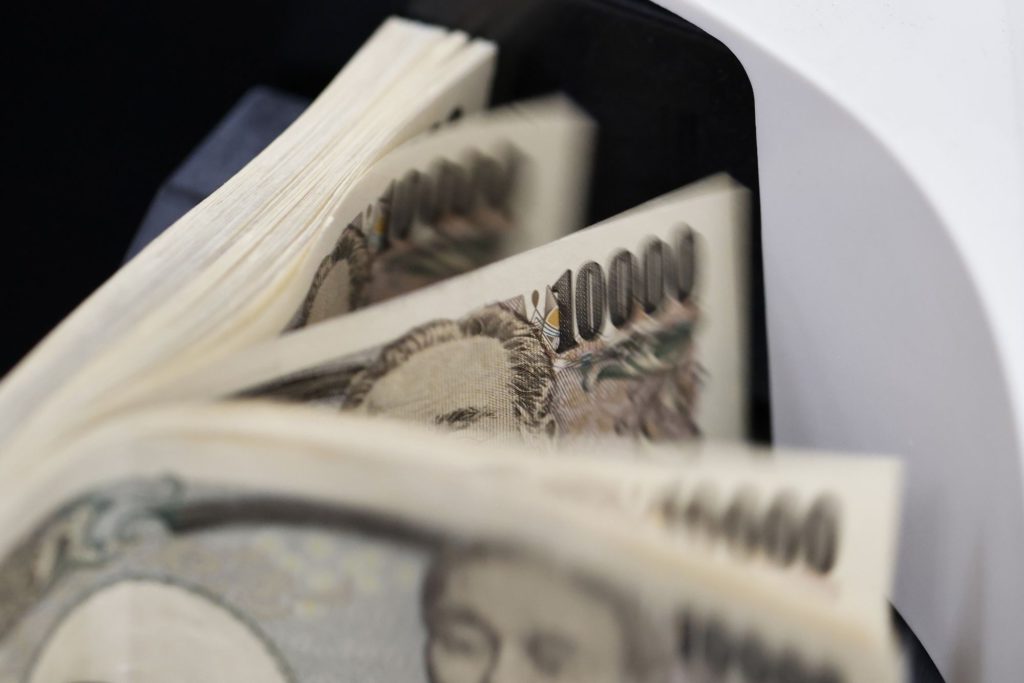
The yen slumped past the key psychological level of 140 per dollar for the first time in almost a quarter of a century and that move could have further to run as the apparent divergence between US and Japanese monetary policy widens.
(Bloomberg) — The yen slumped past the key psychological level of 140 per dollar for the first time in almost a quarter of a century and that move could have further to run as the apparent divergence between US and Japanese monetary policy widens.
Fueled in large part by higher Treasury yields, the dollar surged as much as 0.9% against its Japanese counterpart in spot trading Thursday, extending its year-to-date advance to more than 20%. And options markets show traders are betting there might be more to come, with pricing skewed toward contracts that will pay off if the greenback keeps on rising.
The slide in the yen — the worst performer this year among Group-of-10 currencies — reflects a growing split between the Bank of Japan, which is keeping policy loose to bolster the economy, and a Federal Reserve that has been at pains to stress its inflation-fighting bona fides.
While BOJ boss Haruhiko Kuroda has shown little inclination to move interest rates away from near-zero levels or dial back other unconventional policies, US Treasury yields have been rising in the wake of the recent Jackson Hole Symposium amid speculation that the Fed will this month enact its third-straight three-quarter-point rate hike. Central banks elsewhere have also been forced to chart a path away from rock-bottom borrowing costs in the fight against inflation, leaving Japan as something of an outlier.
“The yen is fast becoming the world’s only zero-yielding currency,” JPMorgan Chase & Co. strategists Benjamin Shatil and Sosuke Nakamura in a note to clients Thursday. “The barrage of hawkish Fed rhetoric post-Jackson Hole, retreat in US recession risk, and apparently unwavering dovish commitment from Kuroda, should leave USD/JPY hostage.”
A combination of improving economic data and the Fed’s hawkish approach has helped push a Bloomberg index of the dollar’s strength to the highest on record, with the gauge on Thursday eclipsing the previous peak from July.
Recent trading in the dollar-yen pair underscores the widening economic gulf between the US and Japan as policy makers contend with a highly uncertain outlook. The yen’s drop is also being stoked by high import prices that are upsetting the usual balance of trade.
Japan has so far declined to intervene in the currency markets to arrest the depreciation of its currency, and officials may have a disincentive to do so since a weaker yen could help the economy by making the nation’s exports more competitive.
Indeed, comments earlier on Thursday from Chief Cabinet Secretary Hirokazu Matsuno did little to suggest any direct intervention was imminent, even as he stressed that rapid FX moves are not desirable and the government is eyeing fluctuations closely.
The government has intervened before, of course. It did so back in 1998 to prop up the currency at around the same time much of Asia was being buffeted by a regional financial crisis. That year was also the last time the yen was close to current levels versus the dollar.
Dollar-yen ended Thursday around 140.21, having at one stage in the day reached 140.23. From a technical analysis perspective, the pair appears to be retaining a positive bias by not only recording fresh highs, but also notching higher daily lows that are above its so-called Ichimoku cloud. This upward momentum may tempt dollar bulls to keep buying dips even as some measures suggest the pair might be in overbought territory.
Outside of direct intervention, a sustained rebound for the yen would require the BOJ to implement significant rate increases, which would take a major toll on the economy, said Steven Englander, head of Group-of-10 currency research at Standard Chartered.
Yet it doesn’t look like any such action on the immediate horizon, with Kuroda last week emphasizing in his appearance at Jackson Hole that he plans to stick with the BOJ’s current approach.
“Halting the yen’s decline would take a shift in rates policy by the BOJ, and they have been adamant so far that getting inflation sustainably to target is their goal,” said Englander, who thinks the yen is undervalued at current levels. “The yen weakness is being driven by an artificially low interest rate compared to everyone else, and there’s the question of how far can it really go.”
More stories like this are available on bloomberg.com
©2022 Bloomberg L.P.