
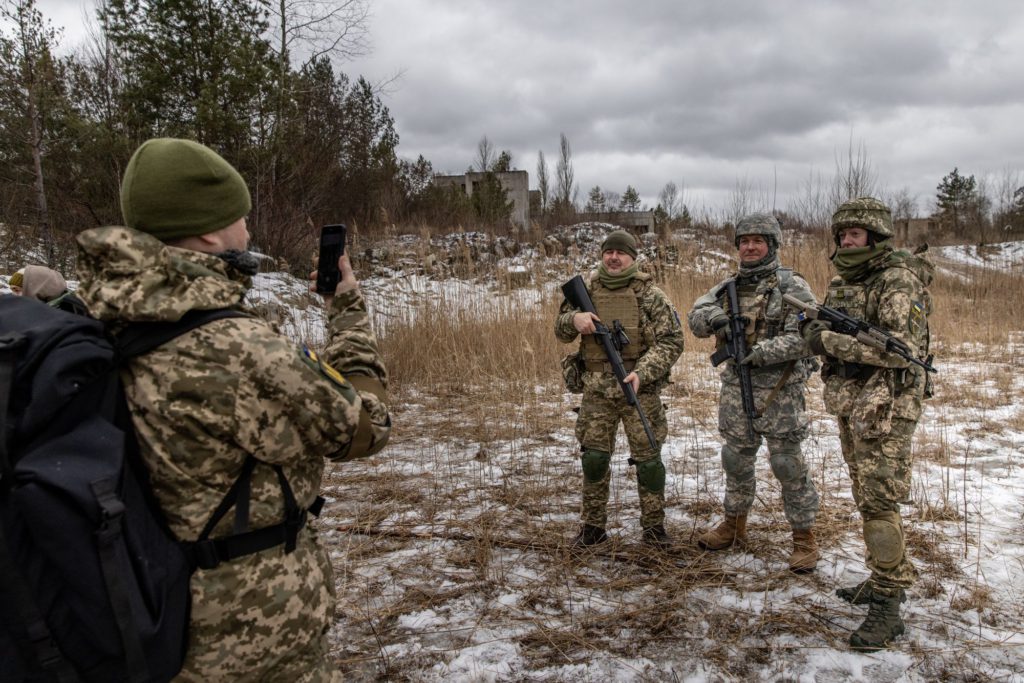
(Bloomberg) — The U.K. is considering the “biggest possible offer” to NATO, including more troops and weapons to Estonia, to help deter any Russian aggression against Ukraine, Prime Minister Boris Johnson announced on Saturday night.
President Joe Biden said Friday he’ll send American troops to Eastern Europe as the threat of a Russian invasion of Ukraine continues to weigh on the U.S. and its allies.
The UN Security Council will debate the Ukraine crisis on Monday. The U.S. and the European Union are zeroing in on a package of sanctions against Russia should President Vladimir Putin invade Ukraine. Russian Foreign Minister Sergei Lavrov is expected to speak with U.S. Secretary of State Antony Blinken in the next few days.
Russia has denied it intends to invade after massing tens of thousands of troops plus tanks and equipment near Ukraine’s eastern border.
Key Developments:
- Wall Street banks briefed by U.S. on possible sanctions
- Many raw materials would be swept into a Ukraine conflict
- Ukraine says U.S. hurting economy by sowing panic
- Azerbaijan is ready to supply emergency gas to Europe
- Where military forces are assembling around Russia and Ukraine
All times CET.
U.K.’s Truss Looks to Deterrence, Sanctions (10:30 a.m.)
Deterrence remains the “number one” way to prevent a potential Russian invasion of Ukraine, but the U.K. is also working to beef up its sanctions regime with new proposed legislation, said Foreign Secretary Liz Truss.
Truss said on Sky News that “nothing is off the table” in terms of going after Russians who hold large amounts of wealth in the U.K., in property and other assets. “There will be nowhere to hide for those propping up the Russian state,” she said.
The top U.K. diplomat said she plans to travel to Ukraine this week and Moscow the following week.
Russia’s Patrushev Calls Ukraine Invasion Threat ‘Absurd (8:12 a.m.)
Russian Security Council Secretary Nikolai Patrushev dismissed allegations that Moscow plans to invade Ukraine as “completely absurd,” the Interfax news service reported.
Russia doesn’t want war and those who suggest the opposite are pursuing “selfish fabrications,” Interfax cited Patrushev as saying at a ceremony in St. Petersburg in memory of the victims of the siege of Leningrad.
France FM Has ‘No Knowledge’ Putin Set to Invade (12 a.m.)
France’s foreign affairs minister Jean-Yves Le Drian said he had “no knowledge” that Russian President Vladimir Putin has made a “decision” to engage into military action in Ukraine, but he added that Russia was logistically prepared for such a scenario.
In an interview with Journal du Dimanche, Le Drian also declined to detail what possible sanctions against Russia could be, because he said describing them would undermine the effectiveness of the threat. His message for Putin was: “Not a single step further.”
U.K. Weighs Big ‘Offer’ to NATO (11:30 p.m.)
The U.K. is considering the “biggest possible offer” of land, sea and air forces to NATO, including more troops and weapons to Estonia, to help deter any Russian aggression against Ukraine.
Prime Minister Boris Johnson said in a statement late Saturday he’s ordered British troops to “prepare to deploy across Europe next week.” He’s also scheduled to speak with Putin this week and visit Eastern Europe in the coming days.
The deployment could include fast jets, warships and military specialists, according to the statement.
“This package would send a clear message to the Kremlin — we will not tolerate their destabilizing activity, and we will always stand with our NATO allies in the face Russian hostility,” Johnson said.
Russia to Shift Location of Naval Drills Near Ireland (6:57 p.m.)
Russia will relocate planned naval exercises to outside of Ireland’s exclusive economic zone, according to its ambassador in Dublin, Yuriy Filatov, in a what he described as a gesture of goodwill toward the Irish government and local fishermen.
Russia’s navy was set to run drills off the southwest Irish coast from Feb. 3 to Feb. 8. Irish Foreign Minister Simon Coveney said this week the exercises weren’t welcome, and the fishing industry raised concern about potential damage.
Coveney commented on Twitter that Russia’s response was “welcome.”
Baerbock Underscores Germany’s Solidarity (5:30 p.m.)
Germany is continuing to seek de-escalation between Ukraine and Russia based on the so-called Normandy format, Foreign Minister Annalena Baerbock said ahead of a visit to Kyiv with her French counterpart.
“Our commitment to the inviolability of Ukraine & solidarity with its people” are behind the planned visit, Baerbock tweeted.
French, German Diplomats to Visit Kyiv on Feb. 7-8 (3:30 p.m.)
French Foreign Minister Jean-Yves Le Drian and Germany’s Annalena Baerbock plan to visit Kyiv on Feb. 7-8, Le Drian said on Twitter.
Le Drian said he assured Dmytro Kuleba, Ukraine’s minister of foreign affairs, of “our full support and solidarity with Ukraine. Our mobilization continues, in particular in the Normandy format, to de-escalate tensions.”
Kuleba, also on Twitter, said he and Le Drian had spoken on ways to help Ukraine’s economy “mitigate security risks.”
France Says Ready to Deploy Troops If NATO Asks (11:49 a.m.)
France is ready to deploy troops if NATO decides it’s needed, Defense Minister Florence Parly said Saturday on France Inter radio. She added that dialogue with Russia remains the priority.
Romania is in talks with France and the U.S. to establish how best to increase the number of troops it hosts under the NATO framework. Parly traveled to Bucharest for consultations earlier this week.
Commodity Price Risk From Fear of Conflict (9:25 a.m.)
Tensions over Ukraine have already sent natural gas prices spiraling, and could hit a raft of other raw materials crucial to the global economy at a time governments are dealing with an energy crunch, surging inflation, and a cost-of-living crisis.
The crisis “could spawn a butterfly effect, sending commodity prices spiraling higher as supply woes multiply,” analysts at Bloomberg Intelligence wrote. “Sanctions could usher in shortages of food and energy, causing prices of both to soar.”
Johnson to Call Putin, Visit Eastern Europe (3:40 a.m.)
Prime Minister Boris Johnson will speak with Putin this week and plans to go to Eastern Europe soon as the U.K. boosts its efforts to help end the Ukraine crisis.
Johnson will reiterate the need for Russia to step back and engage diplomatically, a Downing Street spokesperson said in a statement.
The U.K. plans to use a meeting of the UN Security Council on Monday to apply further pressure on Russia, the official said. At that meeting, the U.K. plans to focus on what it called “Russia’s flawed narrative.”
Biden Says He’ll Send U.S. Forces to Eastern Europe (11:30 p.m.)
Biden said Friday he would be sending American troops to Eastern Europe as the threat of a Russian invasion of Ukraine continues. He added that “not a lot” of soldiers would be involved “in the near term.”
Biden didn’t name any countries where troops may be deployed or elaborate further.
U.S., EU Crafting Sanctions on Russian Debt, Banks, Individuals (11:12 p.m.)
The U.S. and the European Union are zeroing in on a package of sanctions against Russia should Putin decide to invade Ukraine, according to people familiar with the matter and documents seen by Bloomberg.
The measures would broadly fall into several categories including: restrictions on the refinancing of Russian sovereign debt; financial sanctions; and the singling out of individuals and entities close to the Kremlin. Western allies are also working on a series of trade-related measures covering key goods and sectors.
Ukraine Says U.S. is Hurting Its Economy (7 p.m)
Ukrainian President Volodymyr Zelenskiy said the U.S. was damaging his country’s economy by unduly stoking panic that Russia may be planning an invasion. Zelenskiy said satellite images alone were insufficient to assess the extent of the military buildup and the situation hasn’t escalated.
“We are grateful to the U.S. for the support for our independence and territorial integrity,” Zelenskiy told foreign media in Kyiv. “But I am the president of Ukraine, I am here and I know more details and I have deeper knowledge than any other president.”
UN Security Council to Debate Crisis Monday (6:47 p.m.)
The U.S. said the UN Security Council should be fully engaged on the Ukraine crisis and confirmed that the council will discuss the issue during an open meeting on Monday, one day before Russia assumes the rotating presidency of the Security Council for February.
A senior Biden administration official said the meeting, at which Ukraine’s United Nations envoy is expected to speak, will be an opportunity to hear if Russia remains committed to diplomacy.
Ambassador Dmitry Polyanskiy, the deputy at the Russian Mission to the UN, tweeted his opposition to the meeting, calling it a “stunt shameful for the reputation” of the council.
Ukrainian Leader Says Russia’s Posture Is Stable (5:02 p.m.)
The situation on the border with Russia hasn’t escalated beyond where it stood last spring, Zelenskiy told reporters in Kyiv. He criticized “international leaders” who’ve openly speculated about a possible Russian invasion, and said that officials should be more careful in making comments about the imminent risk of war.
“Unbalanced information” costs Ukraine’s economy “a lot,” Zelenskiy added. His remarks come amid increasingly strong U.S. warnings about Russia’s plans. Biden told Zelenskiy in a call Thursday night “that there is a distinct possibility that the Russians could invade Ukraine in February,” according to a U.S. official.
Ukraine needs as much as $5 billion in financial support from countries and international partners to stabilize its economy, Zelenskiy said.
More stories like this are available on bloomberg.com
©2022 Bloomberg L.P.