
(Bloomberg) — New York City’s student enrollment has shrunk to its lowest point in at least a decade as the largest U.S. public-school system contends with staff shortages, low attendance rates and ever-changing Covid protocols.
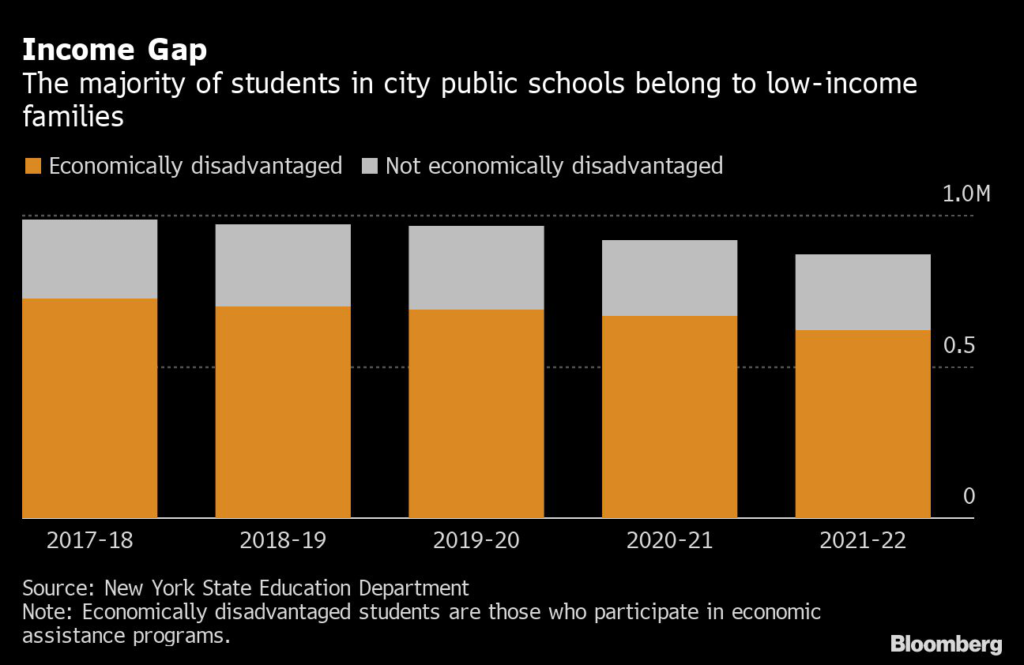
Although the number of kids attending the city’s public schools has declined for six consecutive years, the pandemic accelerated the trend. In the 2021-22 school year, 870,000 pre-K to 12th grade students were enrolled in New York City public schools’s traditional districts, a 5% drop from the year before and a 10% decrease since 2019, according to data released this week from the New York State Education Department. The figures exclude the city’s 3-K program for younger children, where enrollment is growing.
The decline among elementary to high school students reflects a mix of families moving out of the city, switching to private or parochial schools and dropping out of class altogether.
Falling enrollments signal challenges for New York’s economy, as families priced out of the city move to the suburbs or relocate to lower-cost states like Texas or Florida. In the decade before the pandemic, the number of children in families earning over $350,000 surged by more than 100%, while the number of kids in less affluent families dropped. Preliminary data from the city’s education department, released in October, showed a smaller decline for 2021-22 than the state’s figures, with district enrollment decreasing 1.9% from the prior year to 938,000. A spokesperson for the New York City education department said state data is based on older information and undercounts total enrollment because it excludes a number of programs such as students in the 3-K program, which is one of the areas of growth for the city’s school system.The state also uses different classifications. Enrollment including District 75, which provides specialized instruction, was roughly 895,000, down 5% from a year earlier.The public-school declines are a pressing issue for Mayor Eric Adams, who took over on Jan. 1 and has fought to keep schools open despite elevated Covid cases. Low-income schools are seeing twice the attendance hit, a recent analysis of city data showed.
Adams and his newly-appointed school commissioner, David Banks, have pledged to tackle the lingering post-pandemic impact of mental health problems, uneven attendance and prolonged disrupted learning. They have also promised to address more longstanding issues in the city’s schools, which are among the country’s most segregated.
Race, Income Divide
The state data offer insight into the demographic breakdowns of how enrollment has changed. Black students saw the steepest declines since the 2019-20 school year, with a 14% decrease in enrollment. There was an 11% drop in the number of White students and a 9% decrease among Hispanic students, who are the largest cohort and make up about 40% of the total student population. Asian student enrollment fell 6%.
The pandemic also led to a bigger drop among children the state deems “economically disadvantaged,” those who participate in economic assistance programs. The percentage of students enrolled who are “economically disadvantaged” dropped by 14.5% since 2018, while enrollment for students who aren’t economically disadvantaged fell 3.5%.
Overall, roughly 70% of the city’s schoolchildren participate in aid programs. But the distribution is uneven across boroughs: The number of economically disadvantaged students in the Bronx is 44% greater than in Manhattan, and in Queens it is 57% higher.
(Updates with additional context on city and state data discrepancies starting in fifth paragraph.)
More stories like this are available on bloomberg.com
©2022 Bloomberg L.P.