
(Bloomberg) — New York City’s student enrollment has shrunk to its lowest point in at least a decade as the largest U.S. public-school system contends with staff shortages, low attendance rates and ever-changing Covid protocols.
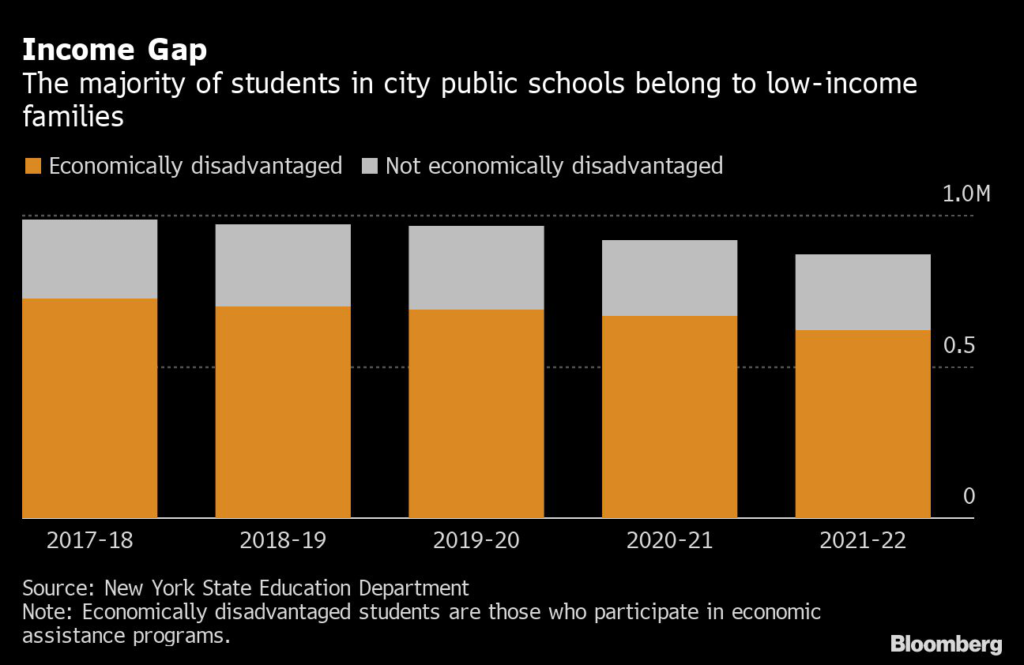
Although the number of kids attending the city’s public schools has declined for six consecutive years, the pandemic accelerated the trend. In the 2021-22 school year, 870,000 pre-K to 12th grade students were enrolled in New York City public schools, a 5% drop from the year before and a 10% decrease since 2019, according to data released this week from the New York State Education Department.
The exodus reflects a mix of families moving out of the city, switching to private or parochial schools and dropping out of class altogether.
Declining enrollments are a challenge for New York’s economy, as families priced out of the city move to the suburbs or relocate to lower-cost states like Texas or Florida. In the decade before the pandemic, the number of children in families earning over $350,000 surged by more than 100%, while the number of kids in less affluent families declined.
The emptying out of the city’s public schools also presents a challenge for Mayor Eric Adams, who took over on Jan. 1 and has fought to keep schools open despite elevated Covid cases. Low-income schools are seeing twice the attendance hit, a recent analysis of city data showed.
Adams and his newly-appointed school commissioner, David Banks, have pledged to tackle the lingering post-pandemic impact of mental health problems, uneven attendance and prolonged disrupted learning. They have also promised to address more longstanding issues in the city’s schools, which are among the country’s most segregated.
New York state’s education data differ from preliminary data released by the city’s education department in October, which estimated district enrollment at 938,000, a 1.9% decline from the year prior. A spokesperson for the New York City education department said state data undercounts total enrollment because it excludes students in the 3-K program, which serves three-year-olds, and is based on older information. The city data is preliminary, unaudited and subject to change, the spokesperson said.
Race, Income Divide
Still, the state data offer insight into the demographic breakdowns of how enrollment has changed. Black students saw the steepest declines since the 2019-20 school year, with a 14% decrease in enrollment. There was an 11% drop in the number of White students and a 9% decrease among Hispanic students, who are the largest cohort and make up about 40% of the total student population. Asian student enrollment fell 6%.
The pandemic also led to a bigger drop among children the state deems “economically disadvantaged,” those who participate in economic assistance programs. The percentage of students enrolled who are “economically disadvantaged” dropped by 14.5% since 2018, while enrollment for students who aren’t economically disadvantaged fell 3.5%.
Overall, roughly 70% of the city’s schoolchildren participate in aid programs. But the distribution is uneven across boroughs: The number of economically disadvantaged students in the Bronx is 44% greater than in Manhattan, and in Queens it is 57% higher.
More stories like this are available on bloomberg.com
©2022 Bloomberg L.P.