
(Bloomberg) — Argentina reached an initial agreement worth $44.5 billion with the International Monetary Fund in an attempt to stabilize its economy and refinance an existing loan with the Washington-based organization.
The country pledged to slowly reduce its fiscal deficit and cut the central bank’s financing of the treasury as part of a economic program agreed with the IMF, Economy Minister Martin Guzman said Friday. The deal would give Argentina at least a four-and-a-half year grace period before starting to pay back its debt, he said.
“This decision opens a path we can walk, and will allow us to take other steps toward a country with more work,” Guzman told reporters in Buenos Aires. “We reached the best agreement we could achieve.”
The deal, which still needs to be approved by the country’s congress and the IMF’s board of directors, would help refinance over $40 billion of outstanding debt Argentina has with the lender stemming from a record bailout given in 2018. It also provides the first framework of an economic plan under President Alberto Fernandez, who has opted to govern through a patchwork of short-term policies.
ARGENTINA REACT: IMF Deal Shows Government Wins Some Concessions
“We suffered a problem and now we have a solution,” Fernandez said in a speech from the Olivos residence on the outskirts of Buenos Aires earlier on Friday. “We will be able to access new financing precisely because this agreement exists.”
In a separate statement, the IMF said that it reached an understanding “on key policies” and that its staff would continue working with government officials in coming weeks to reach a staff-level agreement.
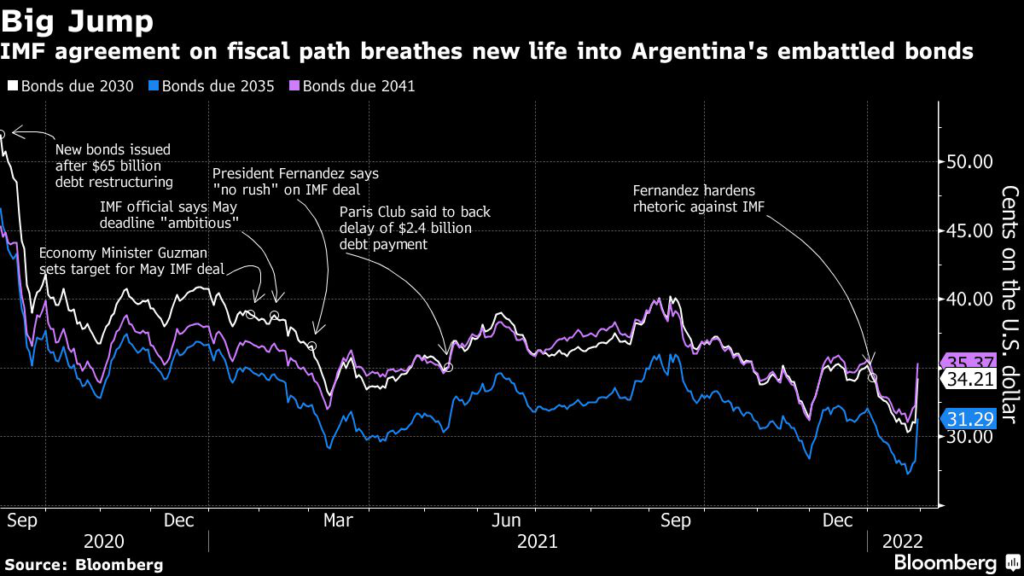
The country’s $16.1 billion in bonds due 2030 climbed as much as 3 cents, in the biggest one-day jump since the notes were issued in Sept. 2020, before paring gains to 33.2 cents on the dollar, according to Bloomberg data. The nation’s bonds due in 2046 also pared back initial gains, rising 2.2 cents on the day to 30.5 cents on the dollar.
The pledges that sustain the economic agreement will last two-and-a-half years as part of a 10-year financing deal, known as an extended fund facility, Guzman said, without providing details on the schedule to repay the debt. The agreement doesn’t include a labor reform nor a privatization of public companies, he added.
Read More: Argentina, IMF Reach Understanding on Fiscal Path for Deal
Approval of the agreement isn’t guaranteed, especially on the Argentine side. Fernandez’s 2022 budget proposal was voted down in December by a new congress. His ruling coalition lost its majority in the senate chamber after being defeated in November’s midterm elections.
If the deal gets approved, Argentina must abide by the budget targets in the program and pass quarterly reviews with IMF staff in order to keep receiving debt relief. That’s a difficult task with next year’s presidential election, and a ruling coalition divided after its loss in the midterms.
“It’s clearly a step in the right direction,” said Edwin Gutierrez, a portfolio manager at Aberdeen Asset Management in London. “But as with all IMF deals with Argentina, this one is fraught with implementation risk.”
(Recast story with details on the agreement provided by Economy Minister Martin Guzman.)
More stories like this are available on bloomberg.com
©2022 Bloomberg L.P.