
(Bloomberg) — Sign up for the New Economy Daily newsletter, follow us @economics and subscribe to our podcast.
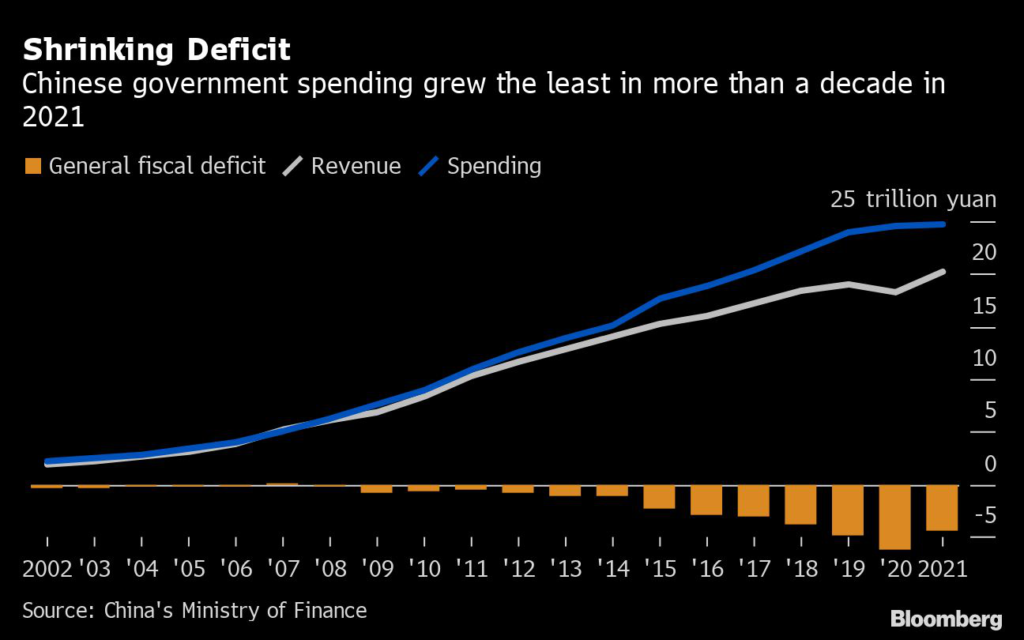
China’s government spending rose at the slowest pace in nearly two decades last year, suggesting limited fiscal support for an economy that’s lost momentum sharply in recent months.
General fiscal expenditure came in at 24.63 trillion yuan ($3.9 trillion), up 0.3% from the previous year, Vice Finance Minister Xu Hongcai told reporters at a Tuesday briefing. That was the weakest pace since 2003, according to Bloomberg calculations based on the ministry’s data.
At the same time, the government took in 20.25 trillion yuan of general fiscal revenue last year, up 10.7% from the previous year, Xu said. That left a deficit of 4.4 trillion yuan, the smallest since 2018, Bloomberg calculations show.
That revenue exceeded the projection in last year’s government budget, which will “provide funding support for us to maintain the strength of spending this year and grant more financial help to governments at lower levels,” Xu said.
Income was boosted by a reduction in the amount of tax and fee cuts in 2021. Government gave 1.1 trillion yuan in reductions in 2021, less than half the record high 2.6 trillion yuan in cuts in 2020 or the 2.36 trillion yuan cut from tax bills in 2019.
The cuts last year included 225.9 billion yuan for manufacturing firms, Wang Daoshu, deputy commissioner of the State Taxation Administration, said at a press briefing Wednesday. Cuts in 2022 will focus on smaller companies and manufacturing firms, Cai Zili, head of the administration’s revenue planning and accounting department, said at the same briefing.
China’s policy makers have switched to a pro-growth stance amid a housing market slump and resurgence in Covid cases, which has weighed on consumption. To counter the slowdown, the central bank has cut interest rates and lowered the amount of cash banks must keep in reserve.
Monetary easing will have only a limited effect in spurring growth though, with analysts calling on the government to boost fiscal stimulus as well.
The weak increase in general government spending indicates fiscal policy likely tightened in the second half of last year, a key reason for the deceleration in economic growth, said Ding Shuang, chief economist for Greater China and North Asia at Standard Chartered Plc.
“Policy is now shifted and fiscal policy will be expanded this year,” he said, estimating at least 2 trillion yuan of funds left over from last year will be spent in 2022.
(Updates with tax and fee cut details)
More stories like this are available on bloomberg.com
©2022 Bloomberg L.P.