
(Bloomberg) — Sign up for the New Economy Daily newsletter, follow us @economics and subscribe to our podcast.
Global traders already on tenterhooks over this week’s key Federal Reserve meeting were jolted further Tuesday by Australian inflation data that smashed expectations, a surprise monetary tightening in Singapore and further swings in U.S. equity futures.
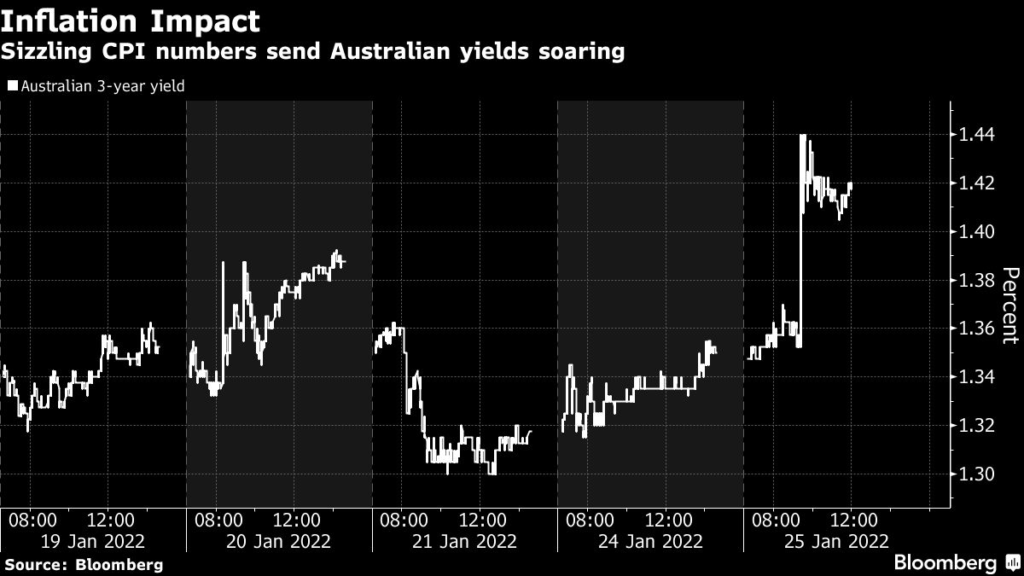
A maelstrom of volatility in the past 24 hours saw almost $3 trillion wiped off global stocks before a reversal with U.S. benchmarks closing in the green. Australia’s three-year bond yield jumped to the highest since April 2019 on rising core consumer prices, while the Singapore dollar strengthened after the central bank reacted to inflation at an 8-year high.
The moves come as traders brace for the impact of Wednesday’s Fed meeting on expectations that they could announce the start of a hiking cycle to damp down inflation, with anticipation already leading to a furious selloff of Treasuries and tech stocks.
“Markets are second guessing the timing and magnitude of rate rises by the Fed — investors were already hypersensitive in the past week and the latest events are certainly not helping,” said George Boubouras, head of research at K2 Asset Management in Melbourne. “It’s all led by the Fed, and it’s still a very risky period for markets.”
Investor jitters show few signs of abating, with U.S. equity futures resuming declines on Tuesday following the sharp swings Monday and Asian stocks tumbling to a 13-month low. Treasuries gained with the yen and the dollar as investors sought out havens.
Surprise Action
The Monetary Authority of Singapore’s first unscheduled action since 2015 came ahead of its scheduled April meeting and was due to upside risks to inflation forecasts. The central bank, which uses foreign exchange as its main policy tool, will allow its currency appreciate against peers in the months ahead to counter imported cost pressures.
Meanwhile, the hotter inflation Down Under bolstered expectations the Reserve Bank of Australia will scrap its bond-purchase program at next Tuesday’s meeting and potentially opens the door to rate rises this year, something Governor Philip Lowe had previously all-but ruled out.
All eyes are now on the Fed, which is expected to pave the way for its first interest-rate hike since 2018 in March, as the U.S. central bank tries to extinguish soaring inflation. Traders have priced in more that four U.S. rate hikes already and are looking for signals on how officials intend to cut the size of the Fed balance sheet — another potential catalyst for financial market volatility.
“The clear message coming out of Asia today is markets need to be ready for active global central banks in the coming two weeks,” said Su-Lin Ong, senior economist and rates strategist at Royal Bank of Canada in Sydney.
Some, including Bank of New York Mellon’s Wee Khoon Chong, are more optimistic that market swings could be contained, at least in Asia.
“The recent volatility I think is quite a typical market reaction to how the monetary policy cycle has turned,” said Chong, senior market strategist in Hong Kong. “Asia inflation is still low in absolute terms but is rising gradually.”
(Updates market moves in fifth paragraph)
More stories like this are available on bloomberg.com
©2022 Bloomberg L.P.