
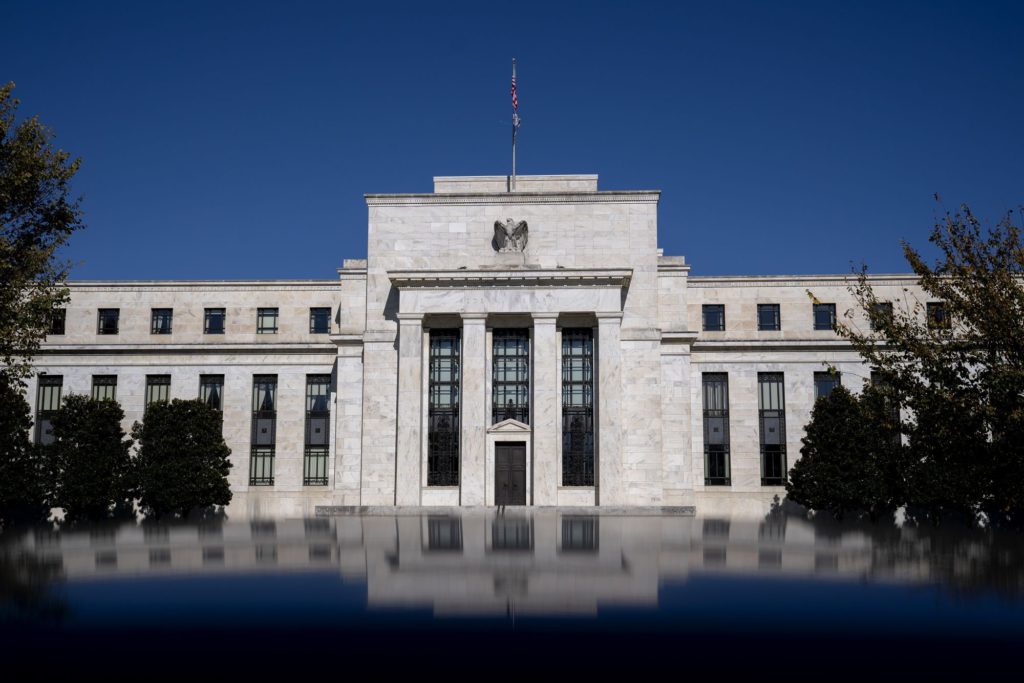
(Bloomberg) — Stocks slumped, while bonds rallied with the dollar amid geopolitical concerns and as investors braced for the Federal Reserve to reiterate its hawkish policy tilt this week.
The S&P 500 sank 3%, extending its rout from a record to more than 10%, while the Cboe Volatility Index soared. The Nasdaq 100 slid as much as 4.2%, with giants Apple Inc. and Microsoft Corp. due to report earnings in the next few days. Small caps were poised for a bear market as the Russell 2000 plunged 20% from its all-time high. Haven currencies outperformed on concern over potential Russian military action against Ukraine. The Treasury yield curve reached new lows, with the gap between 2- and 10-year securities touching a level last seen in late 2020. Bitcoin tumbled.
Traders remain resolute in anticipating the Fed will plow on with increasing borrowing costs even as riskier assets tumble. Swap markets show a quarter-point hike in March and close to a full percentage point rise for the whole of 2022. Morgan Stanley’s Michael Wilson said January’s equity rout “fits nicely” with his so-called fire and ice narrative, according to which markets were set for a drawdown amid tighter policy and decelerating economic growth. In anything, the retreat has further to go as “winter is here” for stocks, he wrote.
“There’s certainly a lot on the table this week, and I think the market behavior and all of these risks that they’re facing really is testing the mettle of the long-term investor,” JoAnne Feeney, partner at Advisors Capital Management, told Bloomberg Television Monday.
Read: U.S. Orders Diplomat Families Out of Ukraine Citing War Risk
European Union foreign ministers renewed their warning that they’d impose “massive consequences” against Russia if it invades Ukraine, but they left the details of specific sanctions for later. Before holding virtual talks with U.S. Secretary of State Antony Blinken, EU foreign policy chief Josep Borrell told reporters that specific measures wouldn’t be discussed, even as the group promised “severe costs” if there was further aggression toward Ukraine. For his part, Russian President Vladimir Putin has denied he’s planning an attack.
Speculators who scrapped bullish bets on the dollar at the fastest pace in more than 18 months are now missing out on the currency’s rally ahead of the Fede decision on Wednesday. Net-long aggregate speculative positions versus major peers have dropped the most since June 2020, according to the latest data from the Commodity Futures Trading Commission.
For more market analysis, read our MLIV blog.
What to watch this week:
- IMF launches the World Economic Outlook update Tuesday.
- U.S. U.S. Conf. Board consumer confidence Tuesday.
- Fed monetary policy decision Wednesday.
- EIA crude oil inventory report Wednesday.
- U.S. new home sales, wholesale inventories Wednesday.
- South African Reserve Bank rate decision Thursday.
- U.S. initial jobless claims, durable goods, GDP Thursday.
- Eurozone economic confidence, consumer confidence Friday.
- U.S. consumer income, University of Michigan consumer sentiment Friday.
Some of the main moves in markets:
Stocks
- The S&P 500 fell 3% as of 11:56 a.m. New York time
- The Nasdaq 100 fell 3.6%
- The Dow Jones Industrial Average fell 2.3%
- The Stoxx Europe 600 fell 3.8%
- The MSCI World index fell 2.9%
Currencies
- The Bloomberg Dollar Spot Index rose 0.5%
- The euro fell 0.3% to $1.1312
- The British pound fell 0.8% to $1.3449
- The Japanese yen fell 0.1% to 113.82 per dollar
Bonds
- The yield on 10-year Treasuries declined four basis points to 1.72%
- Germany’s 10-year yield declined four basis points to -0.11%
- Britain’s 10-year yield declined four basis points to 1.13%
Commodities
- West Texas Intermediate crude fell 3% to $82.58 a barrel
- Gold futures rose 0.2% to $1,836.90 an ounce
More stories like this are available on bloomberg.com
©2022 Bloomberg L.P.