
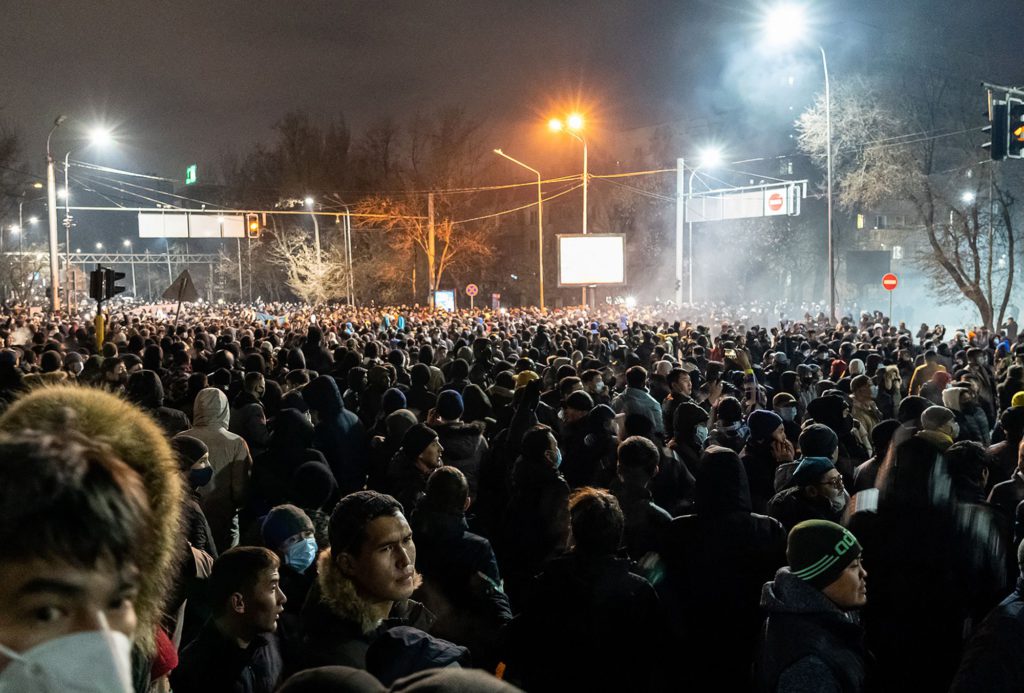
(Bloomberg) — Kazakh President Kassym-Jomart Tokayev vowed to take tough action to quell deadly protests that posed the biggest challenge to the country’s leadership in decades.
The demonstrations started over the weekend in western Kazakhstan over a jump in fuel prices but quickly spilled into broader discontent drawing thousands to the streets across the country. In the former capital, Almaty, both city hall and the president’s residence were ablaze after protesters stormed the buildings Wednesday, Interfax reported.
“I intend to act as harshly as possible,” Tokayev said in a national address, Law-enforcement officers were killed in the line of duty, he said, blaming the protests on “financially motivated conspirators.”
Some of the protesters called for the country’s first president, Nursultan Nazarbayev, who for over three decades has been the major political force in the country, to let go of the reins of power. He chose Tokayev as successor in 2019.
The instability on Russia’s southern border will be a test for President Vladimir Putin, who is currently involved in high-stakes negotiations with the U.S. and Europe over a simmering conflict on Ukraine.
Tokayev, whose primary residence is in the capital Nur-Sultan, initially sought to appease protesters by imposing price caps on motor fuels for the next six months and accepting his government’s resignation. He also declared a state of emergency in and around Almaty, Nur-Sultan and the oil-rich Mangystau region, but the measures failed to ease the tensions.
Far from loosening his grip on power, Tokayev announced Wednesday that he was taking over as head of the Security Council from Nazarbayev and pledged to stay in the capital “whatever happens,”
The state of emergency allows Tokayev to impose a curfew, ban protests, and restrict internet access to quell the rare show of dissent in the tightly controlled nation, which is central Asia’s biggest oil producer.
There was an internet blackout around the country by Wednesday after a day of mobile internet disruptions and partial restrictions, according to NetBlocks, a London-based monitoring agency.
The Kremlin took a neutral stance in the conflict, with presidential spokesman Dmitry Peskov saying it was an internal issue for Kazakhstan.
Kazakhstan’s benchmark stock index fell 3% in Almaty. The tenge weakened and yields on dollar bonds due in July 2045 rose to 4.08%, the highest since May 2020, according to data compiled by Bloomberg.
Saving Kazakhstan
The Kremlin has regularly condemned street protests in former Soviet states, labeling them attempts by the West to use “color revolutions” to overthrow legitimate governments.
Russia is facing “strategic instability on both flanks and it can’t afford to get distracted,” Alexander Baunov, a senior fellow at the Carnegie Moscow Center, wrote on Facebook. “Just as Russia was encroaching on Ukraine, suddenly there are protests across Kazakhstan, which might need saving.”
Like other countries, Kazakhstan has seen inflation soar and its wealth gap widen during the coronavirus pandemic. Consumer price growth jumped to 8.7% in November, exceeding the central bank’s 6% target.
The country of 19 million people has struggled with price growth and domestic fuel supplies as global energy crunch made exports more appealing. Kazakhstan produces about 258,200 barrels of oil a day.
Workers at the Chevron Corp.-led Tengiz oil venture in the Mangystau region are continuing to participate in demonstrations, but operations haven’t been affected, the project operator said Wednesday.
The last time unrest led to a state of emergency in Kazakhstan was in 2011. Those protests, which also started in the Mangystau region, were over oil worker wages and led to at least 14 deaths.
More stories like this are available on bloomberg.com
©2022 Bloomberg L.P.