
(Bloomberg) — U.S. index futures slipped along with European stocks on the last trading day of the year. The 10-year Treasury yield held above 1.5% and the dollar was steady.
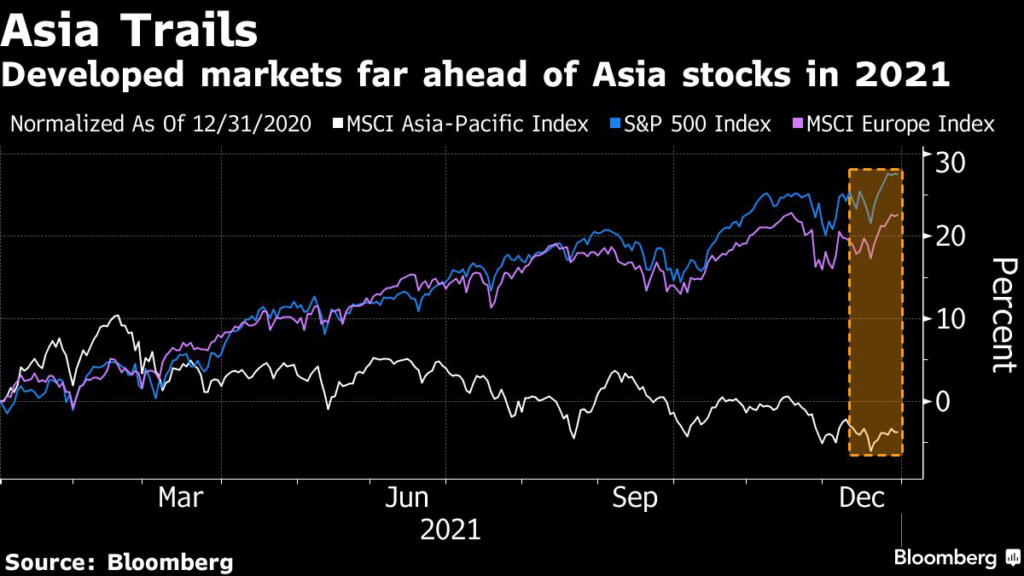
With most European markets closed or shutting down early on Friday, trading was thin as investors drew a line under a strong year for global equities as economies recovered from the pandemic. Emerging markets and Asian benchmarks lagged, partly due to China’s regulatory pressures and slowing economy. Bond investors are nursing losses as many central banks move toward tighter monetary settings to fight inflation. How the coronavirus and those policy shifts shape economic reopening are key for the outlook.
“If there is one thing that we have learned this year, it is that the US economy has proven to be resilient in the face of pandemic-related challenges,” said Brett Ryan, senior U.S. economist at Deutsche Bank. While omicron and fiscal uncertainty present risks, “the economy would still expand at a well-above-trend pace even if these risks are realized,” he said.
The Stoxx Europe 600 index declined about 0.1%, failing to reach a new record close after advancing more than 22% this year. Among major markets, only the U.K. and France were open for trading and both closed early. Contracts on the S&P 500 and Nasdaq 100 edged lower. The S&P 500 pulled back from a record high on Thursday but is 27% up for the year.
Asian stocks got a fillip from a rally in a Hong Kong technology gauge following a surge in U.S.-listed Chinese shares. The Hang Seng Tech Index rose 3.6%, while Chinese shares overall advanced. Those moves came in the wake of the Nasdaq Golden Dragon China Index’s biggest one-day jump Thursday since 2008, though it’s still down more than 40% for 2021.
The latest data showed China’s manufacturing sector continued to expand in December, providing some relief to Beijing as the world’s second-largest economy continues to struggle with a property market slump. Less positively, Hong Kong may be facing an omicron virus-strain cluster.
The city’s stock market shut early and Japan is among those closed ahead of the New Year. Treasury futures were steady after yields fell in U.S. hours. There is no cash Treasuries trading in Asia due to the Japan holiday.
Traders are continuing to monitor China’s struggling property developers. A Chinese state-owned enterprise will take a 29% stake in China South City Holdings Ltd., in the latest sign of the authorities stepping up support for ailing real-estate firms.
The spotlight was also on talks by telephone between U.S. President Joe Biden and Russian President Vladimir Putin. The Kremlin said Putin was satisfied with the outcome of the discussions. The U.S. and its allies have raised alarm over a potential Russian invasion of Ukraine.
Elsewhere, oil declined, paring the biggest annual advance since 2009. Bitcoin rallied for a second session, paring its biggest monthly drop since May to trade around $48,000.
For more market analysis, read our MLIV blog.
Some of the main moves in markets:
Stocks
- Futures on the S&P 500 were little changed as of 8:40 a.m. New York time
- Futures on the Nasdaq 100 were little changed
- Futures on the Dow Jones Industrial Average fell 0.2%
- The Stoxx Europe 600 fell 0.2%
- The MSCI World index was little changed
Currencies
- The Bloomberg Dollar Spot Index fell 0.1%
- The euro was little changed at $1.1333
- The British pound fell 0.2% to $1.3478
- The Japanese yen was little changed at 115.12 per dollar
Bonds
- The yield on 10-year Treasuries was little changed at 1.50%
- Germany’s 10-year yield was little changed at -0.18%
- Britain’s 10-year yield was little changed at 0.97%
Commodities
- West Texas Intermediate crude fell 1.9% to $75.50 a barrel
- Gold futures rose 0.7% to $1,826.40 an ounce
More stories like this are available on bloomberg.com
©2021 Bloomberg L.P.