
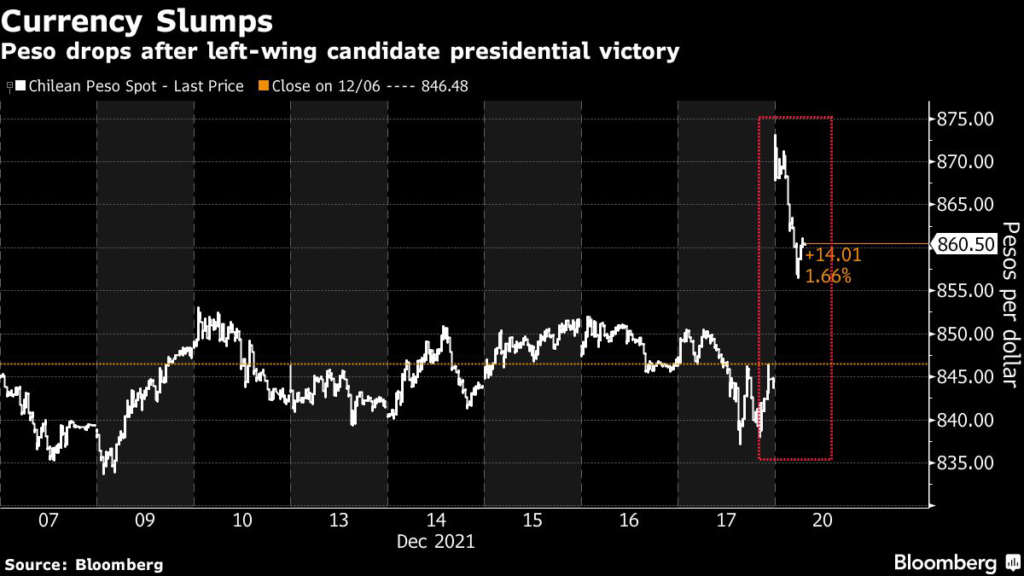
(Bloomberg) — Chilean assets tumbled after left-wing candidate Gabriel Boric rolled to a blowout victory in Sunday’s presidential election, giving him a broad mandate to push ahead with an overhaul of Latin America’s most open economy.
The peso fell more than 2% as it headed for its biggest loss since 2019, while the main stock gauge dropped more than 6%. Yields on Chile’s overseas bonds rose modestly.
Investors are concerned Boric’s policies will upend one of the wealthiest economies in Latin America with higher taxes, increased social spending and more government regulation of business. Boric, a lower house deputy who rose to fame as a student protest leader, beat his conservative rival Jose Antonio Kast by more than 10 percentage points in a second round that just days ago had looked too close to call.
But the candidate was somewhat conciliatory in remarks after he had been declared the winner, and said he would work with a divided Congress to be a president for all Chileans.
“We’ve already priced in the risk of large deficits,” said Graham Stock, a strategist at BlueBay Asset Management in London. “But it won’t get out of control.”
Chile’s benchmark stock index traded 6.6% lower as of 11:18 a.m. in New York, after losing as much as 7.5%. The peso fell 2.8% to 868.98 per dollar. Yields on the country’s dollar-denominated bonds due in 2050 rose 8 basis points to 3.3%.
Sociedad Quimica y Minera de Chile SA, the world’s second-biggest lithium producer, led the losses in the IPSA, falling as much as 15%, the most since the onset of the pandemic. Boric’s program includes the creation of a national lithium company. Water utility Aguas Andinas SA fell as much as 13% as he’s criticized Chile’s privatized water system and proposed stronger government regulation to water access.
“The market is very likely to continue to deteriorate due to all the uncertainty and risks that still exist about how Boric will lead a next government,” said Maria Luz Munoz, director and strategist at Nevasa. “The market is unsure that he will be able to effectively moderate.”
Boric, 35, describes himself as a moderate socialist who shuns the hard-left models of Cuba and Venezuela, and his coalition included a variety of left-wing parties. After the first-round vote last month, Boric moderated his message to appeal to voters in the center.
He reiterated in a speech Sunday that he will seek to maintain fiscal discipline as he advances his reforms, which include raising taxes on the rich and mining industry, rejecting projects that damage the environment, improving social services and dismantling the private pensions system.
His administration will face enormous challenges, including a split congress, a sharp economic slowdown, the writing of a new constitution and the lingering threat of social unrest.
“We cannot continue to allow the poor to pay for the inequalities of Chile,” Boric told thousands of cheering supporters in his victory speech.
Volatility in Chilean assets will dwindle in the coming days as the president-elect appoints a cabinet that isn’t “hostile to markets,” according to LarrainVial Research. The key signal will be his finance minister, the firm said.
Citigroup strategists Fernando Jorge Diaz and Andrea Kiguel said a “knee-jerk” selloff in the peso after the vote could be an opportunity to buy assets on the cheap.
Others were less optimistic.
Chileans came out en masse to vote Sunday, with the highest turnout since the return of democracy in 1990. Combined with the wide margin of victory, it could be seen as a strong mandate for the victor, according to Win Thin, global head of currency strategy at Brown Brothers Harriman & Co.
“While Boric has taken pains to stress that his economic model will not be a radical one, it’s clear that the market-friendly policies are likely a thing of the past,” he said. “Chile is moving on to a new path with an unknown destination.”
More stories like this are available on bloomberg.com
©2021 Bloomberg L.P.