
(Bloomberg) — Most Asian stocks rose Thursday following a rally in U.S. equities on speculation that Federal Reserve policy tightening will help fight high inflation without derailing economic growth.
Japan led gains but Chinese technology shares were under pressure again in part on worries about U.S. sanctions amid tension between Beijing and Washington. S&P 500 and Nasdaq 100 contracts were steady after technology shares powered Wall Street to a strong close, reversing initial declines following the Fed statement. European equity futures advanced more than 1%.
The U.S. central bank said it will double the pace at which it tapers bond purchases to $30 billion a month and projected three quarter-point interest-rate increases in 2022, another three in 2023 and two more in 2024. It also flagged economic risks from the omicron virus strain.
A gauge of the dollar held a drop and Treasury yields were little changed. Oil climbed and gold ticked up. In Australia, bond yields pushed higher after strong jobs data.
The market response to the Fed so far suggests some relief from more policy clarity, and a belief that the rally in a range of assets from pandemic lows can weather the pivot away from ultra-loose monetary settings. But it might take more time for the full takeaway to emerge, particularly since economic risks from the omicron virus variant are shadowing central bank tightening.
“The initial market reaction does not always stick, but we suspect that both the Fed and investors are satisfied that the Fed is aware of and responding to inflation risks, while taking a measured, data-dependent approach in responding,” Steve Englander, head of global G10 FX research at Standard Chartered Bank, wrote in a note.
The five-year breakeven rate on Treasury inflation protected securities — or the difference between those yields and the ones on typical Treasuries — approached 2.8%. That suggests the Fed still faces a challenge to get inflation down toward its 2% target.
No ‘Rash’ Pivot
“If there is a story here, it’s that the Fed is moving forward but they are not going to do anything rash to kill this market move forward that we’ve had over the last year,” Jonathan Golub, chief U.S. equity strategist at Credit Suisse Group AG, said on Bloomberg Television. “They are not looking to disrupt the kind of environment that we’ve had and that’s good news for markets.”
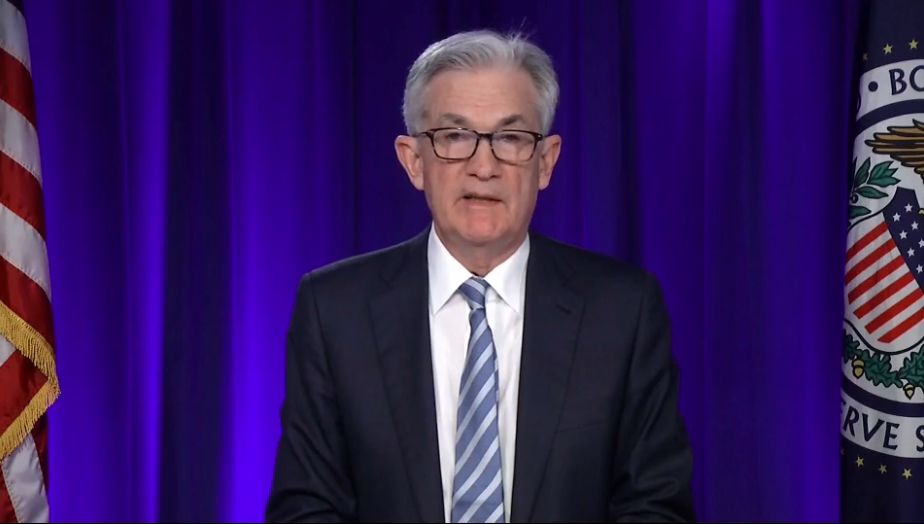
Fed Chair Jerome Powell signaled that restraining inflation is now the key to sustaining economic expansion. But that’s no easy task, since further disruptions to everyday life from omicron could exacerbate supply chain and labor snarls, pushing up costs.
“The markets seem to be complacent about the idea the Fed can get a soft landing, can engineer this graceful soft landing with not a lot of rate hikes,” Diane Swonk, chief economist at Grant Thornton, said on Bloomberg Television.
Next up in a busy week for major monetary policy decisions are the Bank of England and European Central Bank later Thursday.
On the virus front, omicron continues its global spread. A European official said the variant will likely be the dominant strain there by mid-January. Apple Inc. is delaying its return to the office indefinitely as infections rise. Cases in the U.S. have jumped 60% since late October to an average of about 120,000 a day.
Here are some key events this week:
- BOE rate decision, Thursday.
- ECB rate decision, Thursday.
- U.S. housing starts, initial jobless claims, industrial production, Thursday.
- BOJ monetary policy decision, Friday.
- S&P Dow Jones Indices quarterly rebalance effective after markets close, Friday.
- “Quadruple witching” day in the U.S. market, when options and futures on indexes and equities expire, Friday.
For more market analysis, read our MLIV blog.
Some of the main moves in markets:
Stocks
- S&P 500 futures rose 0.2% as of 1:37 p.m. in Tokyo. The S&P 500 rose 1.6%
- Nasdaq 100 futures added 0.2%. The Nasdaq 100 rose 2.4%
- Japan’s Topix index increased 1.1%
- Australia’s S&P/ASX 200 index slipped 0.4%
- South Korea’s Kospi added 0.1%
- Hong Kong’s Hang Seng Index fell 0.8%
- China’s Shanghai Composite Index rose 0.3%
- Euro Stoxx 50 futures rose 1.4%
Currencies
- The Bloomberg Dollar Spot Index was steady
- The euro traded at $1.1287
- The Japanese yen was at 114.12 per dollar, down 0.1%
- The offshore yuan was at 6.3737 per dollar
Bonds
- The yield on 10-year Treasuries held at 1.46%
- Australia’s 10-year yield rose two basis points to 1.58%
Commodities
- West Texas Intermediate crude rose 1% to $71.61 a barrel
- Gold was at $1,782.07 an ounce, up 0.3%
More stories like this are available on bloomberg.com
©2021 Bloomberg L.P.