
(Bloomberg) — The likelihood the Bank of England will raise rates at its meeting next week is fading as new restrictions to curb the spread of the omicron variant cast gloom over the nation’s markets.
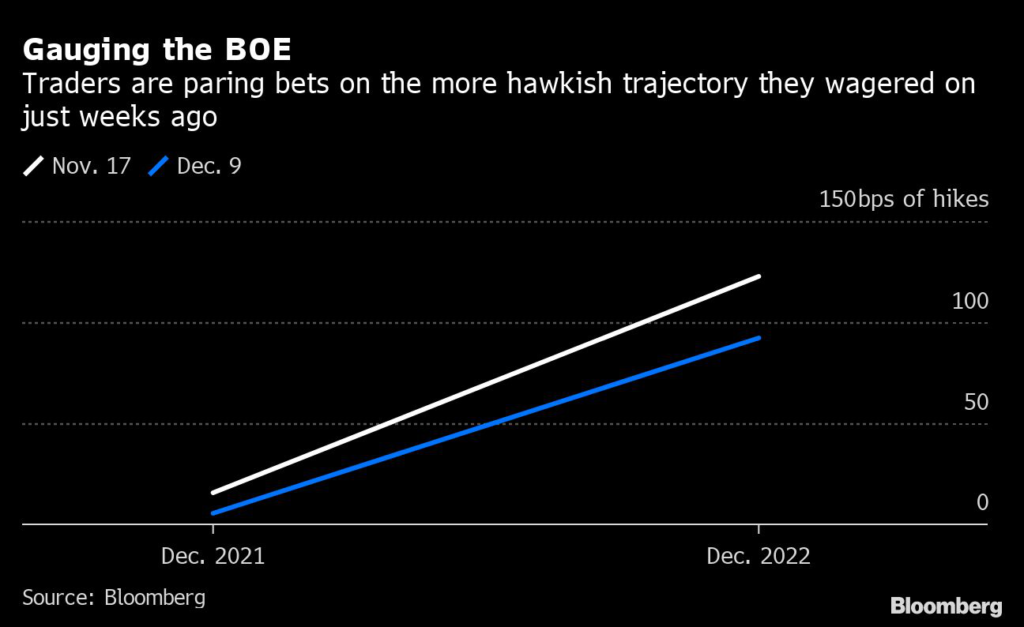
Money markets are pricing in just five basis points of hikes, half of what they had penciled in last week. Traders are betting the BOE will wait for more clarity over the economic impact of the new coronavirus strain after measures such as work-from-home guidance were reintroduced Wednesday.
That kept the pressure on the pound, lingering near its weakest level against the dollar in a year. The yield on 10-year U.K. bonds fell to the lowest since early September, as investors piled into safe government securities amid concern over further restrictions.
It’s a dramatic turnaround. Last month, a hike was considered a done deal given consumer prices are rising at the fastest pace in a decade, yet the BOE caught markets off guard when it held rates steady. Now, banks including Goldman Sachs Group Inc. are pushing their predictions for the first move to February, with some saying a decision to hike earlier would be a mistake that risks hurting growth.
Even if the BOE does hike rates next week, any strength in sterling could be short-lived, according to Jordan Rochester, currency strategist at Nomura International Plc. “I suspect investors will treat this as a “policy mistake” and lower U.K. growth expectations further,” he said.
Money markets are pricing in a shallower path of rate hikes over the next year, with traders almost pushing back an increase to 1% to 2023. Just last month, they saw the key rate rising to as high as 1.25% by the end of next year.
To be sure, it’s still a much faster pace of hikes than markets are anticipating for either the European Central Bank or the Federal Reserve. And traders are still pricing in around 22 basis points of hikes in February 2022, which leaves the possibility of a larger-than-expected initial hike from the BOE if they hold rates this time around.
Cable fell to a fresh year-to-date low on Wednesday as reports emerged that the U.K. government was weighing further restrictions. It’s still hovering close to that level, trading at around $1.3187 and eyeing a close below a key technical threshold.
Benchmark 10-year gilt yields have erased the increase they’ve made over the last few months, touching 0.68%. That was in contrast to bond markets globally, which saw yields climb Wednesday amid optimism over the effectiveness of existing vaccines against the new omicron variant.
Traders are bracing for volatility ahead of key central bank meetings next week, including the ECB, the Fed as well as the BOE. One-week implied volatility — which now captures the meetings — is at its highest since late February.
More stories like this are available on bloomberg.com
©2021 Bloomberg L.P.