
Japanese authorities barely had time to catch their breath after calming currency markets before they were faced with a flare-up of stress in the nation’s government bond market.
(Bloomberg) — Japanese authorities barely had time to catch their breath after calming currency markets before they were faced with a flare-up of stress in the nation’s government bond market.
Amid a global rise in yields and a weakening yen, a gauge of demand at Japan’s sale of 20-year government bonds fell to the lowest in a decade Thursday, leading to a slump in longer-dated debt. And data showed overseas funds offloaded almost 2.6 trillion yen ($18.1 billion) of mostly government bonds in the week to Sept. 9, the biggest amount since the speculative attack on the market in mid-June.
Japan’s 10-year yield climbed to 0.25%, the upper end of the central bank’s trading range, on Wednesday when the BOJ increased debt purchases to cap a rise. The yield of a former benchmark which now has a 9-year maturity rose to 0.26% in a further sign of market stress, causing an inversion.
The bond market tension creates a fresh headache for Japan’s embattled officials, already locked in a struggle with traders over the weakening yen. At the heart of both issues is the Bank of Japan’s easy monetary policy, which stands in stark contrast to the global wave of tightening to rein in sky-high inflation.
“The foreign selling basically is in line with investors shedding debt allocations amid the rise in global yields that included JGBs,” said Tsuyoshi Ueno, a senior economist at NLI Research Institute in Tokyo. “As the yen weakened to 140 per dollar, that may also have fueled speculation the BOJ would have to reduce stimulus if cost-push inflation pressure mounts.”
Japanese government bonds last came under pressure in June when foreign funds shorted them in the expectation the BOJ would be forced to tweak policy. The heavy selling pressure eased only when unprecedented central bank buying dragged benchmark yields back below the 0.25% ceiling.
Now with the yen under attack — a fall to a fresh 24-year low this week prompted Japan’s strongest warning yet that it would act to halt the currency’s slide, the pressure on the BOJ is rising again. The central bank has emphasized its determination to stick with rock-bottom interest rates even as global peers hike to tackle accelerating inflation.
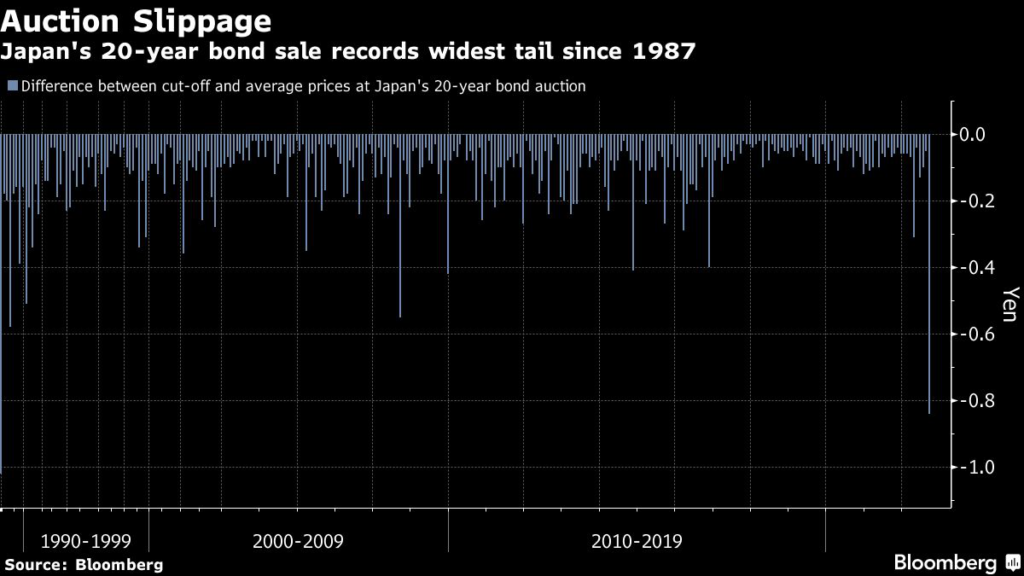
While Japan’s 10-year yields are controlled, longer-dated equivalents are not, exposing them to local and global market trends. The so-called tail of Thursday’s 20-year auction — the gap between the lowest price paid for the bonds and the average — was the widest since 1987, based on Bloomberg data. That’s a sign of weak demand.
“The result is really bad,” said Kazuya Sato, a strategist at Daiwa Securities Co. in Tokyo. “The biggest reason probably is 20-year yields aren’t very high and pale in comparison with Treasuries.”
The BOJ ends its two-day meeting on Sept. 22, the day after one from the Federal Reserve, from whom markets expect at least a 75 basis-point rate hike.
“This time it’s more a lingering speculation that the weak yen might push BOJ into the corner, rather than challenge to the BOJ,” NLI’s Ueno said.
(Updates with more details and comments on auction.)
More stories like this are available on bloomberg.com
©2022 Bloomberg L.P.