
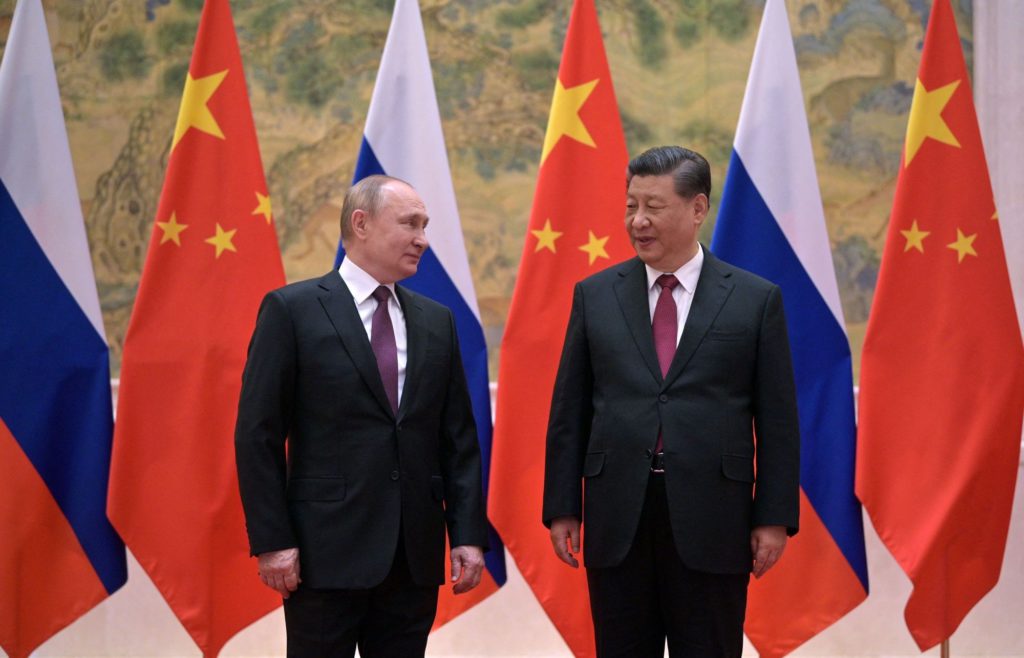
Chinese President Xi Jinping is set to meet Russian President Vladimir Putin in Uzbekistan on Thursday, as Moscow struggles with its most significant military setbacks in Ukraine in months.
(Bloomberg) — Chinese President Xi Jinping is set to meet Russian President Vladimir Putin in Uzbekistan on Thursday, as Moscow struggles with its most significant military setbacks in Ukraine in months.
Xi met with Central Asian leaders from Tajikistan, Uzbekistan, Turkmenistan and Kyrgyzstan on Thursday morning, as Russian TV showed Putin’s arrival in Samarkand. Both men are in Uzbekistan for a two-day summit of the Shanghai Cooperation Organization, a Beijing-led group seen as a counter to US-dominated alliances.
The Chinese leader told Kyrgyzstan’s President Sadyr Japarov he wanted construction to start on the China-Kyrgyzstan-Uzbekistan railway “at an early date,” according to state broadcaster China Central Television. The route will reduce China’s dependence on Russia and Kazakhstan to transit goods.
In a separate meeting with his Turkmenistan counterpart, Serdar Berdimuhamedov, Xi said the two countries should scale up cooperation on natural gas, the official Xinhua News Agency reported. Xi also held talks with Tajikistan’s President Emomali Rahmon, pledging to import more agricultural goods from the central Asian nation and deepen cooperation in areas including transit and anti-terrorism, CCTV reported.
Before the summit began Thursday, Xi said in a statement that he wanted to “deepen mutually beneficial cooperation, and promote the sound and steady development” of the forum. Xi’s comments were shared in a statement after he was greeted by Uzbek President Shavkat Mirziyoyev upon landing in Samarkand on Wednesday evening.
Photographs in Chinese state media of Xi’s arrival showed him wearing a mask with a small Chinese flag on it. Xi has repeatedly backed China’s zero-tolerance approach to the coronavirus, despite the punishing economic costs.
Xi’s sitdown with Putin at the SCO will be their first in-person exchange since declaring a “no limits” friendship in Beijing in February. Putin ordered an attack on Ukraine weeks later, a move that seemed to surprise Beijing.
China has since provided verbal backing for Moscow. The Asian nation’s No. 3 official, Li Zhanshu, recently told Russian lawmakers that leaders in Beijing “fully understand the necessity” of Putin’s actions. Yet, China has avoided sending military supplies or providing financial support, which would make Beijing a target of economic sanctions that Washington and others have applied to Russia.
Xi and Putin “planned to discuss both the bilateral agenda and key regional and international topics” on Thursday, Putin aide Yury Ushakov told Russia’s Tass news agency, adding that the Ukraine and Taiwan issues will be discussed.
Why Taiwan’s Status Risks Igniting a US-China Clash: QuickTake
China’s ties with the US have worsened recently over Taiwan, especially after Nancy Pelosi became the first House Speaker in 25 years to visit the democratic island. Beijing responded with unprecedented military drills around Taiwan, including launching ballistic missiles that traveled directly over the island that Beijing claims as its territory.
On Wednesday, the Senate Foreign Relations Committee approved a bill to boost ties with Taipei and give it more military hardware to deter a Chinese invasion, a development that is likely to further strain ties.
Xi Unlikely to Throw Putin a Lifeline as Ukraine Struggles Mount
Xi’s Central Asian trip marks his return to the world stage after being the only Group of 20 leader to avoid leaving his country since the first Covid lockdown began in January 2020.
On Wednesday, he traveled to Kazakhstan, where the 69-year-old held talks with President Kassym-Jomart Tokayev in the capital Nur-Sultan. Xi said his choice of Kazakhstan for his first foreign trip in nearly 1,000 days showed “the high level and uniqueness of China-Kazakhstan relations and our profound friendship.”
Xi’s sweep through Central Asia is also a chance to promote his vision of a world where China can expand its interests without fearing the threat of US economic or military pressure. It comes a month before a twice-in-a-decade Communist Party congress where he’s expected to clinch a precedent-busting third term, and push his agenda for a multipolar world.
He was originally expected to make his inaugural international trip in November for the G-20 summit in Bali, which will be attended by President Joe Biden as well as Putin.
Instead, his decision to visit Central Asia first has put the focus on meeting with leaders from Russia, India, Pakistan and Iran — countries more aligned with Beijing’s efforts to push back on the US and its allies.
(Updates with details of Xi’s meetings and Putin’s arrival to Samarkand.)
More stories like this are available on bloomberg.com
©2022 Bloomberg L.P.