
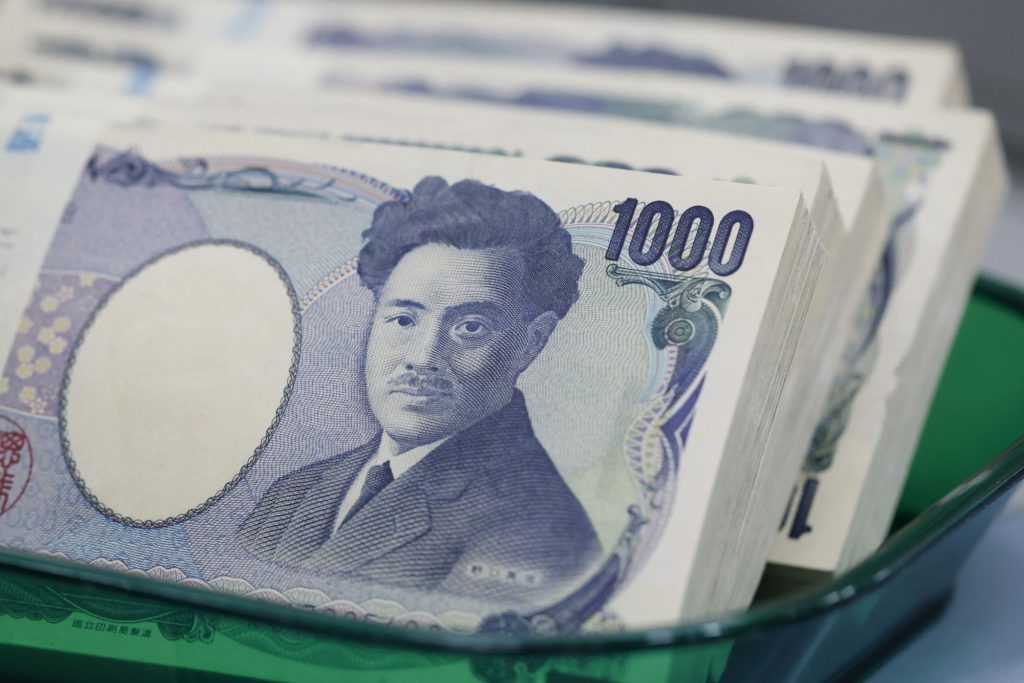
The yen rallied further away from the closely-watched 145 per dollar level after reports the Bank of Japan conducted a so-called rate check in the currency market, a move considered a precursor for intervention.
(Bloomberg) — The yen rallied further away from the closely-watched 145 per dollar level after reports the Bank of Japan conducted a so-called rate check in the currency market, a move considered a precursor for intervention.
The currency rose more than 1% to around the 143 level after falling to 144.96 against the dollar early in the Asian session. Around lunchtime Tokyo Wednesday, Finance Minister Shunichi Suzuki said Japan wouldn’t rule out any response if current trends in the FX market continued and those options included stepping into markets.
A break of 145 would bring 146.78 into play, the level reached before a joint Japan-US intervention to support the yen back in 1998.
Japanese authorities have been stepping up verbal warnings as the yen has fallen but these have failed to turn the tide against dollar strength. Wednesday’s reports are a step up again and come as traders question how effective any intervention would be, especially if it was unilateral and without the backing of the US.
“If this kind of situation continues, we won’t rule out any options in responding,” Suzuki said, reiterating a warning shot given earlier in the day by top currency official Masato Kanda. When asked a direct question if intervention was one of those options, Suzuki said it was.
The Ministry of Finance could not be immediately reached for comments, while the BOJ didn’t immediately respond to a request for comment. Governor Haruhiko Kuroda refrained from talking to reporters about the weak yen after a panel on the economy on Wednesday afternoon in Tokyo.
Rate Check
A rate check happens when the BOJ calls traders to see the price of the currency against the dollar — a move that can serve as a warning for them to avoid one-way bets. It usually happens when volatility increases and verbal intervention may not be sufficient.
The BOJ made a call Wednesday after Kanda’s comments, according to a person with direct knowledge of the event. In Japan, the finance ministry decides whether to intervene in the market and the central bank does the actual buying or selling. The Nikkei earlier reported the checks.
While this should put traders on their highest alert that authorities are considering direction intervention in markets, rate checks are by no means a guarantee that action is imminent.
Intervention to weaken the yen in September 2010 came more than a month after reports of rate checks. After similar reports in 2016, Japan ultimately didn’t intervene.
When Yen Jawboning Isn’t Enough, BOJ Rate Checks Loom: Primer
“It won’t be surprising if there actually was a rate check given a slew of verbal warnings from the morning today,” said Akira Moroga, manager of currency products at Aozora Bank in Tokyo. “But while the rate check report probably is a precursor to actual intervention, it isn’t likely to lead to an immediate action and is just a hearing and an extension of verbal intervention.”
Pressure Builds
Putting further pressure on Japanese officials Wednesday, the country’s benchmark 10-year yield hit the 0.25% upper limit of the central bank’s tolerated range. Earlier in the day, the BOJ had boosted its scheduled bond purchases once more in a bid to cap the rise in yields.
The impact of the stronger dollar wasn’t just confined to Japan, with officials across Asia busy trying to bolster their currencies. A tumble in South Korea’s won sparked comments from officials there that they were closely monitoring markets. China extended its currency defense by setting its reference rate for the yuan with the strongest bias on record.
Japan’s currency has tumbled more than 20% versus the greenback this year due to widening policy differentials between the two nations. Tuesday’s US inflation data reinforced bets the Fed will raise its benchmark by 75 basis points at this month’s policy meeting, while the BOJ is forecast to keep rates on hold at the end of its September gathering.
“Speculation will continue and volatility will remain high until the Fed meeting next week,” said Takeshi Minami, chief economist at Norinchukin Research Institute. “While the BOJ will continue to send warning signals on the yen’s rapid weakness at its meeting, it is very unlikely it will change policy in response to the yen’s weakness.”
Official Language
That leaves any action from Tokyo in the hands of the finance ministry. Japanese officials’ language on recent yen moves is approaching the wording used before they directly intervened in the currency market in the past.
Still, economists say the chance for intervention is low. While Japan has more firepower in its foreign exchange reserves to prop up the yen than it did in 1998, analysts see little chance of Tokyo being able to turn the trend through intervention without US help.
How and When Japan Intervenes in Currency Markets: QuickTake
“Today’s developments tell me that intervention is not off the table. But you need to remember that intervention will be meaningless unless it works,” said Hideo Kumano, executive economist at Dai-Ichi Life Research Institute. “It remains hard for Japan alone to intervene. If they do so and cause a rebuke from the US, markets will be confused further.”
Options traders are beginning to look for protection against possible action. One-month risk-reversals for dollar-yen — a gauge of expected direction for the currency pair over that time frame — point to near-term downside.
Japan’s $1.2 Trillion Buffer May Not Scare Yen Bears Without US
“The BOJ’s rate checks can be seen as adding weight to their ongoing jawboning efforts,” said Yanxi Tan, a FX strategist at Malayan Banking Berhad. “Despite the upside surprise in US CPI yesterday, such push-back efforts may help moderate the pace of dollar gains. There is now an increasing likelihood that the current dollar-yen uptrend may fail to breach the 1998 top near 147.66.”
(Updates with Kuroda on Wednesday afternoon..)
More stories like this are available on bloomberg.com
©2022 Bloomberg L.P.