
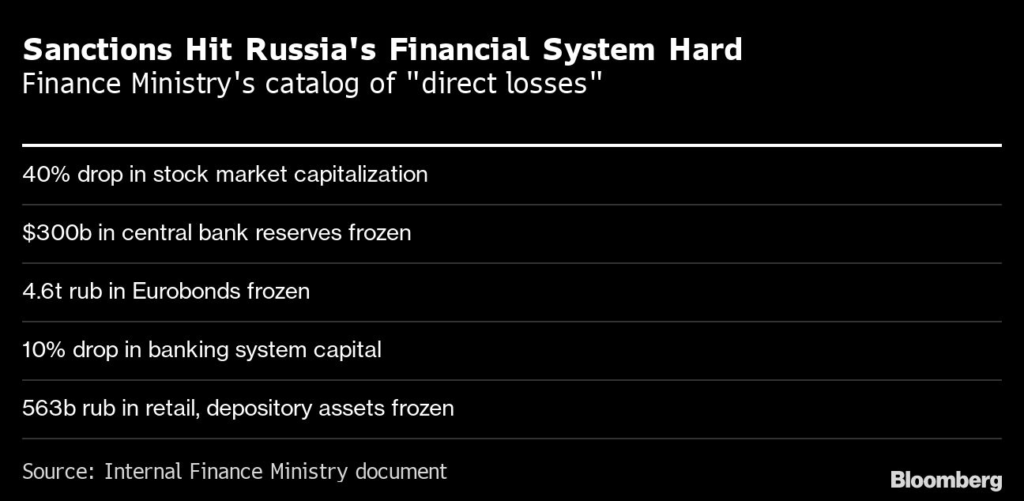
Russia’s financial sector suffered hundreds of billions of dollars in “direct losses” from the sweeping sanctions imposed by the US and its allies over President Vladimir Putin’s invasion of Ukraine, according to an internal Finance Ministry document.
(Bloomberg) — Russia’s financial sector suffered hundreds of billions of dollars in “direct losses” from the sweeping sanctions imposed by the US and its allies over President Vladimir Putin’s invasion of Ukraine, according to an internal Finance Ministry document.
The estimate, which includes significant hits to the stock market, bank capital as well as $300 billion in foreign-exchange reserves frozen by the restrictions, was included in a presentation for a top-level meeting of officials on responding to sanctions held last month. People familiar with the event confirmed the contents, speaking on condition of anonymity to discuss matters that aren’t public.
The Finance Ministry declined to comment. Putin told officials in televised comments Monday that “Russia is confidently handling the external pressure,” with the economy “stabilizing and heading for a growth trajectory.”
The report didn’t put a total value on the hit from sanctions, which focuses on the financial system and doesn’t address the impact on the broader economy.
Some of the most severe impacts have eased compared to the figures in the presentation, dated Aug. 29. Russia’s benchmark MOEX stock index is now down about 20% since the invasion, compared to 33% at the lows in July. The Bank of Russia has suspended release of data on bank capital, making it impossible to update that calculation.
For Russia, 10 Lessons on Sanctions From 1980s South Africa
The presentation also catalogs damage to financial infrastructure, including 80% of banking-sector assets falling under sanctions, cutoffs from the Swift financial-messaging service and loss off access to key equipment and software. It said instruments including derivatives, hedging, Eurobonds and initial public offerings had “practically disappeared.”
The presentation doesn’t address the broader economic impact of the restrictions, which have pushed Russia into a recession that’s likely to extend into next year. Another document for the top-level meeting showed the contraction may be longer and deeper than that, Bloomberg reported.
More stories like this are available on bloomberg.com
©2022 Bloomberg L.P.