
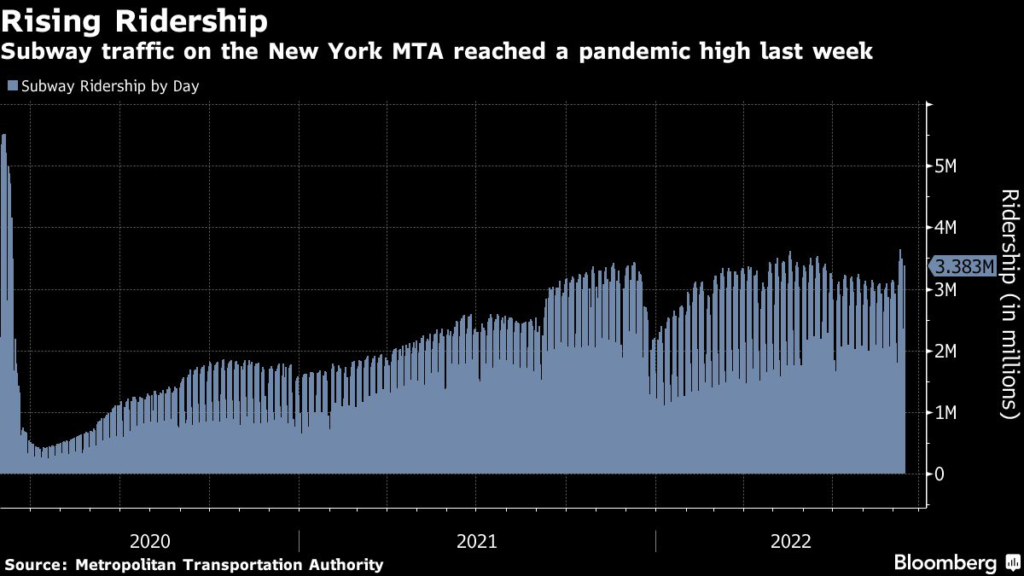
Schoolchildren are piling into morning buses and office workers are jostling for space in the subway on their way home. But as crowded as the urban commute is beginning to seem, stricter return-to-office policies and the start of the academic year won’t be enough to rescue beleaguered public transit agencies from the financial woes of the pandemic.
(Bloomberg) — Schoolchildren are piling into morning buses and office workers are jostling for space in the subway on their way home. But as crowded as the urban commute is beginning to seem, stricter return-to-office policies and the start of the academic year won’t be enough to rescue beleaguered public transit agencies from the financial woes of the pandemic.
In New York City, for example, the first day of school last week marked a pandemic subway ridership record, with numbers up 35% from the comparable day a year ago. But that boost brought ridership to just 63% of pre-pandemic levels, around the national trend as of late August. Most fare-dependent transit agencies predict a 70% to 90% recovery over the next few years, according to Fitch Ratings.
Transit systems that rely heavily on farebox revenues hoped that relief would come when bosses clamped down on workers returning to their desks, as many have promised to do after the US Labor Day holiday in early September. But for agencies that count on riders to return, the bigger test will be whether they can come up with alternative revenue sources to buoy their finances, said Andy Shin, senior municipal research analyst at Insight Investment.
“A return to office will help, but we’re still far away from the level reached before the pandemic,” said Mikhail Foux, a municipal strategist at Barclays Plc. “Unlike other sectors where the trend is improvement of credit quality or even stability, here we will continue to see deterioration. Maybe not as fast as before, but it’s still deterioration.”
Several fare-dependent transit agencies, including New York’s Metropolitan Transportation Authority and the San Francisco Municipal Transportation Agency received downgrades over the past two years after their budgets were battered by muted ridership, according to an S&P Global Ratings report released Sept. 8.
“It used to be that reliance on farebox revenue was touted as a credit positive because you didn’t have to rely on regular state appropriations or federal aid as much,” said Dora Lee, director of research at Belle Haven Investments. “Now it’s kind of the opposite.”
Transit systems that rely on tax revenue generally fared better than their fare-dependent counterparts. The Utah Transit Authority, VIA Metropolitan Transit in San Antonio and Colorado’s Roaring Fork Transportation Authority received positive credit outlooks on tax revenue growth over the past two years, according to S&P. While some agencies were able to maintain a stable outlook because of the federal aid they received during the pandemic, they risk burning through that money without finding other means to fund deficits.
Recovery of farebox revenues will depend on whether companies make good on their pledge that Labor Day marks the official return to the office. On Wall Street, Bank of America Corp. is formalizing the flexibility it allowed in the past few years, while executives at Morgan Stanley and Goldman Sachs Group Inc. have removed the final hurdles for in-person, full-time work.
But ridership declines remain a challenge for transit systems as workers push back against mandates to return to their desks and safety concerns discourage once-loyal riders from coming back.
More stories like this are available on bloomberg.com
©2022 Bloomberg L.P.