
(Bloomberg) — Pakistan’s dollar bonds are failing to rebound after the nation resumed its deal with the International Monetary Fund as devastating floods drag on the nation’s economic outlook.
(Bloomberg) — Pakistan’s dollar bonds are failing to rebound after the nation resumed its deal with the International Monetary Fund as devastating floods drag on the nation’s economic outlook.
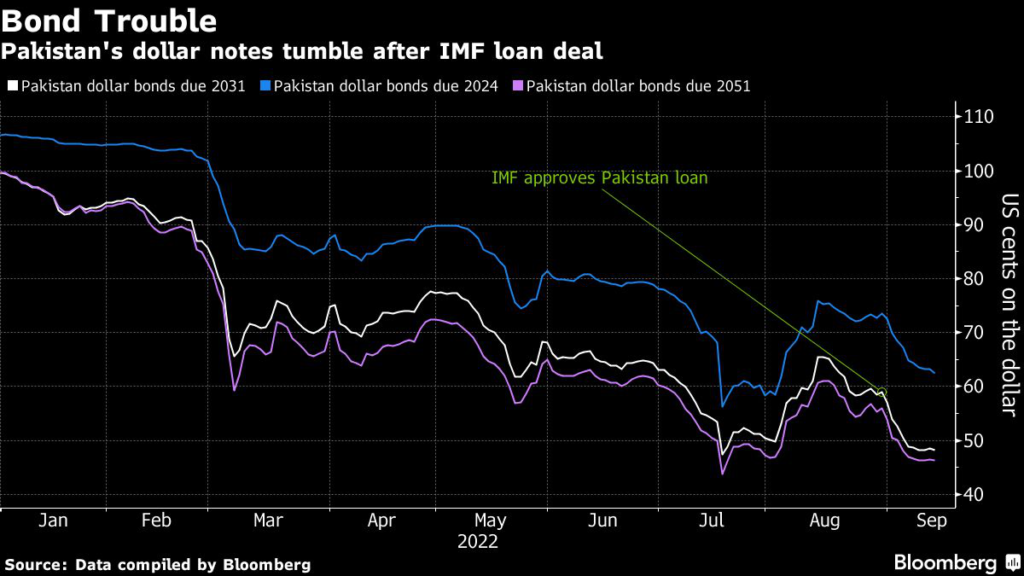
The South Asian country’s foreign debt edged lower on Wednesday in New York, sending notes due in 2031 and 2051 to their lowest on a closing basis since mid-July, according to data compiled by Bloomberg. The bonds have struggled to recover despite the dispersal of a $1.16 billion loan in late August, which helped the nation to avert default as political turmoil and deadly flooding threatened the economy.
“Markets are waiting for a better understanding of the flood fallout and to see whether the likely increase to the current account will be offset by fresh donor support,” said Patrick Curran, a senior economist at Tellimer Ltd. “Bonds are trading below recovery value, so there’s plenty of upside, but with political uncertainty complicating the reform story and the floods causing uncertainty on the economic outlook it will take some time for that upside to be realized.”
While the nation’s resumed $6.5 billion loan program with the IMF eased fear of a default, millions of acres of agricultural land have been destroyed in record rainfall. Bonds due in 2031 edged lower on Wednesday to 48.2 cents, the lowest since mid-July on a closing basis, according to data compiled by Bloomberg. Pakistan’s dollar bonds due in 2024, meantime, fell about half a cent to 62.7 cents on the US dollar, the lowest since early August.
The nation’s currency fell about 1% against the dollar on Wednesday to 234.32.
Pakistan’s government has already slashed its economic growth projections by more than half due to the floods, expecting growth to come in at 2.3%, compared to a target of 5% growth in June. Officials also agreed with the IMF to increase a gasoline tax to 50 rupees per liter from 37.5 rupees by early 2023.
That will likely add to price pressures, Bloomberg Intelligence economist Ankur Shukla said in a note Wednesday, forecasting that inflation will climb to 27.5% on average in the year ending in June 2023.
More stories like this are available on bloomberg.com
©2022 Bloomberg L.P.