
UK economists lifted their forecasts for interest rates after Prime Minister Liz Truss announced a multi-billion-pound package to help consumers struggling with energy bills.
(Bloomberg) —
UK economists lifted their forecasts for interest rates after Prime Minister Liz Truss announced a multi-billion-pound package to help consumers struggling with energy bills.
The government’s decision to freeze household natural gas and electricity will cut headline inflation in the next few months but stimulate the economy just as the Bank of England tries to head off a domestic price spiral.
Nomura estimated the BOE will raise its key rate to 3.75% in the coming months, up from its previous forecast of 2.5%. NatWest Markets added a half point to its outlook, which is now 3.5%.
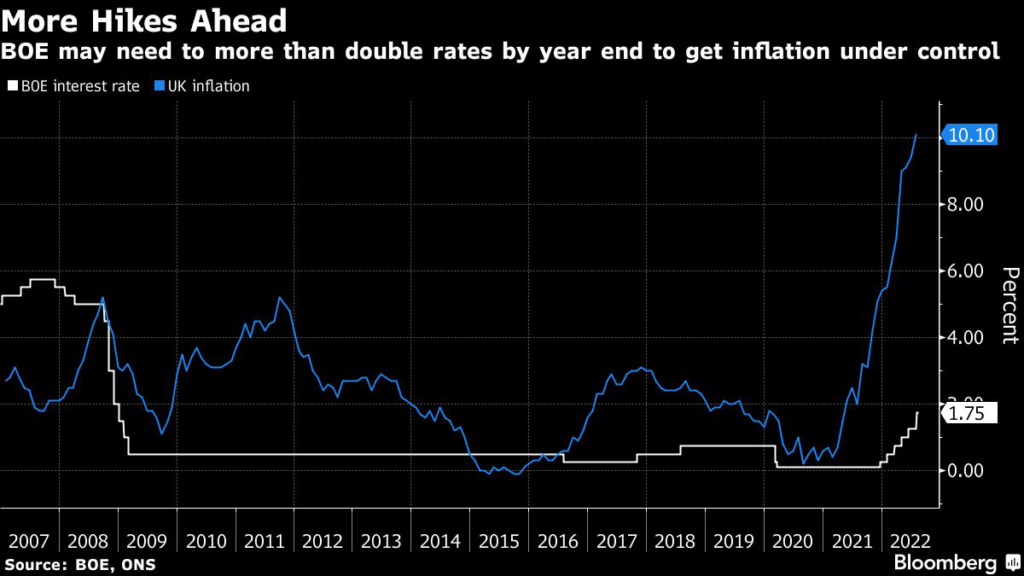
The UK central bank delivered its biggest rate rise in 27 years last month, lifting the benchmark to 1.75%. Investors are betting on another half point, with a 40% chance of a 75 basis point move next week.
“A 75 basis point rate hike next week is a very real possibility,” said Hugh Gimber, global market strategist at JPMorgan Asset Management.
JPMorgan Securities is even more bullish, with economist Allan Monks anticipating an extra 50-basis points of hikes from the BOE and only one negative quarter of growth for the UK economy. He expects a 75-basis-point increase next week.
“A 50 Bps hike at next week’s meeting would amount to a dovish surprise,” Monks wrote in a note. “This would be hard to justify just after a large, unfunded and not well targeted fiscal easing which has been accompanied by falling confidence in markets about the sustainability of the UK’s fiscal position.”
What Bloomberg Economics Says …
“UK Prime Minister Liz Truss has announced plans for a two-year freeze on household energy bills and six month shield for businesses. According to our estimates, that means £80 billion more fiscal support than we had previously assumed and should be enough to avoid a recession. For inflation, the peak will now probably come in October. That will reduce the need for the Bank of England to front-load rate hikes anytime soon. But because it raises the risk of the economy overheating next year, it could also mean higher rates for longer.”
–Ana Luis Andrade, Bloomberg Economics. Click for the INSIGHT.
The Treasury expects the support, which is expected to cost more than £100 billion, to lower peak inflation by 4 to 5 percentage points from the 15% peak currently forecast by economists.
The concern is that protecting households from a surge in energy prices will boost domestically generated inflation by spreading beyond utility bills into the cost of goods and wages.
“By shielding household finances from higher energy prices, the government is significantly boosting the amount of demand in the economy, which will fuel underlying inflation pressure,” said Luke Bartholomew, senior economist at the fund manager Abrdn, also anticipating a 75 bps hike next week. “This means the bank will need to raise interest rates even more rapidly.”
Sandra Horsfield at Investec said, “A higher peak in bank rate may well result. Much, however, will depend on the wider fiscal stance unveiled at the mini-Budget later this month.”
Goldman Sachs expects half-point rate increases at each of the next three meetings, taking the benchmark lending rate to 3.25% by the year-end. It has raised its peak forecast to 3.5%.
Barclays’s economist Fabrice Montagne said the rescue package will allow the BOE to “refocus on the domestic drivers of inflation.”
“Falling inflation will in our view remove support for a prolonged hiking cycle,” he said. Barclays expects rates to top out at 2.5% in November.
Read more:
- UK Says Energy Aid Will Cost Treasury Billions and Cut Inflation
- UK Sidelines Budget Watchdog in Assessing Cost of Energy Bailout
- BOE Says Energy Bill Cap Could Cut Inflation in Short Term
- UK Taxpayers on the Hook for Truss’s £200 Billion Energy Plan
More stories like this are available on bloomberg.com
©2022 Bloomberg L.P.