
Japan’s economy grew at a faster clip than initially thought in the three months through June, regaining the ground it lost during the pandemic and indicating greater resilience as it faces downside risks materializing in the global economy.
(Bloomberg) — Japan’s economy grew at a faster clip than initially thought in the three months through June, regaining the ground it lost during the pandemic and indicating greater resilience as it faces downside risks materializing in the global economy.
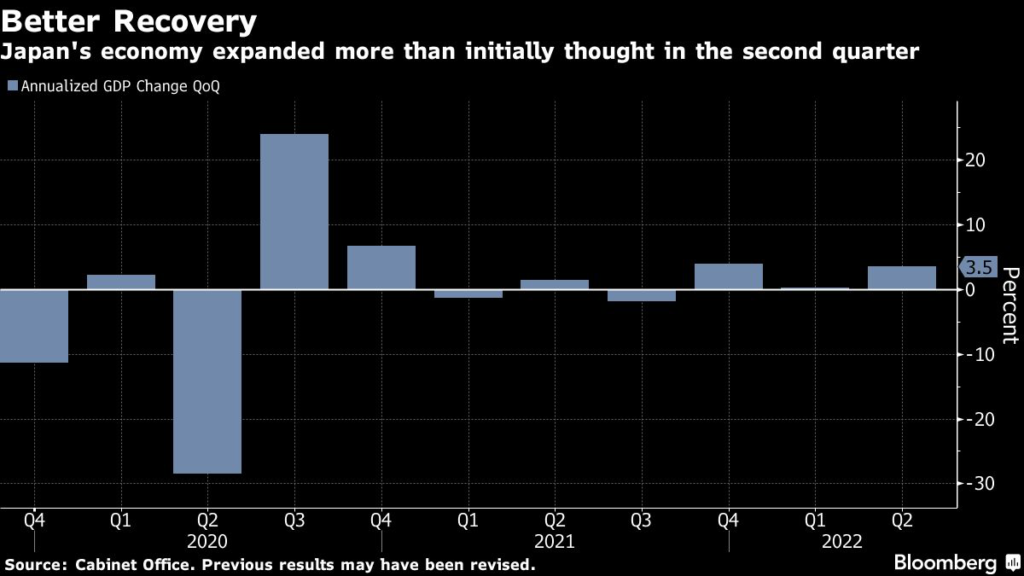
Gross domestic product grew an annualized 3.5% in the second quarter from the previous period, revised figures from the Cabinet Office showed Thursday. Economists had expected a 2.9% expansion, compared with an initial reading of 2.2%.
Stronger business spending was the main driver of the upward revision indicating stronger-than-expected confidence among companies in the second quarter. Other components including private consumption and net exports also contributed to the larger expansion.
The latest figures confirm that Japan’s economy regained its pre-pandemic size and is on firmer footing than was seen in the initial reading. The recovery pace picked up as Japan emerged from the winter wave of the virus, prompting gains in consumer outlays, while business spending rose 2% after the finance ministry reported a stronger increase last week.
Still, the pace of growth is expected to slow this quarter as a record virus wave and continued supply chain snarls limit production and consumer spending and households take a hit from further price rises. Higher energy and imported food prices are being fueled by a yen that continues to set fresh 24-year lows against the dollar.
The trajectory of the global economy is also looking much cloudier as central banks race to raise interest rates in the battle against inflation, risking a slowdown of growth. For now the Bank of Japan is not among them.
“An improvement in capital investment led to the upward revision,” said economist Yuichi Kodama at Meiji Yasuda Research Institute. “But I get the sense that the rebound in consumption has already stalled and inflation is gradually weighing on consumers. Strong capital investment is likely to lead the recovery from here, but if the US economy slows down, Japan will also take a hit.”
What Bloomberg Economics Says…
“Higher import costs are also squeezing corporate profits and crimping wage growth, likely damping the recovery in household spending going forward. Taken together, the 2Q GDP results don’t change the fact that the government must keep delivering fuel subsidies and other stimulus.”
–Yuki Masujima
For the full report, click here.
The blow to the economy from the latest Covid wave is expected to be much smaller than previous surges. The government has kept the economy free of virus-related restrictions in a strategic change. Although new cases soared to more than 200,000 a day over the summer before peaking, the number of serious cases and deaths remain relatively limited compared with the number of infections.
But the pain for households from inflation is steadily increasing. To help them, Prime Minister Fumio Kishida is set to announce another round of price relief measures on Friday. As part of the package, local media reported that the government is considering handing out 50,000 yen ($349) to low-income households.
Inflation remains a global phenomenon, fueled by the war in Ukraine, post-pandemic demand and supply line glitches. As Japan’s major trading partners like the US and Europe try to cool growth to contain rampant price gains, Japan’s exporters may also take a hit. Key indicators in July have shown a mixed picture with production picking up and consumption cooling.
The weak yen boosts Japanese companies’ overseas earnings when brought home, but their workers are getting a smaller share of the earnings. The corporate propensity for saving is part of the reason why wage growth is failing to keep up with inflation despite the ongoing push from the government.
Due to the lack of robust wage gains, the BOJ is keeping its monetary stimulus program intact to ensure inflation becomes more sustainable. The central bank, whose dovish stance has fueled the yen’s weakness, is expected to stand pat later this month.
“A weaker yen is positive as a whole for the economy as it boosts Japan’s global companies,” said Meiji Yasuda’s Kodama. “But it also hits consumers with higher import prices and so people feel it’s working against them.”
(Updates to add more details from the report, economist comments)
More stories like this are available on bloomberg.com
©2022 Bloomberg L.P.