
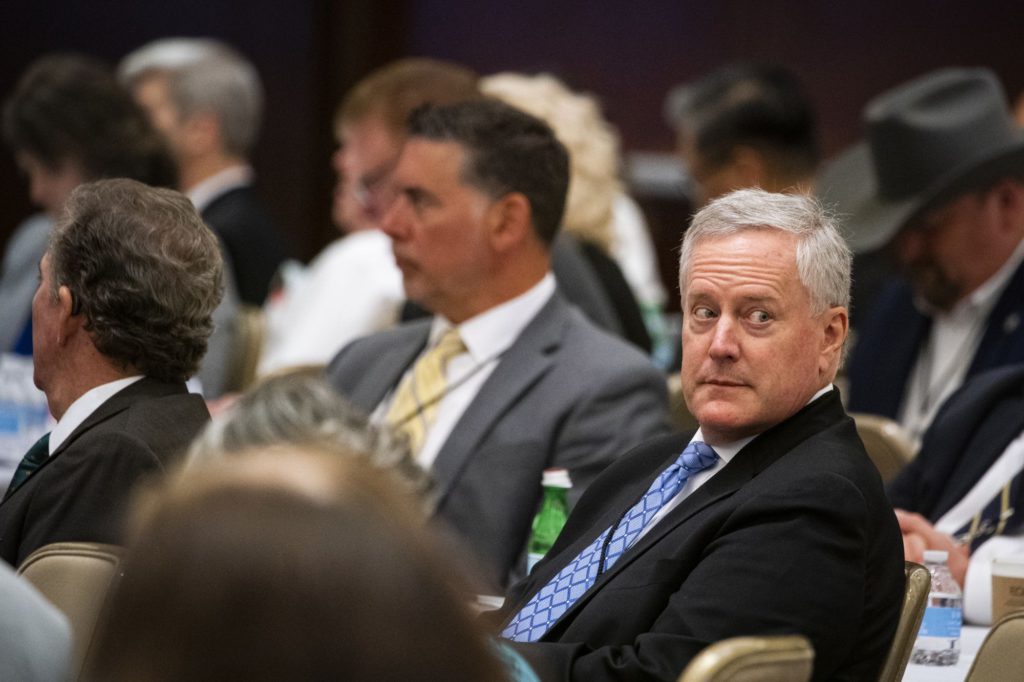
Nearly a year after Donald Trump’s former Chief of Staff Mark Meadows was subpoenaed by the House Jan. 6 committee, a federal judge pressed the panel’s lawyer on why they hadn’t pursued what seemed like an easier legal argument to get Meadows’ legal challenge tossed.
(Bloomberg) — Nearly a year after Donald Trump’s former Chief of Staff Mark Meadows was subpoenaed by the House Jan. 6 committee, a federal judge pressed the panel’s lawyer on why they hadn’t pursued what seemed like an easier legal argument to get Meadows’ legal challenge tossed.
US District Judge Carl Nichols engaged in a lengthy back-and-forth with House General Counsel Douglas Letter in a Washington courtroom Wednesday over the committee’s decision to not invoke a sweeping protection that prevents members of Congress from being hauled into court to defend their legislative work.
Nichols asked if he could consider dismissing Meadow’s suit under the Constitution’s Speech or Debate Clause, even though the committee had decided not to rely on it. Letter replied that the judge couldn’t do that, and that it was up to members of Congress to decide when they did, or did not, want to participate in court.
Nichols reserved ruling on the fate of Meadows’ challenge, saying he would act “appropriately quickly.” But he called the committee’s legal strategy “frustrating” after Letter at one point said that invoking the clause would be an “ironclad” defense against Meadows’ claims.
Letter explained that the committee wants an explicit court ruling that a person in Meadows’ position — a former top aide to an ex-president — isn’t entitled to absolute immunity, as Meadows has argued, and had to show up when subpoenaed by Congress. Meadows had an obligation to treat the Jan. 6 committee with “dignity” and members expected that he would respect a decision from the court and do his “patriotic” duty, Letter said.
Wednesday’s hearing underscored that the committee investigating the Capitol attack is still trying to get testimony from people who were close Trump at the time. Trump directed Meadows and other officials not to comply with subpoenas on executive privilege grounds. Some challengers may simply be trying to run out the clock in the courts until a new Congress, possibly with a Republican majority, is seated next year, when the subpoenas and the committee’s authority would expire.
The committee subpoenaed Meadows on Sept. 23, 2021, seeking documents as well as his testimony; they also issued a separate subpoena to Verizon Communications Inc. for his phone records. He entered into negotiations and produced several thousand pages of documents and more than 2,000 text messages and data from his personal cell phone. But he filed the lawsuit in December, arguing the subpoenas were unlawful and that he was entitled to immunity.
Letter told the judge that the committee had “massive cooperation” from other witnesses and obtained a large amount of document evidence, but that Meadows remains a key witness given his close proximity to Trump on Jan. 6.
Even if the committee wins the case, it’s not clear what would happen if Meadows still refused to comply, since the Justice Department previously said that it wouldn’t press criminal contempt charges following a referral by the House. In a contempt of Congress case against former Trump adviser Peter Navarro, a prosecutor recently said in court that at least one reason why officials decided against charging Meadows was that, unlike Navarro, Meadows attempted to negotiate a compromise with the committee and turned over some documents.
On Wednesday, Meadows’ lawyer George Terwilliger III objected to Letter’s suggestion that his client’s opposition to the subpoenas was unpatriotic, saying the position was a “principled one” meant to protect the confidentiality of presidential decision-making.
Nichols asked why Meadows was still pressing the case once DOJ said it wouldn’t bring charges. Terwilliger said the committee could issue more subpoenas in the future and that, generally, it was important to resolve the legal questions at stake.
Terwilliger said it was possible the committee had already received some of the records it wanted from Meadows from the National Archives. In an apparent reference to the separate probe into whether Trump mishandled classified materials and other government records after he left office, Terwilliger told the judge he was “confident” that they could show Meadows was “meticulous” about making sure his records went to the Archives.
Justice Department lawyer Elizabeth Shapiro briefly addressed the court to reiterate their position that former top advisers to former presidents were entitled to a “qualified” immunity against being forced to appear before Congress, but that Meadows failed to meet the criteria for claiming that.
(Adds details about impact of elections on subpoena in sixth paragraph.)
More stories like this are available on bloomberg.com
©2022 Bloomberg L.P.