
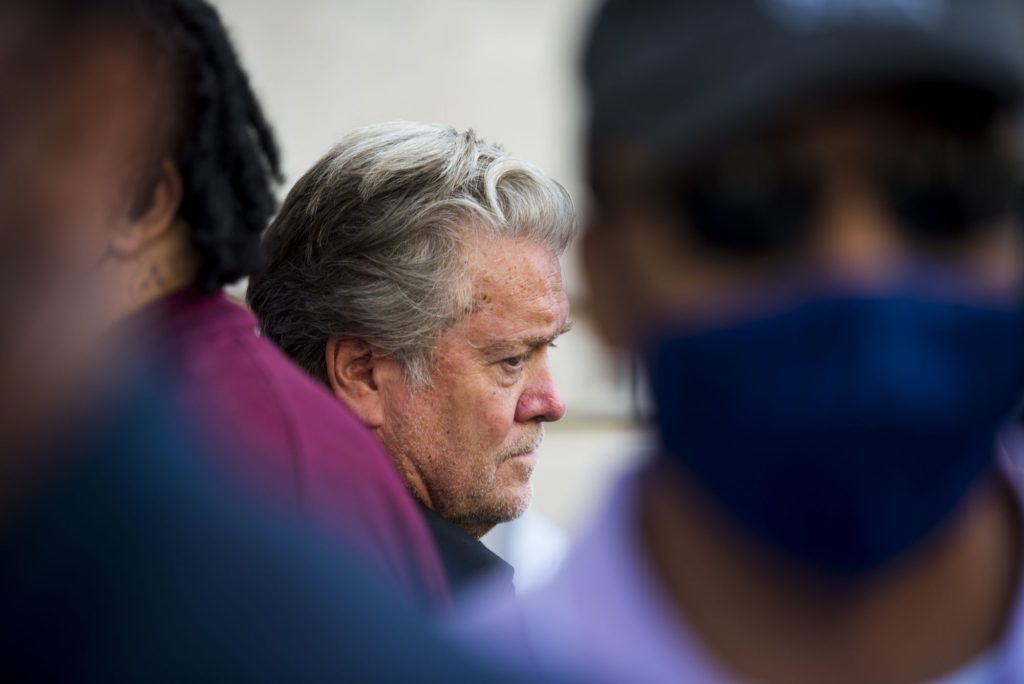
Steve Bannon is about to learn that a presidential pardon only goes so far in New York. Donald Trump pardoned his onetime top aide on his last day as president, allowing Bannon to avoid a trial on US charges that he defrauded contributors to a fund to build Trump’s wall on the US-Mexico border. Thanks to a state law enacted three years ago — which was aimed at weakening Trump’s power to protect people in his orbit from criminal prosecutions — the 68-year-old political consultant now will have
(Bloomberg) — Steve Bannon is about to learn that a presidential pardon only goes so far in New York. Donald Trump pardoned his onetime top aide on his last day as president, allowing Bannon to avoid a trial on US charges that he defrauded contributors to a fund to build Trump’s wall on the US-Mexico border. Thanks to a state law enacted three years ago — which was aimed at weakening Trump’s power to protect people in his orbit from criminal prosecutions — the 68-year-old political consultant now will have to answer to an indictment over his role in the “We Build the Wall” project.
1. How did Bannon avoid federal charges?
The US Constitution gives the president power to pardon anyone convicted or accused of a federal crime, and even issue a preemptive pardon to someone who hasn’t yet been charged. One example is when then-President Gerald Ford pardoned his predecessor, Richard Nixon, in 1974 after the Watergate scandal.
Bannon was charged by Manhattan federal prosecutors in 2020 and was pardoned on Jan. 20, 2021, just hours before Trump left office. Three other men accused in the fraud scheme weren’t pardoned. Two pleaded guilty while a third faces a retrial after a jury couldn’t reach a unanimous verdict.
2. How can state prosecutors bring a similar case?
It’s tricky. New York state law is modeled on the constitutional principle of double jeopardy that bars the prosecution of a person twice for the same crime. An older law prohibited New York prosecutors from charging people with state crimes similar to the federal crimes for which they were pardoned.
That’s how Trump’s former campaign chairman, Paul Manafort, avoided mortgage-fraud charges brought in 2019 by then-Manhattan District Attorney Cyrus Vance Jr. A state judge concluded that the Vance indictment overlapped with two earlier cases brought in federal court that resulted in Manafort’s conviction. The judge dismissed the state charges on double jeopardy grounds, a decision that was upheld by New York’s highest court. Trump pardoned Manafort in December 2020 after he’d been convicted.
Bannon’s situation is different because his federal case never made it to trial before Trump pardoned him. Legal experts said the prosecution led by current New York District Attorney Alvin Bragg stands to benefit from a measure signed in 2019 by then-New York Governor Andrew Cuomo that made it harder for a president to use his federal pardon power to shield associates from criminal liability. Cuomo said at the time that the legislation closes an “egregious loophole” that could have allowed any president to unfairly use the pardon power.
3. Is the case against Bannon the first of its kind?
This isn’t the first time local prosecutors in Manhattan have stepped in to bring criminal charges after a Trump pardon. In 2021, Vance indicted former New York Observer editor-in-chief Ken Kurson on state cyberstalking charges related to his ex-wife, months after Trump pardoned Kurson in a Brooklyn federal court prosecution. Kurson, a friend of Trump’s son-in-law Jared Kushner, pleaded guilty to state charges in February.
4. How does Bannon view the turn of events?
Bannon said through a spokesman that Bragg “decided to pursue phony charges against me 60 days before the midterm election,” and accused the Democratic prosecutor of targeting him because he and his radio show are popular among Trump and Republican supporters.
More stories like this are available on bloomberg.com
©2022 Bloomberg L.P.