
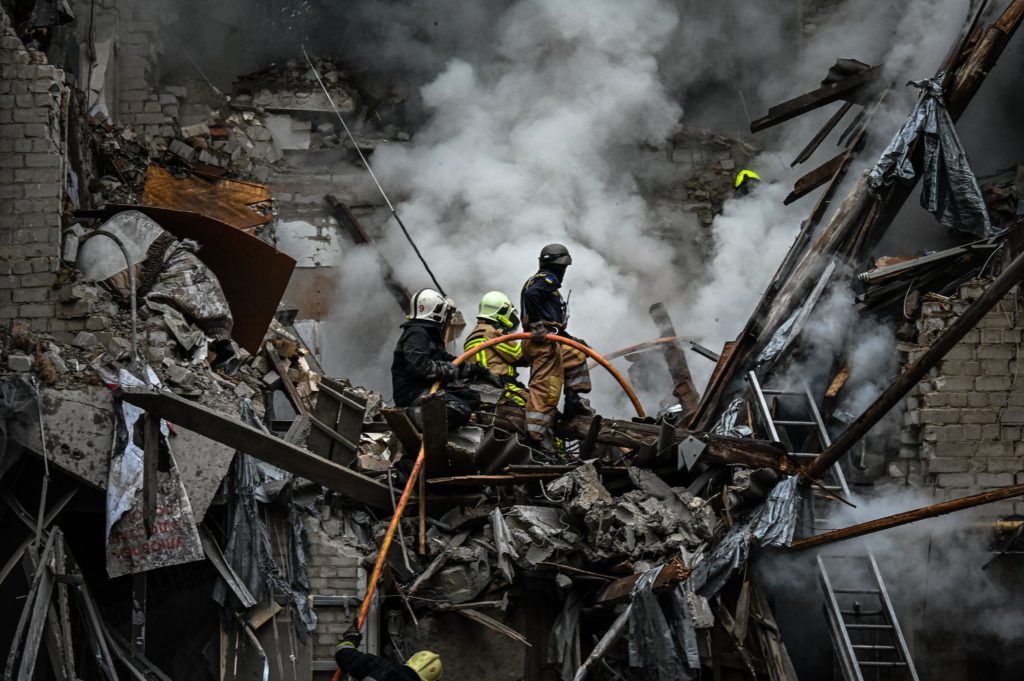
NATO Secretary General Jens Stoltenberg said the war in Ukraine is “entering a critical phase” and warned of a tough winter ahead for members of the military alliance that could include “energy cuts, disruptions and perhaps even civil unrest.”
(Bloomberg) — NATO Secretary General Jens Stoltenberg said the war in Ukraine is “entering a critical phase” and warned of a tough winter ahead for members of the military alliance that could include “energy cuts, disruptions and perhaps even civil unrest.”
“Our unity and solidarity will be seriously tested, as families and businesses feel the crunch of soaring energy prices and costs of living caused by Russia’s brutal invasion,” Stoltenberg wrote in a guest article for the Financial Times. “For Ukraine’s future and for ours, we must prepare for the winter war and stay the course.”
A defiant Vladimir Putin dismissed accusations that he’s using energy as a weapon and said Russia will emerge stronger from his invasion of Ukraine. Chancellor Olaf Scholz earlier accused the Kremlin leader of seeking to blackmail Germany and its European partners by shutting off gas deliveries and highlighted the importance of ending imports of Russian fossil fuels.
(See RSAN on the Bloomberg Terminal for the Russian Sanctions Dashboard.)
Key Developments
- EU to Consider Emergency Power-Use Cuts, Price Caps, Profit Grab
- Ukraine Counterattack Unfolds Slowly, Focuses on Limited Aims
- Defiant Putin Says His War in Ukraine Will Strengthen Russia
- Scholz Accuses Russia of ‘Blackmail’ Over Gas Pipeline Shutdown
- China State-Backed Expo Pulls Ukraine Trade Event at Last Minute
- Europe Gas Extends Losses as Politicians Rush to Contain Crisis
On the Ground
Ukrainian forces launched counterattacks in the northern Kharkiv region and have retaken several settlements, according to the latest report from the Washington-based Institute for the Study of War. Russian redeployment of forces from the area to defend against a counteroffensive in Kherson in the south likely prompted and facilitated the counterattacks, the Institute said. Ukraine’s General Staff reported steady Russian missile and air strikes on military and civilian targets in the east and south of the country. According to its regular update on Facebook, Ukrainian troops are holding their positions and preventing Russian forces from advancing deeper into the country. Russia struck Kharkiv again overnight, causing damage to infrastructure, the regional governor, Oleh Synyehubov, said on Telegram, adding that information on casualties was not yet available.
(All times CET)
Ukraine Needs Control of Plant to Work on IAEA Plan (1:30 p.m.)
Recommendations of the International Atomic Energy Agency can be fulfilled only if Ukraine fully regains control of the Zaporizhzhia nuclear power plant, Ukrainian Energy Minister Herman Halushchenko said on Facebook.
“Only we can guarantee implementation of all components of secure operation and we are interested in that, unlike the Russians,” Halushchenko said.
EU Prepares to Release $4.9 Billion for Ukraine (12:20 p.m.)
The European Union formally proposed releasing 5 billion euros ($4.9 billion) of aid for Ukraine, part of a larger 9 billion euro package pledged last May, Commission President Ursula von der Leyen tweeted.
Baltic States Aim for Russian Visa Ban (12 p.m.)
The European Union’s Baltic members reached a deal to restrict Russian citizens from entering the bloc at land crossings and will aim to pass national measures by mid-September.
The move would further complicate entry for Russian holders of Schengen visas for travel throughout the EU’s visa-free travel zone. Latvia and Estonia — both of which share a border with Russia — are finalizing the details of the restrictions for government approval as early as this week, foreign ministers for both nations said on Wednesday in Kaunas.
Xi, Putin to Meet (11:10 a.m.)
Xi Jinping will meet Putin in Uzbekistan next week, Tass reported, during the Chinese leader’s first trip abroad in 2 1/2 years.
Xi will sit down with Putin on the sidelines of the Shanghai Cooperation Organization summit that runs from Sept. 15-16 in Samarkand, Russia’s ambassador to China Andrey Denisov said, according to the state-run news agency. Chinese Foreign Ministry spokesperson Mao Ning said at a news briefing in Beijing that she didn’t have information on any such meeting.
Myanmar Junta Head Hails Putin (11 a.m.)
Myanmar junta head Min Aung Hlaing, who’s sanctioned by the US for alleged human rights violations, hailed Putin as the “leader of the world” during talks on the sidelines of an economic forum in Vladivostok.
“We would call you not the leader of Russia, but the leader of the world, because you control stability across the globe,” the Myanmar military ruler said, according to a Kremlin statement. Putin noted the “positive” development of relations between Russia and the Southeast Asian state, which he called a “trustworthy partner.”
Wheat Jumps After Putin Criticizes Grain Deal (10:30 a.m.)
Chicago wheat futures jumped more than 3% after Russian President Vladimir Putin criticized the recently agreed Ukraine grain deal.
The grain shipment corridor from Ukraine is not helping poorer countries, as the majority of supplies are going to Europe, Putin said during the Vladivostok Economic Forum. Russia was deceived, even though “we have done everything to reach these agreements, we adhere to them and ensure them,” he said.
Scholz Says Nord Stream Leak ‘Pretense’ (10:20 a.m.)
Scholz dismissed an apparent leak in the key Nord Stream 1 gas pipeline as “pretense” and said that “Russia could deliver if it wanted to.”
In prepared remarks to the lower house of parliament, he said Gazprom PJSC simply needs to request a turbine for the Nord Stream 1 link that is in western Germany and ready for use after repairs. “We have to make ourselves independent of such an unreliable supplier as quickly as possible,” Scholz said.
‘We’ve Lost Nothing,’ Putin Says (10 a.m.)
“I’m sure that we’ve lost nothing and won’t lose anything,” Putin said in Vladivistok. He was asked about the conflict in Ukraine by the panel’s moderator following a speech in which he didn’t directly mention the war once. “The main thing we’ll gain is strengthening our sovereignty,” he added.
The US and its allies estimate that tens of thousands of Russian troops have been killed or wounded and huge amounts of military equipment destroyed since Putin ordered the Feb. 24 invasion. Russia has also faced a barrage of US and European sanctions that are pushing its economy toward recession.
UK’s Truss Discusses Ukraine With Biden (1 a.m.)
The UK’s new prime minister, Liz Truss, spoke with US President Joe Biden and the two leaders discussed cooperation on issues including “supporting Ukraine as it defends itself against Russian aggression,” according to a White House statement.
Russia ‘Seeks Millions of Rounds From North Korea’ (10:20 p.m.)
Russia wants to buy millions of rockets and artillery shells from North Korea to use in its war against Ukraine, a sign that Western sanctions on its military and economy are starting to bite, US officials said Tuesday.
The decision to buy the munitions indicates that Russia “continues to suffer from severe supply shortages in Ukraine due in part to export controls and sanctions,” State Department deputy spokesman Vedant Patel told reporters. “Our sense is that it could include literally millions of rounds,” John Kirby, spokesman for the National Security Council, said. But he said there are no indications that purchases from North Korea have been completed.
Truss Makes First Call to Zelenskiy (10:11 p.m.)
Ukrainian President Volodymyr Zelenskiy said he spoke with Truss, inviting her to visit his country and calling for further pressure on Russia.
A British readout of the conversation said that “in her first call with a counterpart since becoming prime minister, she reiterated to the Ukrainian leader that he had her full backing, and Ukraine could depend on the UK’s assistance for the long term.”
More stories like this are available on bloomberg.com
©2022 Bloomberg L.P.