
Stocks climbed as Treasury yields halted a surge to multiyear highs, with traders sifting through remarks from a slew of Federal Reserve speakers. Oil tumbled, easing concern about further price pressures that could imperil the central bank’s war against inflation.
(Bloomberg) — Stocks climbed as Treasury yields halted a surge to multiyear highs, with traders sifting through remarks from a slew of Federal Reserve speakers. Oil tumbled, easing concern about further price pressures that could imperil the central bank’s war against inflation.
The S&P 500 rebounded from its lowest since mid-July, with every group but energy moving higher. West Texas Intermediate crude slumped below $85 a barrel for the first time since January. The dollar fell after a rally that rattled currencies around the globe and briefly drove gold below the “danger zone” of $1,700 per ounce. The US Treasury stuck by its reluctance to support any potential intervention to halt the yen’s depreciation after its plunge to a 24-year low.
Follow Apple’s ‘Far Out’ Product Event in Real Time: TOPLive
“Stocks are rebounding as the global bond market selloff takes a break,” wrote Edward Moya, senior market analyst at Oanda. “Economic momentum remains for the US economy, and that could only improve if inflation continues to soften. Investors seem poised to enter a holding pattern until the September 13th inflation report.”
In the final week before officials enter a blackout period ahead of the Fed’s Sept. 20-21 policy meeting, a hefty lineup of central bankers are offering their views. Vice Chair Lael Brainard said the US will have to hike rates to restrictive levels and keep them there for “some time,” while cautioning risks would become more two-sided in the future. She also sees the scope for lower retail margins to ease price pressures.
Separately, Fed Bank of Cleveland President Loretta Mester warned against declaring early victory on inflation, while her Boston counterpart Susan Collins said it’s too soon to specify what policy makers should do at this month’s gathering.
Equities have tumbled since mid-August amid a panoply of risks spanning from restrictive central banks, Europe’s energy crisis and China’s economic slowdown. The recent slide in the S&P 500 pared a bounce from June lows that a Goldman Sachs Group Inc. team led by Peter Oppenheimer described as a “bear-market rally.” The strategists “expect further weakness and bumpy markets before a decisive trough is established.”
Read: Burry of ‘Big Short’ Fame Says ‘No, We Have Not Hit Bottom Yet’
US stocks haven’t fallen enough to account for the elevated inflation pressures that will drive the Fed to keep interest rates high for a sustained period of time, said billionaire investor Thomas Peterffy.
The founder and chairman of Interactive Brokers Group Inc. told Bloomberg Television the S&P 500 won’t hit a bottom until it trades at levels between 3,300 and 3,500. After it reaches that trough, which represents a slide of as much as 16% from Tuesday’s close, it will stay there for “a while” until the US contends with an inflation-fueled economy.
“Economies all around the world are slowing down, and that’s really not a market that says we’re on the verge of a dynamic rebound in equities,” Margaret Patel, senior portfolio manager at Allspring Global Investments, told Bloomberg Television. “Earnings are going to decelerate a lot. That says a lot of stocks could go down.”
Bank of America Corp. clients were net sellers of US equities for the third straight week. As the S&P 500 posted weekly losses of over 3%, the group sold $1.9 billion in equities, including exchange-traded funds and single stocks, strategists led by Jill Carey Hall wrote. Industrials, tech and real estate bore the brunt of the selling among the clients, who were net sellers in five of the S&P 500’s 11 sectors. Meanwhile, consumer discretionary and communication services saw the largest inflows.
The weakening economy should favor continued outperformance for cheaper, so-called value stocks over their growth equivalents, a separate Goldman note from strategists led by Cormac Conners said.
“History shows value stocks outperform around the start of recessions,” they wrote. Goldman economists forecast a one in three probability of a recession in the coming year.
Traders pushed the market-implied odds of another three-quarter-point Fed rate increase in September — instead of a smaller half-point move — to the highest level since the central bank’s last meeting. The peak was reached shortly after a Wall Street Journal article suggested the larger move appeared likely. While it was only briefly sustained, the rate of the swap contract referencing this month’s meeting remains about two basis points higher on the day.
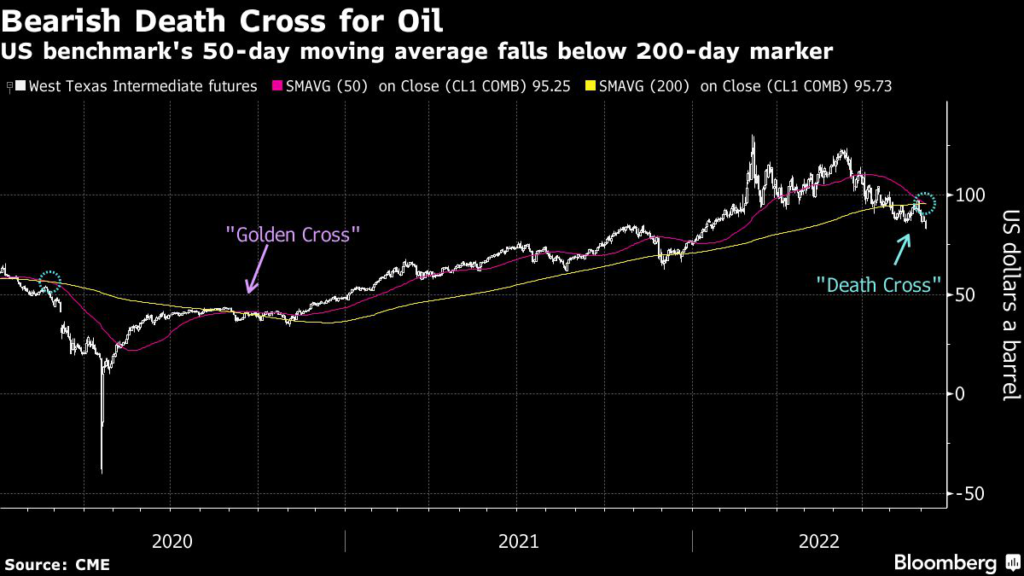
Meantime, Wednesday’s plunge in crude was exacerbated by a bearish technical picture. The US oil benchmark formed a so-called death cross for the first time since February 2020, a pattern in which the 50-day moving average falls below its 200-day marker. Such a crossover typically signals a loss of short-term momentum and further selling pressure ahead.
What to watch this week:
- European Central Bank rate decision, Thursday
- Fed Chair Jerome Powell due to speak, Thursday
- Chicago Fed President Charles Evans and his Minneapolis counterpart Neel Kashkari due to speak, Thursday
- EU energy ministers extraordinary meeting on emergency intervention in electricity markets, Friday
Are you bullish on energy-related assets? This week’s MLIV Pulse survey focuses on energy and commodities. Please click here to participate anonymously.
Some of the main moves in markets:
Stocks
- The S&P 500 rose 1.5% as of 1:46 p.m. New York time
- The Nasdaq 100 rose 1.6%
- The Dow Jones Industrial Average rose 1.2%
- The MSCI World index rose 0.8%
Currencies
- The Bloomberg Dollar Spot Index fell 0.3%
- The euro rose 0.9% to $0.9998
- The British pound was unchanged at $1.1520
- The Japanese yen fell 0.7% to 143.87 per dollar
Bonds
- The yield on 10-year Treasuries declined nine basis points to 3.26%
- Germany’s 10-year yield declined six basis points to 1.58%
- Britain’s 10-year yield declined seven basis points to 3.03%
Commodities
- West Texas Intermediate crude fell 5% to $82.51 a barrel
- Gold futures rose 1% to $1,729.90 an ounce
More stories like this are available on bloomberg.com
©2022 Bloomberg L.P.