
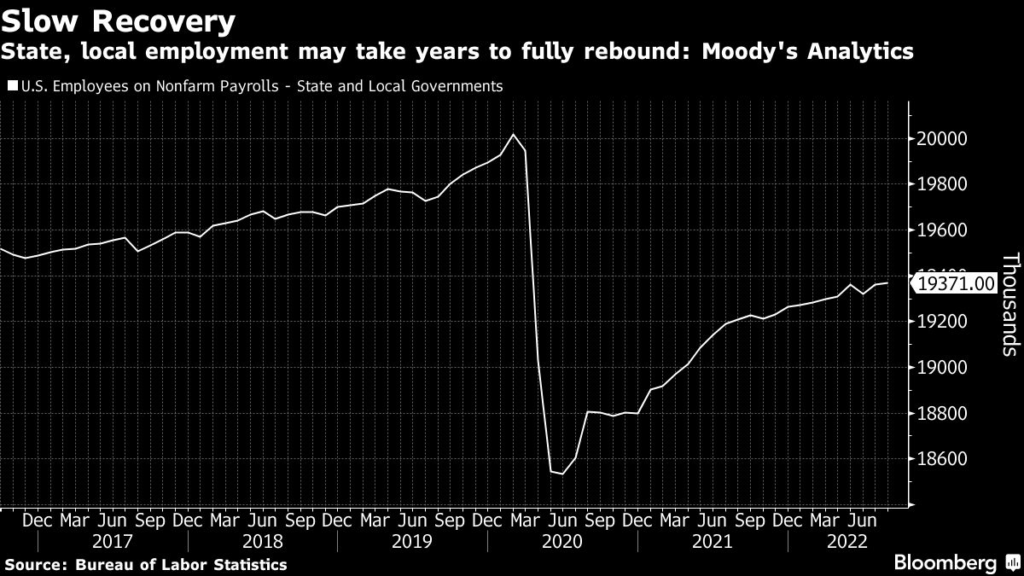
The sluggish recovery in US state and city employment has left payrolls hundreds of thousands of positions below pre-pandemic levels, a deficit that may take years to plug as the private sector lures away workers.
(Bloomberg) — The sluggish recovery in US state and city employment has left payrolls hundreds of thousands of positions below pre-pandemic levels, a deficit that may take years to plug as the private sector lures away workers.
State and local payrolls rose to about 19.4 million last month, the highest since March 2020, according to Bureau of Labor Statistics data released Friday. However, that’s still roughly 650,000 less than the peak from right before Covid-19 struck, even after states and municipalities received hundreds of billions of dollars in federal stimulus to ease the pandemic’s blow.
It may take until 2026 to recoup that early 2020 level, according to Emily Mandel, an economist at Moody’s Analytics. She attributes the slow rebound in part to a wave of retirements and pandemic-fueled burnouts, particularly in education. She also pointed to the robust private-sector job market, which has made hiring even more difficult.
“Governments are definitely trying to hire — you can see that in the openings data,” Mandel said. “Because the private sector rebounded so quickly and competition for labor heated up so fast in the private sector, it’s been really difficult for the public sector to compete for these workers.”
900,000 Vacancies
There were more than 900,000 job openings at the state and local level as of July, according to Bureau of Labor Statistics data. Across the economy, job vacancies have exceeded 11 million positions since late last year.
The nation’s jobless rate rose to a six-month high of 3.7% last month, the first jump since January, as the participation rate climbed. The still-low level bolstered expectations that the Federal Reserve will keep lifting interest rates to combat rampant inflation.
For Elise Gould at the Economic Policy Institute, part of the challenge for local governments involves raising the appeal of public-sector employment, whether it’s by enhancing benefits, improving working conditions or boosting salaries.
Granted, thanks to federal pandemic aid, the picture is brighter for states and cities than it was after the 2007-2009 recession, when it took over a decade for the sector to bounce back.
Read More: A $15 Minimum Wage for State Workers Gets Unlikely GOP Backers
But some economists see that federal relief as a band-aid solution, especially in the public-education sector — doing little to fill teacher vacancies in school districts around the country.
“The problem with using the stimulus funds for hiring, salaries or raises is that these are one-time funds,” Mandel said. “If you take these one-time funds and put them toward something that is still going to incur costs down the road after the funds are exhausted, that can put governments in a bit of a tight spot.”
More stories like this are available on bloomberg.com
©2022 Bloomberg L.P.