
Investors in UK mid-cap stocks cheered Prime Minister Liz Truss’s plan to freeze energy bills for British households. However, any relief provided for sectors such as hospitality, shops and construction that have slumped this year on the worsening macro backdrop may prove fleeting.
(Bloomberg) — Investors in UK mid-cap stocks cheered Prime Minister Liz Truss’s plan to freeze energy bills for British households. However, any relief provided for sectors such as hospitality, shops and construction that have slumped this year on the worsening macro backdrop may prove fleeting.
Stocks from retailer Marks & Spencer Group Plc to Greggs Plc, a seller of lunch snacks such as sausage rolls, jumped today. The bet is that Britons will be able to afford to pay for living costs this winter if the government acts to avert massive increases in energy bills. The FTSE 250 rose as much as 1.6% earlier, compared to a gain of as much as 0.5% for the larger FTSE 100 benchmark.
But freezing energy bills may only make a small dent in surging living costs as real wages struggle to keep up. Retail sales growth slowed last month as shoppers tightened their purse strings, while parents curbed their back-to-school spending. One business lobby group has suggested the UK is already in the midst of a recession.
Investors in the stock market can see that. The mid-cap gauge is far more influenced by domestic factors than the commodity-heavy FTSE 100. This year, the FTSE 250 is down some 20%, heading for its worst year in well over a decade, compared to a modest drop of about 1% in the FTSE 100.
Meanwhile, the ratio of UK domestic to large-cap stocks is approaching pandemic lows as investor sentiment toward the country’s assets has soured. The FTSE 250 is likely to keep underperforming the FTSE 100 as the UK grapples with an uncertain outlook even if energy aid plans give a temporary boost.
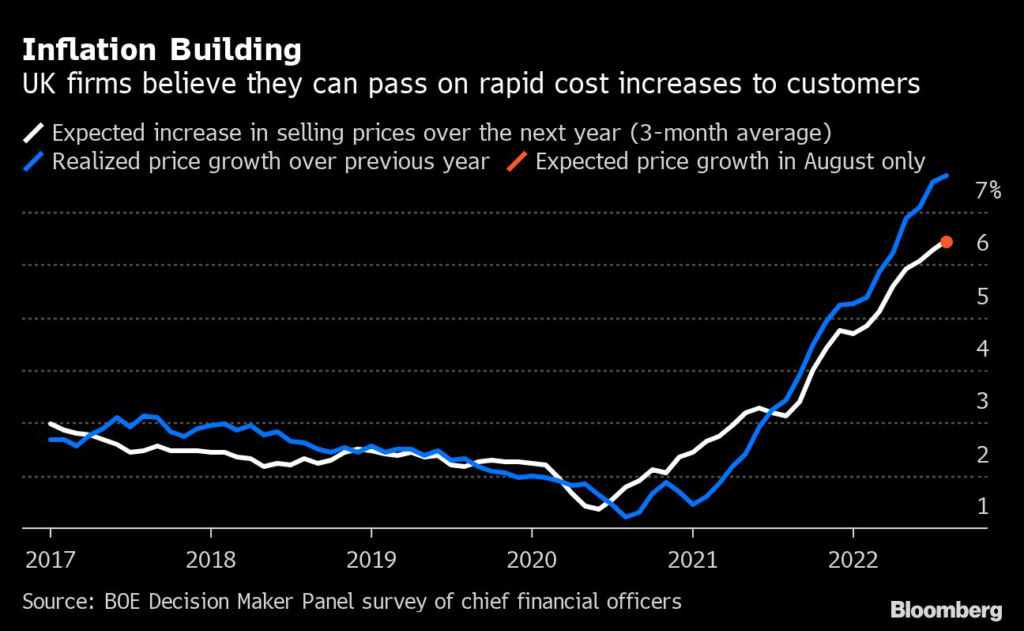
Some businesses have recently been getting total annual energy cost quotes that exceed current bills by more than ten times. Those in the hospitality industry, for instance, have little choice but to pass much of those extra costs to consumers if they’re going to survive. With quotes for energy bills of this size, it’s hard to see how UK inflation can peak anytime soon. Current energy price caps do not apply to businesses in the UK, though some relief might be in store from Truss’s plans for an energy aid package.
And it isn’t just about inflation. The level of overall business uncertainty remains high, according to the Bank of England’s Decision Maker Panel survey conducted in August.
A potential savior in the short term could be a well-rounded fiscal plan that provides immediate relief to businesses. But the cost of Truss’s proposed energy price freeze for UK households risks running out of control.
The pound pared earlier gains against the dollar, but still outperformed G-10 FX peers. The yield on 10-year UK government bonds soared past 3% to the highest since 2011, as long-dated issuance extended declines. Meanwhile, short-end bond yields retreated to 3.19%.
The problem is that fiscal and monetary policies typically work hand in hand. This time, should fiscal support materialize, it’ll come at a time when the central bank is committed to raising rates aggressively to tackle inflation.
BOE policy maker Catherine Mann, an advocate of front-loading rate hikes, reiterated on Monday that the bank needs to act forcefully now to contain inflation. Either way, a response lag to policy would apply here and domestic stocks could see the short end of the stick in the meantime.
The fact is that UK markets look in pretty dismal shape as Truss takes office. The FTSE 250 is no exception, and has a lot of ground to make up. Valuations and profit expectations are less attractive than the FTSE 100 and European peers.
- NOTE: Nour Al Ali and Heather Burke write for Bloomberg’s Markets Live. The observations are their own and not intended as investment advice. For more markets commentary, see the MLIV blog.
More stories like this are available on bloomberg.com
©2022 Bloomberg L.P.