
The euro slipped ahead of a likely weak start for Asian bourses on Monday as a worsening energy crisis in Europe stokes concerns about the global economic outlook.
(Bloomberg) — The euro slipped ahead of a likely weak start for Asian bourses on Monday as a worsening energy crisis in Europe stokes concerns about the global economic outlook.
Futures fell for Japan, Australia and Hong Kong, while US contracts fluctuated after the worst week for world shares since a June drop to bear market lows.
More dollar strength was evident in Asian, with commodity-linked currencies and the British pound joining the euro’s retreat.
Gazprom PJSC last week again halted its key European gas pipeline indefinitely after Group of Seven leaders agreed to implement a price cap on Russian oil as the Kremlin continues its war in Ukraine.
European ministers will discuss special measures to rein in soaring power costs, from gas-price caps to a suspension of power derivatives trading. Germany — most affected by the Nord Stream pipeline cutoff — has unveiled a $65 billion package to protect consumers.
There’s no cash Treasuries trading because of the Labor Day break, which also shutters the US stock market. Bonds rose in Australia and New Zealand. Crude jumped past $88 a barrel ahead of an OPEC+ meeting on supply and as traders weighed the latest energy-sector twists.
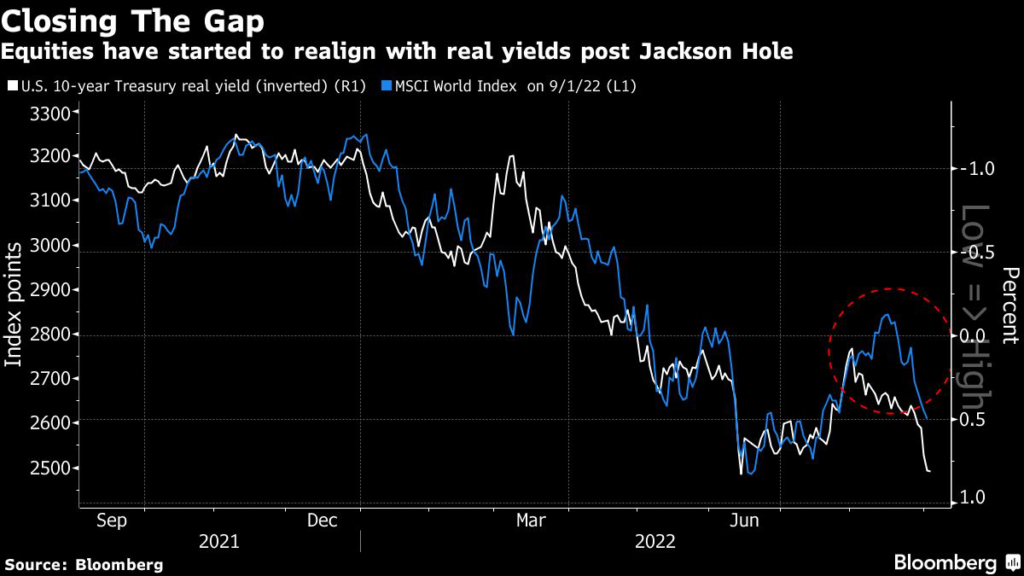
Monetary authorities including Europe’s central bank are set to keep hiking interest rates this week to fight inflation despite a darkening global economic outlook due to risks such as natural gas shortages and China’s Covid curbs. An attendant advance in real yields — seen as the true cost of money for borrowers — poses an obstacle to a variety of risk assets.
“Russia’s response to the G7’s plan to apply price caps on Russian oil imports was to shut off the Nord Stream 1 pipeline and we’re at the point where lots of questions are being asked by the market on how this escalates and right now there is minimal clarity,” Chris Weston, Pepperstone Group Ltd. head of research, wrote in a note.
Markets also face more uncertainty from US-China tension — the Biden administration is considering moves to curb US investment in Chinese technology firms and will allow Trump-era merchandise import tariffs to continue while they are reviewed.
China extended its lockdown in districts of the megacity Chengdu and ordered more mass testing there as it tries to contain a Covid outbreak.
Elsewhere, Bitcoin retook the $20,000 level and gold edged lower.
Some of the main moves in markets:
Stocks
- S&P 500 futures rose 0.2% as of 8:51 a.m. in Tokyo. The S&P 500 fell 1.1%
- Nasdaq 100 futures added 0.1%. The Nasdaq 100 fell 1.4%
- Nikkei 225 futures fell 0.5%
- Australia’s S&P/ASX 200 Index futures were steady
- Hang Seng Index futures lost 0.6%
Currencies
- The Bloomberg Dollar Spot Index rose 0.2%
- The euro fell 0.4% to $0.9913
- The Japanese yen fell 0.2% to 140.48 per dollar
- The offshore yuan fell 0.1% to 6.9205 per dollar
Bonds
- The yield on 10-year Treasuries declined six basis points to 3.19% on Friday
Commodities
- West Texas Intermediate crude rose 1.6% to $88.25 a barrel
- Gold was at $1,708.83 an ounce, down 0.2%
More stories like this are available on bloomberg.com
©2022 Bloomberg L.P.