
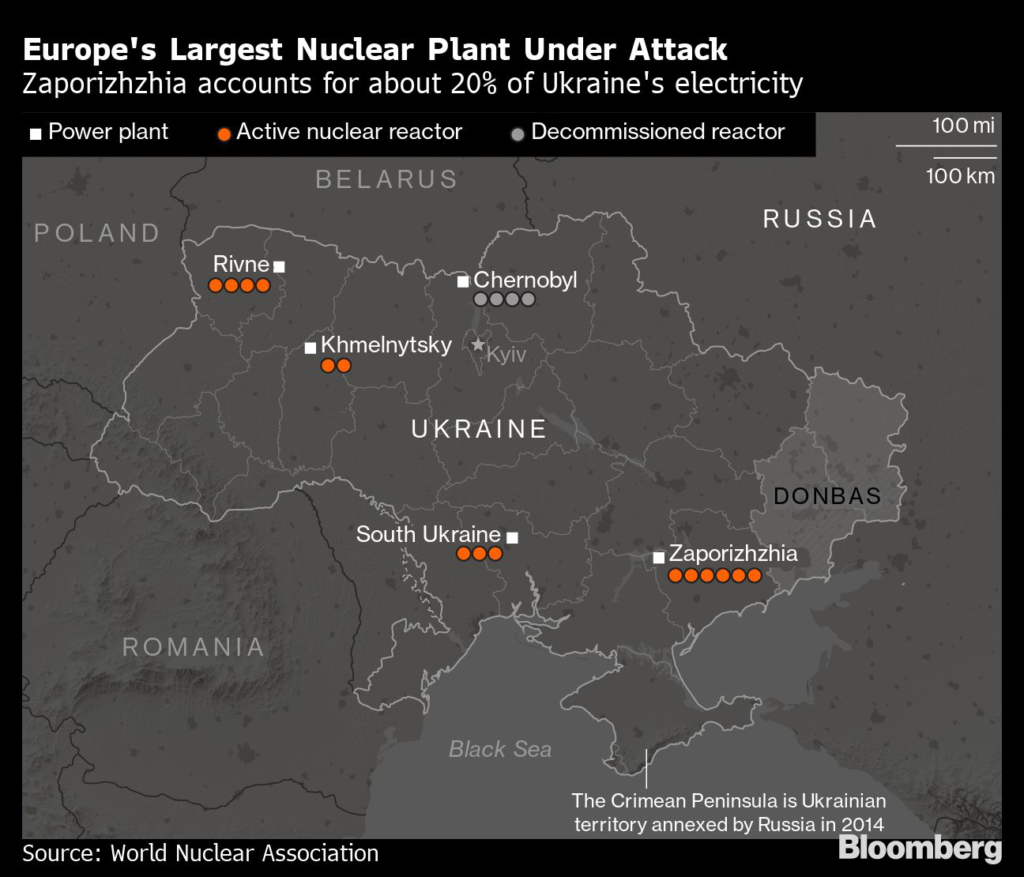
The UN nuclear agency’s convoy arrived at the Zaporizhzhia atomic power plant in southeast Ukraine, the International Atomic Energy Agency said on Twitter. The facility has become a focus of the six-month-old war after its occupation and use by Moscow’s troops as a military base, stoking international alarm over a potential nuclear accident.
(Bloomberg) — The UN nuclear agency’s convoy arrived at the Zaporizhzhia atomic power plant in southeast Ukraine, the International Atomic Energy Agency said on Twitter. The facility has become a focus of the six-month-old war after its occupation and use by Moscow’s troops as a military base, stoking international alarm over a potential nuclear accident.
Rafael Grossi, the IAEA’s director general, left the plant for the night, according a statement from Energoatom, the state company the manages Ukraine’s nuclear facilities. Five other mission members remained behind. Russia and Ukraine traded blame on shelling in the nearby Energodar area.
Russia is considering a plan to buy as much as $70 billion in yuan and other “friendly” currencies this year to slow the ruble’s surge. Meanwhile, Europe is considering various measures to intervene in energy markets rocked by Russia’s invasion of Ukraine.
(See RSAN on the Bloomberg Terminal for the Russian Sanctions Dashboard.)
Key Developments
- UN Inspectors Arrive At Ukraine Nuclear Plant Amid Fighting
- One of Russia’s Original Investment Bankers Gives Up Passport
- Russia Mulls Big Purchases of ‘Friendly’ FX to Stem Ruble’s Rise
- Russia Points Conspiracy-Theory Factory at New Audience
- Putin, Who Mourned USSR Loss, Offers Gorbachev Faint Praise
- Europe Considers Energy Price Cap, Windfall Tax Amid Russia Risk
On the Ground
Ukraine’s air force conducted a number of strikes against Russian troops using jets, helicopters and drones this week, Oleksiy Hromov, a spokesman for the Ukrainian armed forces, said at a briefing. Most of the Ukrainian air attacks were aimed at Russian targets in the country’s south, including command posts, munitions and fuel depots, and air defense systems. Meanwhile, the situation in the Russian-occupied region of Kherson remains difficult because of heavy fighting, regional authorities said on their website. According to the UK’s latest intelligence update, Ukrainian forces have pushed the front line back some distance in places, exploiting relatively thinly held Russian defenses.
(All times CET)
Ransomware Attack Has Montenegro Reaching Out to NATO Partners (5 p.m.)
Montenegro is getting support from US and other allies in fending off cyberattacks against its information systems and electronic services at a time of political turmoil.
Dusan Polovic, Montenegro’s cybersecurity chief didn’t name Russia as the culprit, but state broadcaster RTCG cited sources at the Balkan nation’s security agency, ANB, as saying that Russia was behind the attack, prompting the government to ask US and other NATO allies for protection.
Read more: Ransomware Attack Sends Montenegro Reaching Out to NATO Partners
Ukraine’s Winter Grain Planting May Drop by Half (4:30 p.m.)
Ukraine’s planted areas for winter grains may fall by half this year after the Russian invasion deprived farmers of land, equipment and cash, according to the Ukrainian Agri Council lobby group.
Lithuania Pursues Regional Plan to Reduce Russian Visitors (3 p.m.)
Lithuanian Foreign Minister Gabrielius Landsbergis said that five countries bordering Russia will aim to have a solution on how to reduce the number of the Russian tourists entering by land in the coming weeks.
“A visa doesn’t automatically mean a permission” of entry, Landsbergis told reporters in Vilnius. “The decision is made by border guards.”
Officials from Finland, Estonia, Latvia, Lithuania and Poland will meet next week to devise a regional mechanism to handle some 12 million Russians who currently hold a Schengen visa, Landsbergis said. Among the potential measures could be additional questions at the border crossings or allowing entry only to certain groups such as diplomats or for humanitarian purposes.
Read more: EU Members Back Tougher Visa Rules for Russian Tourists
Macron Pitches Diplomats on New Coalitions (2:45 p.m.)
Emmanuel Macron wants to build a new coalition of countries to help end the war in Ukraine, he told ambassadors during his annual speech to diplomats at the presidential palace.
“We must progressively build more coalitions, even imperfect, even incomplete,” the French president said. He cited China, India, South Africa, Algeria, Senegal, Indonesia and Ethiopia as potential partners who could side with Europe to avoid an expansion of the war that would oppose “the West against the rest.”
He suggested focusing diplomatic efforts on countries that abstained during UN votes in the spring, and to help their agriculture sectors to shield them from the rising food prices. Outreach to build coalitions is likely to happen before leaders attend the Group of 20 summit gathering the world’s largest economies in November in Bali, diplomats who watched the speech said.
Russian Air Attacks Have Decreased, Ukraine Says (2:30 p.m.)
Russia has reduced its use of air force with Ukraine’s airspace, Ukrainian State Border Guard Service officer Leonyd Baran said during a briefing.
The number of Russian air raids launched from inside Ukraine declined to 5 in August from 19 in July, he said. Ukraine has “effectively reduced to zero” the number of piloted military jets from Russia entering its territory, he added.
Russia also regularly fires missiles at targets inside Ukraine from its own airspace, as well as from Belarus, without entering Ukrainian airspace.
Ukraine Blames Russia for $26 Billion in Environmental Damage (2 p.m.)
Russian invasion caused $26 billion in damage to Ukraine’s environment and natural resources, Ukraine’s environment minister, Ruslan Strilets, said at the briefing.
“The ministry has transferred more than 300 cases to law enforcement agencies for investigation and now continues to record all the losses in order to claim compensation from the Russian Federation through international courts,” Strilets said, adding that the largest losses are caused by burning of oil products, forest fires and rocket explosions.
Europe’s Sanctions Keep Gazprom From Meeting Obligations: Kremlin (1:15 p.m.)
European sanctions have created “a tangle of problems” for Gazprom to fulfill its obligations, Kremlin spokesman Dmitry Peskov tells reporters on the conference call.
“Gazprom is ready and wants to continue fulfilling its obligations, but the European side has created legal and technological hurdles that don’t allow Gazprom to work,” he said. There have been snags over repairs of Siemens turbines used in the pipeline.
Lukoil Chairman Dies After Fall From Hospital Window (12 p.m.)
Ravil Maganov, the chairman of Lukoil PJSC, died after falling from a window in a Moscow hospital, according to Russian media reports.
Lukoil was the only Russian oil producer to call for a “fast resolution of the military conflict” in Ukraine early March, just after Moscow’s invasion of its neighbor entered its second week. Maganov passed away following “a severe illness,” the company said in a statement.
Maganov committed suicide, Tass news agency said Thursday, citing an unidentified law enforcement official with knowledge of the matter. The 67-year old was in a hospital after a heart attack and was also taking antidepressant drugs, the report said.
Russia Mulls Buying $70 Billion in Yuan, ‘Friendly’ Currencies (10:20 a.m.)
Russia is considering a plan to buy as much as $70 billion in yuan and other “friendly” currencies this year to slow the ruble’s surge, before shifting to a longer-term strategy of selling its holdings of the Chinese currency to fund investment.
The proposal is among a slew of measures that would amount to an effective repudiation of more than a decade of economic policy as the Kremlin overhauls its strategy amid sweeping sanctions imposed by the US and its allies over Vladimir Putin’s invasion of Ukraine.
Europe Considers Energy Price Cap, Windfall Tax (10:02 a.m.)
Europe is considering various measures to intervene in the energy market, including price caps, reducing power demand and windfall taxes on energy companies as surging prices threaten the economy and push more households toward poverty.
The bloc’s energy ministers are due to discuss how to respond to the crisis at an emergency meeting next week. More and more governments are demanding a tool to limit the spike in electricity prices, though views on how it should be designed vary.
Europe Considers Energy Price Cap, Windfall Tax Amid Russia Risk
IAEA Chief Says ‘We’re Not Stopping’ as Monitors Head for Plant (8:22 a.m.)
UN atomic inspectors vowed to press on to the Russian-occupied Zaporizhzhia nuclear power plant in southeastern Ukraine despite shelling in adjacent areas.
“There has been increased military activity, including this morning,” IAEA chief Rafael Grossi said Thursday morning in the city of Zaporizhzhia, still a few hours away from the plant. “But weighing the pros and cons and having come so far we are not stopping.” The convoy departed the city around 7:15 a.m. CET, AFP reported.
Russian and Ukrainian officials traded blame on Thursday’s shelling near Energodar, The IAEA convoy, which traveled from Kyiv on Wednesday, must cross a so-called gray zone, where the last line of Ukrainian defense ends before the first line of Russian occupying forces begins.
Ukraine Looks to Degrade Russia’s ‘Situational Awareness,’ UK Says (7:33 a.m.)
Ukraine’s armed forces continued offensive operations in the south of the country Tuesday and Wednesday, with “intensive long-range strikes against Russian command and logistics locations across the occupied zone,” the UK defense ministry said in an update.
Russia’s military “prioritizes strong ground-based air defences — the radar coverage which enables this is a critical capability in its Ukraine operation,” the UK said, underlining the importance of the week’s action.
Solutions Sought to Reduce Russian Tourist Flow (7:49 p.m.)
The Baltic states will aim to impose regional restrictions for Russian visitors entering the European Union by land, as will Poland and Finland, according to two EU diplomats who spoke on condition of anonymity. Officials from these countries intend to meet and discuss the measures as soon as next week, the diplomats said.
The countries “will aim to find solutions in coming weeks that would allow to significantly reduce the flows of the Russian tourists,” Lithuanian Foreign Minister Gabrielius Landsbergis said in a statement.
Ukraine’s Forces Restrict Russian Moves: NATO Official (7:44 p.m.)
Recent action by Ukrainian forces in the south of the country has affected Russia’s ability to move north and south across the Dnipro River, but it’s not yet possible to confirm the extent of the Ukrainian advances, a senior NATO official said.
Ukrainian troops have conducted focused strikes on lines of communication, bridges and railroads, targeting components the Russians would need to provide additional forces to join those that moved into the western Kherson region to be the front line of defense, said the official, who asked not to be identified discussing the military situation.
Russian supply lines are being disrupted, if not severely challenged, as a result of the stepped-up Ukrainian operations, the official said.
More stories like this are available on bloomberg.com
©2022 Bloomberg L.P.