
South Korean inflation eased more than expected in August, reducing pressure on the central bank to deliver another outsized interest-rate increase as its yearlong tightening cycle begins to pay dividends.
(Bloomberg) — South Korean inflation eased more than expected in August, reducing pressure on the central bank to deliver another outsized interest-rate increase as its yearlong tightening cycle begins to pay dividends.
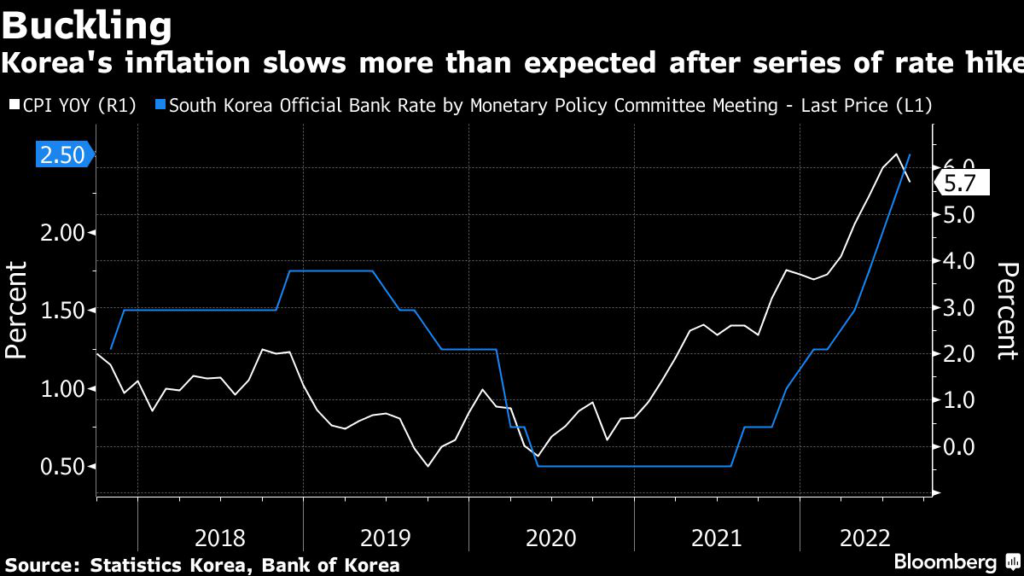
Consumer prices advanced 5.7% from a year earlier, slowing from July’s pace of 6.3% and coming in below economists’ estimate of 6.1%, statistics office data showed Friday. From the prior month, prices actually fell 0.1% in August, the first decrease since late 2020.
While the global inflationary impulse remains strong, energy and food prices have recently declined from very high levels. Korea had been expecting inflation to peak around October.
Price gains in Korea have been led this year by a burst of consumer demand directed at dining and travel after Covid regulations were relaxed and a series of extra budgets spurred business activity.
Bank of Korea Governor Rhee Chang-yong said at Jackson Hole last weekend that he would prioritize price concerns if inflation stayed elevated more than expected. He was among central bankers joining the Federal Reserve in reaffirming a willingness to keep focused on inflation over growth concerns.
Inflation has also put upward pressure on wages in Korea at a time when Russia’s prolonged war on Ukraine is keeping raw materials prices high. The won hovering around a 13-year-low has also made it more expensive to import energy, food and other items that the trade-reliant country needs.
Korea’s trade deficit came in at a record $9.5 billion in August, while export growth slowed further. Imports of energy and commodities required to assemble semiconductors and other key exports hit a record high, the trade ministry said Thursday.
The hawkish signals from Jackson Hole have prompted Citigroup Inc. and Goldman Sachs Group Inc. to raise their forecast year-end BOK rate to 3% from 2.75%.
The BOK has meetings in October and November remaining this year and its rate currently stands at 2.5%.
Today’s report also showed:
- Korea’s core inflation came in at 4.4% from a year earlier, slightly below economists 4.5% estimate
(Adds chart, more details.)
More stories like this are available on bloomberg.com
©2022 Bloomberg L.P.