
The post-Jackson Hole global debt rout has renewed scrutiny on funds betting against Japanese government bonds, though this time some expect fewer fireworks than the market saw in June.
(Bloomberg) — The post-Jackson Hole global debt rout has renewed scrutiny on funds betting against Japanese government bonds, though this time some expect fewer fireworks than the market saw in June.
AllianceBernstein Holding LP and GAMA Asset Management join a cohort of fund titans that are short or underweight JGBs on bets the Bank of Japan will have to loosen its iron-clad grip on yields as soaring inflation hammers bonds everywhere. Local investors have a different take: you can attempt to beat the BOJ, but it’s called the ‘widow-maker’ trade for a reason — no one has succeeded yet and they likely won’t now.
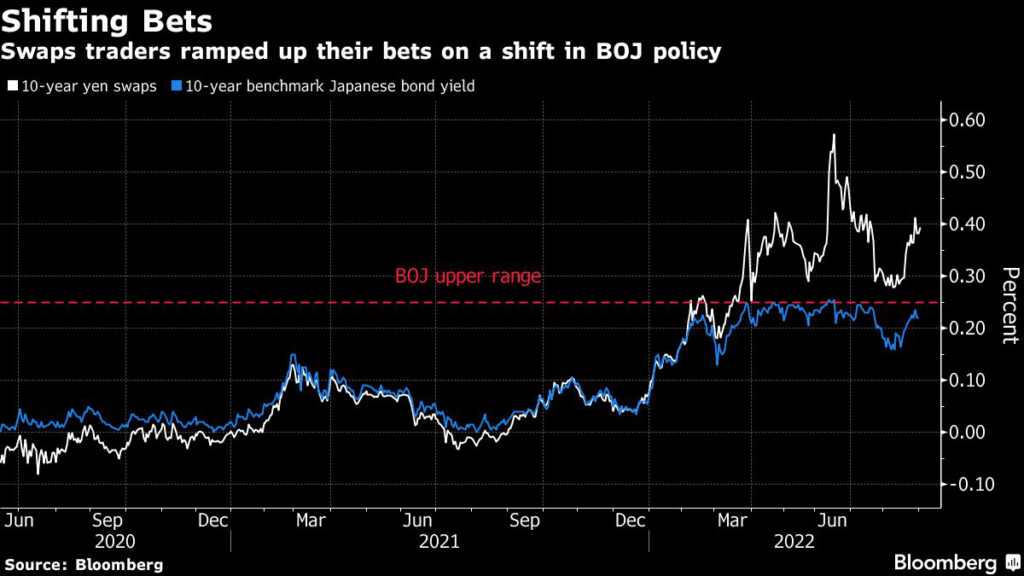
That’s not stopping global funds from trying. Japan’s 10-year yields — those targeted by the central bank under its curve control policy — have risen toward its 0.25% ceiling this week and are threatening to dart higher by the day as peers rise around the world. With bets of higher US interest rates mounting and the yen slumping to fresh lows, pressure is building on the BOJ to wrestle the bond vigilantes once more.
“The interest rate differentials, potential for imported inflationary pressures to begin to rise with a much weaker yen — they’re going to have to force the BOJ’s hand eventually,” said Brad Gibson, co-head of Asia Pacific fixed income at AB, who is underweight Japanese bonds. “That’s probably now in our minds going to happen sooner rather than later.”
Speculative Attacks
Japan’s sovereign bond market — the world’s second largest — has beaten back speculative attacks already this year as traders bet in June that heated global price growth would force the BOJ to tweak policy. But a series of unprecedented asset purchases coupled with fears of a global recession pushed yields lower for a time and the BOJ stood doggedly by its policy of rock-bottom interest rates and benchmark yield cap.
Now 10-year yen swap rates — which are popular with international funds — are creeping higher again. They were almost 15 basis points above the BOJ’s 0.25% line in the sand on Thursday, a sign that at least some traders are betting that Japanese authorities will be forced to capitulate, though not to the degree seen earlier this summer when swaps neared 0.60%.
“There’s a probability that the BOJ does something to tweak yield-curve control at some stage,” said Rajeev de Mello, global macro portfolio manager at GAMA Asset Management in Geneva, who has shorted JGBs since May. “The risk reward is not bad being short JGBs.”
Tokyo Bulls
In the bull corner are some of Japan’s biggest funds.
BOJ Governor Haruhiko Kuroda has repeatedly called for ultra-loose monetary policy to combat deflationary forces in the third-biggest economy. At the recent Jackson Hole symposium, he said he had “no choice” but to keep easing monetary policy as inflation will turn lower in Japan this year or the next.
As Kuroda sticks with his dovish messaging, Sumitomo Mitsui DS Asset Management Co.’s Shinji Kunibe reckons any fresh attempts to bet against the BOJ are unlikely to be successful.
“In June, there were some doubts even among Japanese about the BOJ’s stance, but it is now crystal clear,” said the firm’s head of its global fixed-income group in Tokyo. “This time, the impact of foreigners shorting JGBs won’t be as strong as domestic buyers aren’t seen joining their selling.”
Bond market volatility may not rise until closer to the end of Governor Kuroda’s term, Kunibe added.
Yen Complication
Complicating matters for Kuroda is the renewed slide in the yen, as Japan’s yield gap with foreign peers widens. The currency hit a fresh 24-year low Thursday and breached the closely-watched 140 per dollar level that is reigniting chatter on the likelihood officials will intervene to support it.
The currency’s slide is helping fuel Japan’s inflation, leading companies and households to complain about elevated prices. A tweak to yield-curve control — such as raising the ceiling for the benchmark yield — would likely strengthen the yen and relieve some of that pressure.
But economists largely expect the BOJ to stick with its current monetary easing program until Kuroda’s term expires in April even if it causes further currency weakness. The governor insists that he must see larger wage increases before he can accept that recent inflation levels above his 2% target are sustainable.
BOJ Patience
One factor likely to play in the BOJ’s favor is the risk that over-aggressive US rate hikes cause a recession and a pull back in yields. Options markets are still pricing in more than one 25 basis point Fed rate cut next year.
US inflation should also peak out this year or early 2023, which could lead to such cuts and ease pressure on bond markets, said Hachidai Ueda, senior investment specialist, fixed income at abrdn. With less upward pressure on Japanese rates and downward pressure on the yen, “it should increase the likelihood of the BOJ keeping yield-curve control.”
For fund managers like Tadashi Matsukawa of PineBridge Investments Japan Co., it’s also far safer to stick with the side of the central bank you know than the bet you don’t.
“I am just steadily buying the 10-year when its yield comes to 0.25%,” he said. “Kuroda said in Jackson Hole that there would be no change in monetary policy, and we are just doing trades based on what he said.”
More stories like this are available on bloomberg.com
©2022 Bloomberg L.P.