
(Bloomberg) — Russian Foreign Minister Sergei Lavrov and U.S. Secretary of State Antony Blinken will speak by phone Tuesday as diplomatic efforts continue to reduce tensions over Ukraine, with the United Nations Security Council separately rejecting a bid by Moscow to block a public debate on the crisis.
The diplomatic flurry is running alongside a push by the U.S. and European Union to soon finalize a package of potential Russian sanctions, while the U.K. is looking at targeting “any company or individual of direct interest to the Russian state” if Moscow were to invade Ukraine.
Russia further boosted troop levels around the Ukrainian border over the weekend, according to the Pentagon. It has been moving forces also to Belarus for drills next month. Russia has repeatedly denied it plans to attack Ukraine.
Key Developments:
- What We Know So Far About Potential U.S.-EU Sanctions on Russia
- Germany’s Social Democrats will discuss its Russia policy in Berlin on Monday
- Where military forces are assembling around Russia and Ukraine
All times CET
UN Security Council Debates Tensions Over Ukraine (16:42 p.m.)
The UN Security Council voted 10-2, with three abstentions, to hold an open hearing on Ukraine. Russia’s envoy, joined by China, sought to prevent the public hearing, calling it an example of America’s “megaphone diplomacy.” Russia and China have worked together at times over the years to block potential Security Council actions and resolutions they deem critical of the other.
U.S. Ambassador Linda Thomas-Greenfield said previous closed-door meetings on the crisis had failed to make progress and it was time for a public hearing, which began soon after the vote.
“This is not about antics,” Thomas-Greenfield said. “It’s not about rhetoric. It’s not about U.S. and Russia. What this is about is the peace and security of one of our member states.”
BP’s Russian Risk is Rising Again (15:42 p.m.)
Of all the international oil majors, BP Plc potentially has the most to lose if the situation in Ukraine sets off a crisis between Russia and the West, as this story lays out. The London-based firm owns around a fifth of Rosneft PJSC, the state-controlled energy giant run by a close ally of President Vladimir Putin.
The corporate relationship, which already sits uneasily alongside BP’s plans for net-zero carbon, could become untenable if a Russian invasion of Ukraine resulted in hefty economic sanctions. Still, BP’s exposure may also be mitigated by the fact most European nations have an even greater dependence on the country.
U.K.’s Johnson Plans Putin Call Later on Monday (13:35 p.m.)
“Our aim is to continue to encourage Russia to take a diplomatic path to de-escalate and to step back from what could be a very costly exercise if they were to follow the path of further aggression,” U.K. Prime Ministers Boris Johnson’s spokesman, Max Blain, told reporters. Other leaders have also reached out to Putin recently, including French President Emmanuel Macron, who spoke to the Russian president last week.
Johnson’s effort comes as he’s battling on the domestic front for his political future after weeks of allegations of rule-breaking parties in Downing Street during the Covid-19 lockdowns of the past two years.
Poland Offers to Supply Defense Munitions (12:30 p.m.)
The government in Warsaw may decide within days to send Ukraine “tens of thousands” of pieces of munitions, including for anti-aircraft defense, the head of Poland’s national security office, Pawel Soloch, told reporters on Monday.
Poland is also ready to provide humanitarian aid in an event of an invasion, Soloch said, a day before Prime Minister Mateusz Morawiecki travels to Kyiv.
Several European countries have pledged to supply Ukraine with defense equipment, but NATO has made clear it would not send troops in. Lithuania and Latvia plan to provide anti-aircraft Stinger missiles and Estonia will send anti-tank Javelin missiles. Germany offered to send 5,000 helmets.
Lavrov, Blinken to Speak by Phone Tuesday (11:57 a.m.)
The two officials are expected to discuss the written responses the U.S. presented last week to Russia’s security demands and potentially agree on further talks, Tass reported. The Kremlin so far hasn’t presented its assessment of the U.S. position.
Lavrov said last week that the responses didn’t address Moscow’s main concerns but included “rational elements on secondary issues.” Russia is seeking further clarification on the U.S. position before deciding on its next steps, Lavrov said Sunday.
Ukraine to Boost Diplomacy to End Crisis (11:30 a.m.)
Ukrainian Foreign Minister Dmytro Kuleba said he expects a flurry of visits from European leaders in the coming days and weeks, including from the U.K., Poland and the Netherlands, as well as Germany, France and Greece.
Kremlin Says U.K. Sanction Threats Alarming (11:20 a.m.)
Reports the U.K. is considering new sanctions on Russian oligarchs’ financial holdings there are “very alarming,” Kremlin spokesman Dmitry Peskov said Monday.
Saying such limits would be “a blatant attack on business,” Peskov noted that many Russian companies also have U.K. partners and shareholders who would be affected by such limits.
U.K. Foreign Secretary Liz Truss said over the weekend the government is looking at targeting “any company or individual of direct interest to the Russian state” and that “there will be nowhere to hide for those who are supporting the Russian regime” in the event of an invasion.
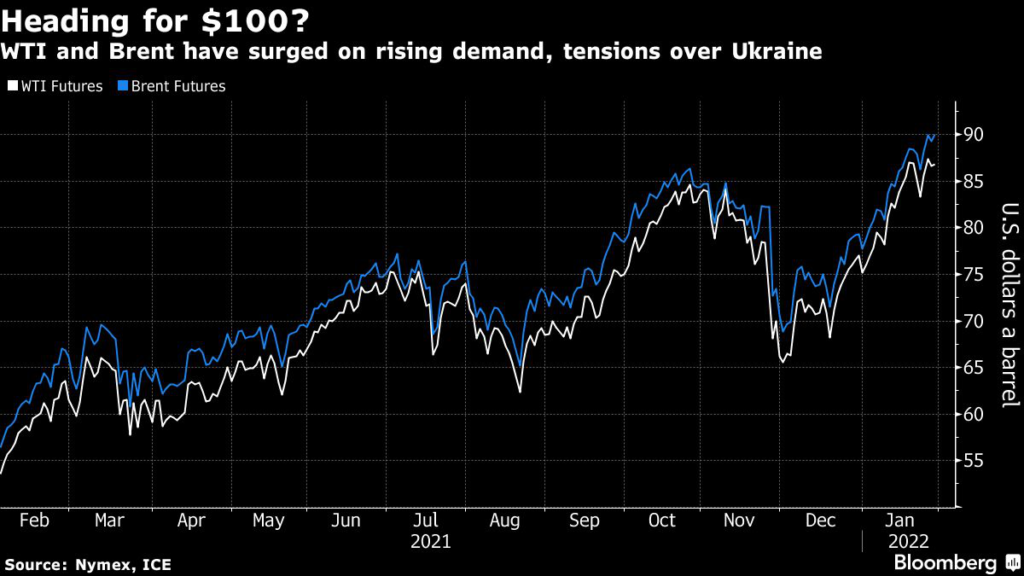
Oil Heads for Best January in Decades (8:30 a.m.)
Brent is on course for its best January performance in at least 30 years.
The global benchmark rose 1.3%, building on a run of six straight weekly gains that saw prices hit the highest level since 2014. West Texas Intermediate advanced to near $88 a barrel after climbing 2% last week.
Scholz’s Party Discusses Russia Policy (7:15 a.m.)
Germany’s Social Democrats — the party of Chancellor Olaf Scholz — will discuss its Russia policy in Berlin on Monday. Co-leader Lars Klingbeil said the talks aim to prevent war in Europe.
Speaking on ARD television, he said Russia is responsible for the escalating tensions and that “all options are on the table” for imposing punitive sanctions if Moscow orders an attack but the focus is on maintaining dialog to prevent military conflict.
He downplayed comments from former Chancellor Gerhard Schroeder — also from the SPD — who said Western politicians were stoking tensions.
More stories like this are available on bloomberg.com
©2022 Bloomberg L.P.