
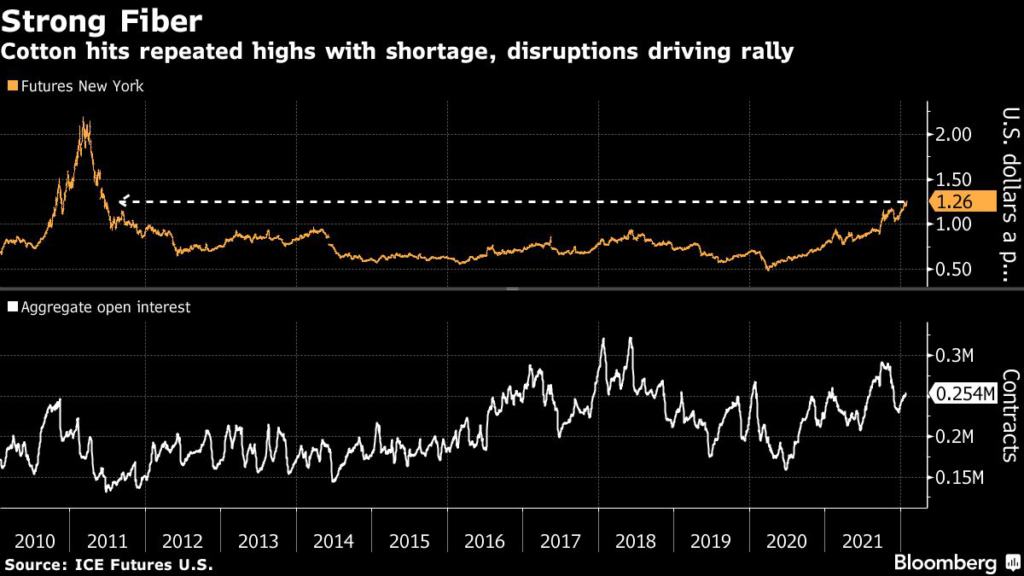
(Bloomberg) — Cotton futures touched a fresh decade high Monday, with a global deficit of the fiber squeezing mills holding huge short positions.
The March contract climbed as much as 2% to $1.2626 a pound in New York, the highest for a most-active contract since June 2011. Its rare premium over May futures has risen 58% this year and is 275 times more than a year ago, showing buyers’ urgency to buy for nearby delivery.
Cotton is up 12% this month, adding to seven straight quarters of gains in the longest quarterly streak since 1959. The higher prices have boosted costs for apparel such as jeans and t-shirts, diapers and even high-demand medical supplies.
U.S. exports sales jumped again in the latest week, paced by Asian buyers including China. Supply disruptions and soaring costs pushed industry to draw on stockpiles, which have practically vanished at ICE Futures U.S., with higher prices unable to lure supplies into the exchange-tracked warehouses.
Demand for yarn, both in the U.S. and around the world, “is simply not being met,” said O.A. Cleveland, a consultant and professor emeritus at Mississippi State University. Domestic spinners are facing a shortage of trucks to move yarn, and that’s been the main impediment in reaching government export projections.
Industry group Cotlook on Friday shifted its global outlook for 2021-22 back to a deficit, the second shortfall in a row, citing diminished production in top exporter U.S. and India. More plantings in the coming season have been put into question by soaring costs for crop inputs including fertilizer.
Meanwhile, mills are holding large short positions as indicated by unfixed call position sales for the marketing year ending July, and they must be bought using options or futures by then.
“It’s extremely bullish,” Cleveland said. “The last time I recall such a situation, I stopped forecasting futures prices once the market reached $1.50 a pound. Will the May or July futures price ascend to such a level? I do not know. This is a no man’s land.”
In other soft commodities, orange juice futures continued to retreat from the highest levels since 2018 even as frost hit groves in Florida on the weekend. U.S. consumption continues to slump, extending a long downward trend that started a couple of decades ago and mitigating any potential losses from the chill.
Orange juice for March slid as much as 4.9% to $1.441 a pound, the lowest since Jan. 10, before regaining some of the losses.
More stories like this are available on bloomberg.com
©2022 Bloomberg L.P.