
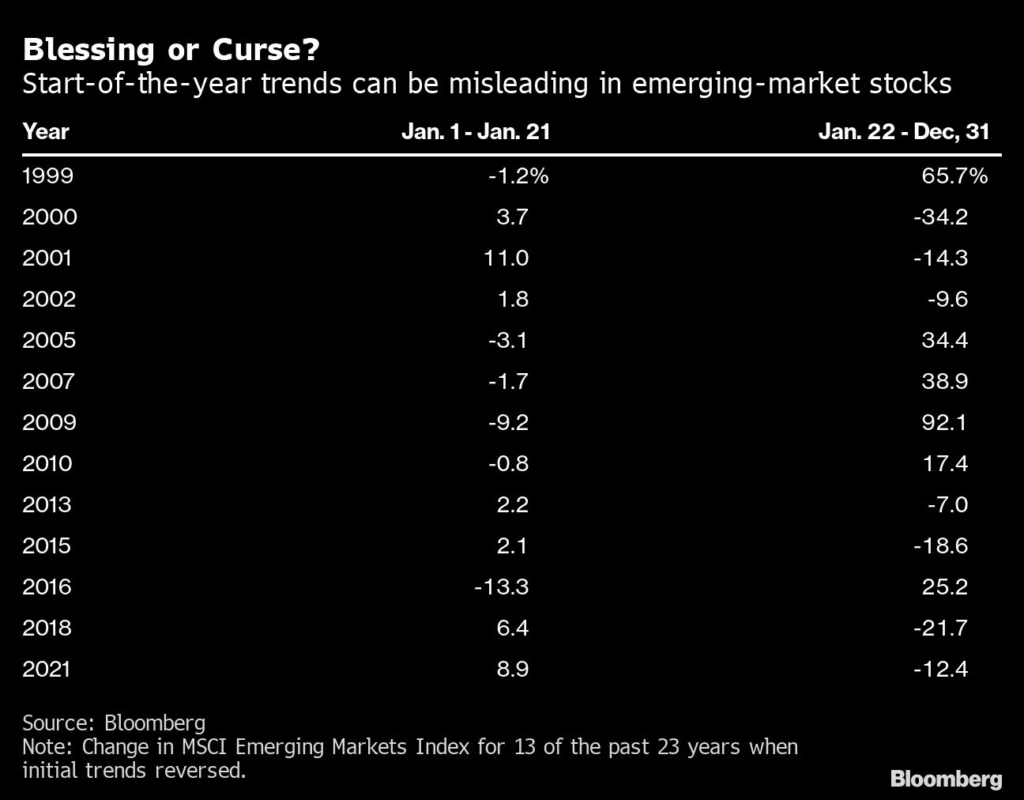
(Bloomberg) — Investors betting emerging-market stocks will best U.S. equities this year have stumbled at the first hurdle.
Traditionally, the fourth week of January is when the market punishes investors who bet the trend in the opening days of the year will continue, and 2022 is proving no exception. Developing-nation equities just had their worst week since August after their strongest showing relative to the S&P 500 Index since 1990 in the previous three weeks.
Aggressive tightening plans at the Federal Reserve and geopolitical tensions over Ukraine have eclipsed robust earnings and cheap valuations, and raise doubts developing nations can end their lost decade versus U.S. equities. With purchasing managers’ indexes due from Russia to India and Brazil this week, investors are looking out for evidence of a speedier economic recovery.
“I don’t believe emerging-market equities will be able to outperform developed markets this year,” said Leonardo Pellandini, a strategist at Bank Julius Baer. “We will need inflation to start wearing off, the economic growth differential against developed markets to widen, and more certainty in China toward its policies and regulations.”
The Fed’s hawkish signal last week “will remain a major headwind for emerging-market performance,” he said.
First 3 Weeks of Year Can Be an Emerging-Market Red Herring
January Flows
The ratio between the MSCI Emerging Markets Index and the U.S. benchmark jumped 9.5% this year through Jan. 21, even as New York-listed technology stocks tumbled. The last time emerging markets showed relative gains on this scale was in 2001 when they heralded a six-year rally.
Investors poured $8.2 billion into emerging-market equities in the week through Jan. 26, according to EPFR Global data cited by Bank of America Corp. The fresh capital ran up against a $1 trillion selloff as tensions over Ukraine swirled and the Fed struck a hawkish note.
U.S. Stocks Lose Out to Emerging Markets by Most Since 1990
The gains could still resume with earnings forecasts near a record high and the valuation discount to U.S. stocks at a whopping 39%. But the period before Fed rate hikes and quantitative tightening will be turbulent, and emerging markets may be a long way from settling.
Gains in the early days of the year have been punctured in the past by the dotcom bust, the taper tantrum, China’s 2015 slowdown, and the U.S.-China trade war in 2018. Last year, investor optimism on the reflation trade in the first three weeks dissipated as the pandemic intensified and growth slowed.
Hunt for Opportunity
To be sure, emerging markets still offer pockets of opportunity.
Latin American stocks are rallying as the region’s political risks ebb, while aggressive rate hikes spur bets for an inflation slowdown. A surge in oil prices has brightening the outlook for energy shares. China’s accommodative stance is boosting optimism in the country’s assets.
“U.S. stocks looked very rich relative to emerging-market stocks at the turn of the year,” said Mitul Kotecha, the chief emerging-market Asia and Europe strategist at TD Securities. “While some of that has corrected over recent weeks, there is scope for a further correction in the months ahead.”
But predicting emerging-market equity performance is a tricky affair, and only a narrative of improving economic data can offset the traditional fourth-week slump.
Wei Li, the global chief investment strategist at BlackRock Inc., is neutral on developing-market equities, preferring their developed-nation peers. Emerging markets face “more challenged restart dynamics,” she said.
Here are some of the major events and data to watch in emerging markets this week:
- India will present the annual budget Tuesday. The country, in the midst of a third wave of the pandemic, faces a stark choice between cutting deficits or alleviating unemployment.
- India, Brazil, Mexico and Indonesia will report purchasing managers’ indexes for January.
- Russia will report its manufacturing PMI amid expectations for a fourth successive month of expansion. Weekly inflation data will give an indication of whether aggressive rate hikes have begun to work.
- Turkey will publish January inflation figures. Loose monetary policy has stoked consumer prices and economists expect the latest report to show no respite, with annual inflation touching 47.55%
More stories like this are available on bloomberg.com
©2022 Bloomberg L.P.