
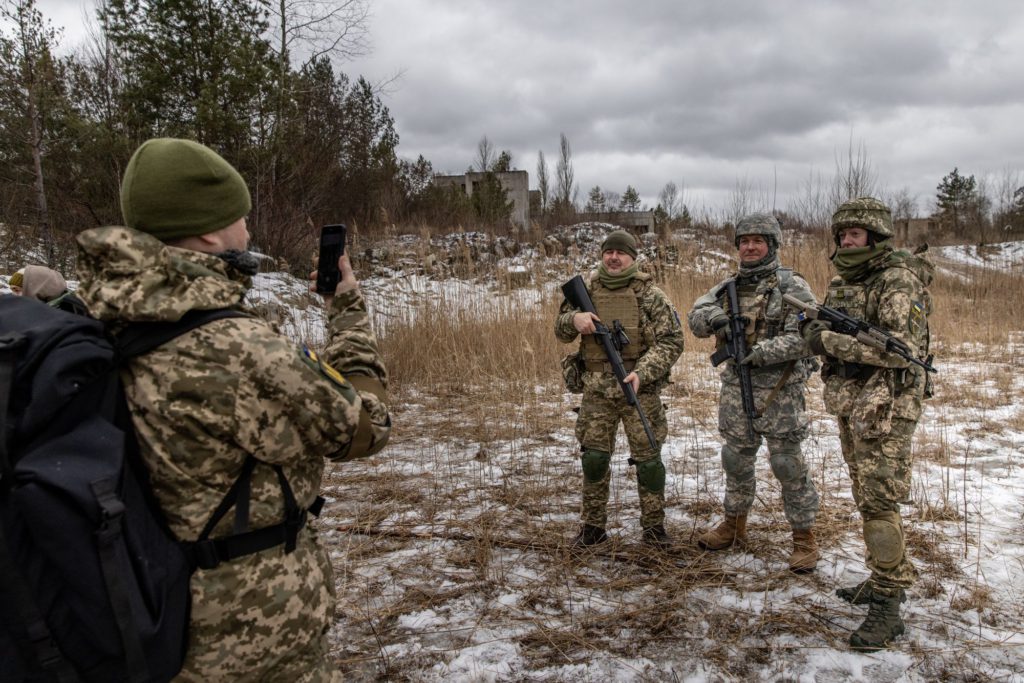
(Bloomberg) — The U.K. is considering the “biggest possible offer” to NATO, including more troops and weapons to Estonia, to help deter any Russian aggression against Ukraine, Prime Minister Boris Johnson announced on Saturday night.
President Joe Biden said Friday he’ll send American troops to Eastern Europe. The UN Security Council will debate the Ukraine situation on Monday. The U.S. and the European Union are zeroing in on a package of sanctions against Russia should President Vladimir Putin invade.
Russia has denied it intends to invade after massing tens of thousands of troops plus tanks and equipment near Ukraine’s eastern border.
Key Developments:
- Wall Street banks briefed by U.S. on possible sanctions
- Many raw materials would be swept into a Ukraine conflict
- Ukraine says U.S. hurting economy by sowing panic
- Azerbaijan is ready to supply emergency gas to Europe
- Where military forces are assembling around Russia and Ukraine
All times CET.
Pentagon Says Putin Still Adding Troops (3:48 p.m.)
Russia further boosted troop levels on the Ukrainian border this weekend, adding to President Vladimir Putin’s options should he decide on a military incursion, Pentagon spokesman John Kirby said.
“He can execute some of those options imminently,” Kirby said on “Fox News Sunday.” “Imminent means it could happen really, honestly, at any time. It depends on what Vladimir Putin might want to do.”
Stoltenberg Says No Plans for NATO Troops in Ukraine (1:06 p.m.)
Jens Stoltenberg, head of the NATO military alliance, said there are “no plans to deploy NATO combat troops to Ukraine” even as members help in various ways to boost Ukraine’s own defenses.
“We are focusing on providing support to Ukraine,” Stoltenberg said on the BBC. “Help them to uphold their right for self defense” and at the same time “find a political solution to prevent a new armed conflict in Europe.”
The U.S. last week said it was putting as many as 8,500 troops on heightened alert for deployment to bolster NATO forces in Eastern Europe if needed.
Putin Can’t Dictate NATO Membership, France Says (12:30 p.m.)
Vladimir Putin can’t dictate to the West what their security policy should be and who can or can’t enter NATO, Clement Beaune, the French junior minister for EU affairs, told LCI in a televised interview on Sunday.
Beaune added that he was “optimistic about our effort” toward a diplomatic solution on Ukraine based on the Normandy meeting last week.
Ukraine Slams Russia Over Donbas Move (11:42 a.m.)
A Russian move to open access to its state social services and payments provider to residents of the occupied eastern Donbas region is an infringement on Ukraine’s sovereignty, the foreign ministry said.
It urged Moscow to avoid steps which would complicate the diplomatic process, including the work of the Normandy format, which involves representatives of Russia, Ukraine, Germany and France.
Russia Will Delay Response to West: Lavrov (11:22 a.m.)
Russia wants an explanation of European security obligations from Western nations before making its next proposals on the Ukraine crisis, said Foreign Minister Sergei Lavrov said.
Moscow is asking NATO members and countries in the Organization for Security and Co-operation in Europe to clarify how they intend to fulfill OSCE obligations not to strengthen security at the expense of others’ security, Lavrov said on Russian state television.
The answers will be “key to determining our future proposals,” to be reported to Putin, he said.
U.K.’s Truss Looks to Deterrence, Sanctions (10:30 a.m.)
Deterrence remains the “number one” way to prevent a potential Russian invasion of Ukraine, but the U.K. is also working to beef up its sanctions regime with new proposed legislation, said Foreign Secretary Liz Truss.
Truss said on Sky News that “nothing is off the table” in terms of going after Russians who hold large amounts of wealth in the U.K., in property and other assets. “There will be nowhere to hide for those propping up the Russian state,” she said.
The top U.K. diplomat said she plans to travel to Ukraine this week and Moscow the following week.
Russia’s Patrushev Calls Ukraine Invasion Threat ‘Absurd’ (8:12 a.m.)
Russian Security Council Secretary Nikolai Patrushev dismissed allegations that Moscow plans to invade Ukraine as “completely absurd,” the Interfax news service reported.
Russia doesn’t want war and those who suggest the opposite are pursuing “selfish fabrications,” Interfax cited Patrushev as saying at a ceremony in St. Petersburg in memory of the victims of the siege of Leningrad.
France FM Has ‘No Knowledge’ Putin Set to Invade (12 a.m.)
France’s foreign affairs minister Jean-Yves Le Drian said he had “no knowledge” that Russian President Vladimir Putin has made a “decision” to engage into military action in Ukraine, but he added that Russia was logistically prepared for such a scenario.
In an interview with Journal du Dimanche, Le Drian also declined to detail what possible sanctions against Russia could be, because he said describing them would undermine the effectiveness of the threat. His message for Putin was: “Not a single step further.”
U.K. Weighs Big ‘Offer’ to NATO (11:30 p.m.)
The U.K. is considering the “biggest possible offer” of land, sea and air forces to NATO, including more troops and weapons to Estonia, to help deter any Russian aggression against Ukraine. The deployment could include fast jets, warships and military specialists.
Prime Minister Boris Johnson said in a statement he’s ordered troops to “prepare to deploy across Europe next week.” He’s also scheduled to speak with Putin this week and visit Eastern Europe in the coming days.
Russia to Shift Location of Naval Drills Near Ireland (6:57 p.m.)
Russia will relocate planned naval exercises to outside of Ireland’s exclusive economic zone, according to its ambassador in Dublin, Yuriy Filatov, in a what he described as a gesture of goodwill toward the Irish government and local fishermen.
Russia’s navy was set to run drills off the southwest Irish coast from Feb. 3 to Feb. 8. Irish Foreign Minister Simon Coveney said this week the exercises weren’t welcome, and the fishing industry raised concern about potential damage.
French, German Diplomats to Visit Kyiv on Feb. 7-8 (3:30 p.m.)
French Foreign Minister Jean-Yves Le Drian and Germany’s Annalena Baerbock plan to visit Kyiv on Feb. 7-8, Le Drian said on Twitter.
Le Drian said he assured Dmytro Kuleba, Ukraine’s minister of foreign affairs, of “our full support and solidarity with Ukraine. Our mobilization continues, in particular in the Normandy format, to de-escalate tensions.”
Kuleba, also on Twitter, said he and Le Drian had spoken on ways to help Ukraine’s economy “mitigate security risks.”
Commodity Price Risk From Fear of Conflict (9:25 a.m.)
Tensions over Ukraine have already sent natural gas prices spiraling, and could hit a raft of other raw materials crucial to the global economy at a time governments are dealing with an energy crunch, surging inflation, and a cost-of-living crisis.
The crisis “could spawn a butterfly effect, sending commodity prices spiraling higher as supply woes multiply,” analysts at Bloomberg Intelligence wrote.
Biden Says He’ll Send U.S. Forces to Eastern Europe (11:30 p.m.)
Biden said Friday he would be sending American troops to Eastern Europe as the threat of a Russian invasion of Ukraine continues. He added that “not a lot” of soldiers would be involved “in the near term.”
Biden didn’t name any countries where troops may be deployed or elaborate further.
Ukraine Says U.S. is Hurting Its Economy (7 p.m)
Ukrainian President Volodymyr Zelenskiy said the U.S. was damaging his country’s economy by unduly stoking panic that Russia may be planning an invasion. Zelenskiy said satellite images alone were insufficient to assess the extent of the military buildup and the situation hasn’t escalated.
“We are grateful to the U.S. for the support for our independence and territorial integrity,” Zelenskiy told foreign media in Kyiv. “But I am the president of Ukraine, I am here and I know more details and I have deeper knowledge than any other president.”
UN Security Council to Debate Crisis Monday (6:47 p.m.)
The U.S. said the UN Security Council should be fully engaged on the Ukraine crisis and confirmed that the council will discuss the issue during an open meeting on Monday, one day before Russia assumes the rotating presidency of the Security Council for February.
Ambassador Dmitry Polyanskiy, the deputy at the Russian Mission to the UN, tweeted his opposition to the meeting, calling it a “stunt shameful for the reputation” of the council.
Ukrainian Leader Says Russia’s Posture Is Stable (5:02 p.m.)
The situation on the border with Russia hasn’t escalated beyond where it stood last spring, Zelenskiy told reporters in Kyiv. He criticized “international leaders” who’ve openly speculated about a possible Russian invasion, and said that officials should be more careful in making comments about the imminent risk of war.
“Unbalanced information” costs Ukraine’s economy “a lot,” Zelenskiy added.
Ukraine needs as much as $5 billion in financial support from countries and international partners to stabilize its economy, Zelenskiy said.
More stories like this are available on bloomberg.com
©2022 Bloomberg L.P.