
(Bloomberg) — Sign up for the New Economy Daily newsletter, follow us @economics and subscribe to our podcast.
Australia’s central bank will jettison its 15 month-old quantitative easing program and revise up its inflation forecasts, setting the stage for an interest-rate hike in the third quarter, economists say.
The Reserve Bank will keep its cash rate at 0.1% on Tuesday, while ending its A$4 billion ($2.8 billion) a week of bond purchases, a survey of economists showed. They now see a first rate hike coming in about six months’ time, well ahead of their previous view of early 2023 and the bank’s guidance of 2024.
A more hawkish Australian central bank would bring it closer to counterparts from Wellington to Washington, who have started or will soon begin tightening policy to try to combat inflation. While consumer prices Down Under aren’t as hot as they are in the U.S. or New Zealand, they have moved into a zone that Governor Philip Lowe set out as necessary before any rate increase.
“Our working assumption is that the RBA will recognise that the inflation outlook has changed,” said Gareth Aird at Commonwealth Bank of Australia. “This means we expect them to make a solid upward revision to their forecast for underlying inflation in 2022.”
Lowe said last month that stronger economic data would likely make it appropriate to end QE when the program is reviewed at the Feb. 1 meeting.
Any move to wind back stimulus would be cushioned somewhat by a 7% drop in the currency since late October. That was driven by a strengthening dollar as accelerating U.S. inflation prompted markets to reprice the timing of the Federal Reserve’s first hike.
Similarly, Australian three-year bond yields have risen to 1.4% from below 1% in December, in line with a sell-off in Treasuries.
Since the Australian central bank’s last meeting in December, unemployment has fallen to a 13-year low of 4.2% and core inflation accelerated to a seven-year high of 2.6%.
The other key event in between meetings was another outbreak of Covid-19, which sapped some of the economy’s strong momentum. Still, the RBA is expected to look through the impact of the omicron variant on its forecasts.
Lowe has indicated that he sees full employment at around 4% and said that consumer-price growth needs to be sustainably near the midpoint of the RBA’s 2-3% target before he would move. The economy is now approaching both markers.
Communications Challenge
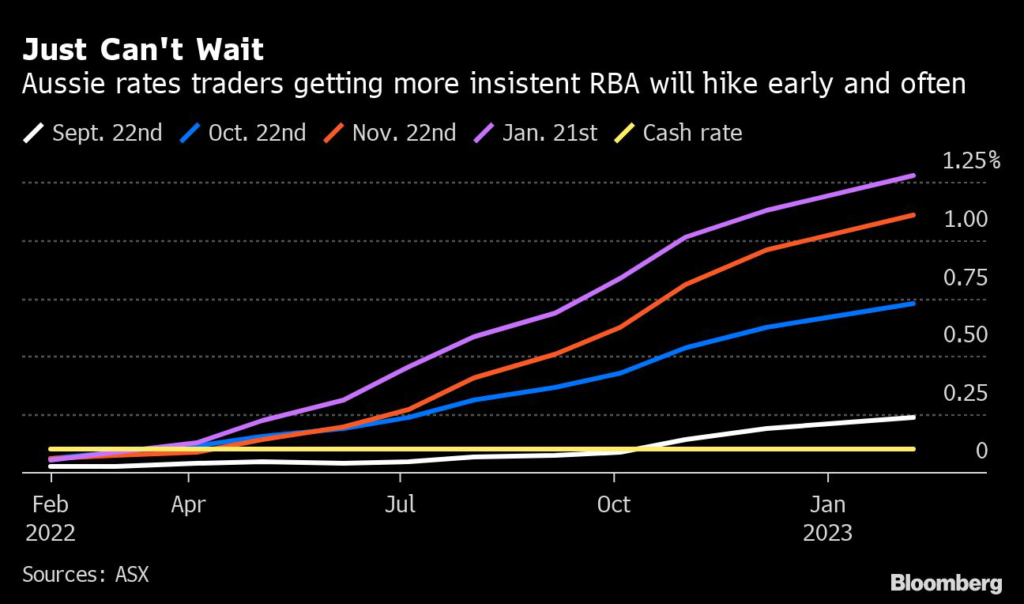
Yet expectations of an ultra-hawkish tilt from Lowe — reflected in money markets pricing in four rate hikes this year — are likely to be disappointed.
The single biggest factor restraining the RBA will be still-modest pay increases. The governor maintains that without strong underlying wage growth, any acceleration in inflation is likely to prove temporary.
“We expect the RBA board to say it will wait until wages growth accelerates further before it lifts the cash rate,” said David Plank at Australia & New Zealand Banking Group Ltd., predicting the central bank’s forecasts will point to a hike in the first half of 2023.
“This will be a complicated message for the market to absorb,” he said. “But it will be a clear signal the RBA is serious about wanting to see sustainably faster wages growth before it moves.”
Wages are showing some signs of life after years of stagnation, but the increases are nothing like the scale of those recorded in the U.S.
Australia’s main gauge of labor costs rose 2.2% in the third quarter, well short of the “3-point something” gain that Lowe has been seeking. Figures for the final three months of 2021 will be released on Feb. 23.
Lowe will have the opportunity to explain his stance on Wednesday, when he delivers his first speech of the year at the National Press Club. Two days later, the RBA releases its full suite of forecasts in its Statement on Monetary Policy.
More stories like this are available on bloomberg.com
©2022 Bloomberg L.P.