
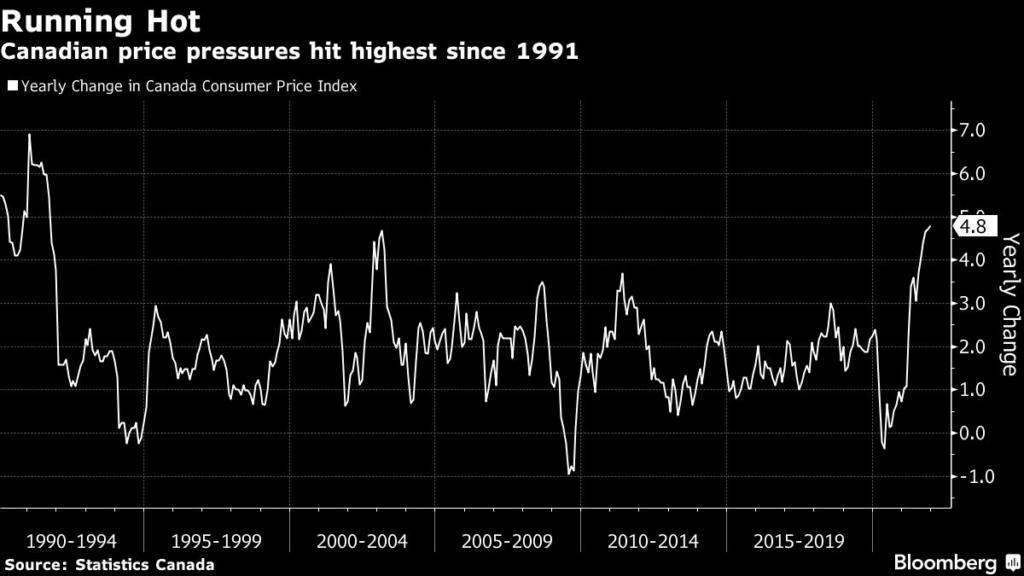
(Bloomberg) — The Bank of Canada held interest rates unchanged but signaled it could tighten monetary policy in coming weeks to contain the highest inflation in three decades.
Policy makers led by Governor Tiff Macklem left the central bank’s main policy rate at 0.25%, where it’s been since March 2020, amid uncertainty stemming from the resurgent coronavirus. In a decision Wednesday, they also dropped a pledge to not increase borrowing costs and said the economy appears to have fully recovered from the pandemic — a potential cue they plan to adjust rates at their next decision on March 2.
It’s a more dovish move than markets had been anticipating, reflecting worries the timing isn’t right to increase rates as the country deals with the omicron variant and fresh lockdowns. The surge in Covid-19 cases last month prompted shutdowns in Ontario and Quebec, Canada’s two most populous provinces, and many restrictions are still in place.
The Canadian dollar and short-term bond yields fell. Money markets were pricing in a 70% chance of a rate increase, while economists were more skeptical with only 12 of 27 in a Bloomberg survey projecting a hike this week.
“Looking ahead, the Governing Council expects interest rates will need to increase,” bank officials said in the policy statement.
Fed on Tap
The hold illustrates a potential wariness by central bankers broadly to press ahead aggressively with tightening and could be seen as a dovish signal just hours before the U.S. Federal Reserve announces its policy decision Wednesday afternoon.
While investors aren’t anticipating a U.S. rate hike, Fed policy makers are expected to telegraph a move in March.
The Canadian dollar pared its gains on the news, little changed at C$1.2629 at 10:33 a.m in Toronto after falling as much as 0.6% earlier in the day. Canadian bonds extended their rally, as two-year yields fell five basis points to about 1.18%.
The language in the Bank of Canada statement, and accompanying quarterly forecast report, focused in large part on how the economy appears to have run up against full capacity and is struggling to contain price and wage pressures.
The Bank of Canada revised its inflation forecasts higher, saying consumer price gains will average 4.2% this year, up from 3.4% previously. Officials also flagged concerns that more persistent price pressures become embedded in expectations, including wages.
Annual inflation was 4.8% last month, the highest since 1991. Inflation has exceeded the central bank’s 1% to 3% control range for nine straight months. Since Canada introduced inflation targeting in the early 1990s, the inflation rate has averaged about 1.8%.
“The Bank of Canada did everything but hike today, ditching its forward guidance and signaling that higher rates are nigh,” Warren Lovely, chief rates strategist at National Bank of Canada, said by email.
Macklem and his officials even downplayed the impact of the omicron wave of cases, saying the impact would be temporary and limited by Canada’s high vaccination rate.
“The BoC’s entire set of forecasts and narrative says hike. So they hold,” Derek Holt, vice president and and head of capital markets Economics at Scotiabank, said by email.
Still, markets are anticipating a string of increases over the next 12 months that will take the policy rate to 1.75%.
“When we look at the Bank of Canada and the decision today, I think what’s most important is that there is still a sequencing to this policy normalization,” Eric Theoret, global macro strategist at Manulife Asset Management, told BNN Bloomberg television.
(Updates with details, economist reaction.)
More stories like this are available on bloomberg.com
©2022 Bloomberg L.P.