
(Bloomberg) — Hong Kong will extend social restrictions through the end of the Lunar New Year to help contain an omicron outbreak that’s taken local cases to about 60, local media reported. In the meantime, South Korea eased some curbs on gatherings in the lead-up to the festivities early next month.
Global automakers have been caught in the latest coronavirus outbreak in the Chinese city of Tianjin. A factory operated by Volkswagen AG’s joint venture with FAW Group has been shut since Monday, along with a gearbox supplier controlled by the German giant. They join a Toyota Motor Corp. factory that has been closed for five days.
Germany reported record new coronavirus cases for the third straight day as the highly transmissible omicron variant swept through Europe’s biggest economy. The U.K. is set to abandon Covid passes this month, the Times reported, citing a government official it didn’t identify.
Key Developments:
- Virus Tracker: Cases top 319.1 million; deaths pass 5.5 million
- Vaccine Tracker: More than 9.6 billion shots administered
- U.S. Spotlight: Covid hospital admissions show omicron spreading to West Coast
- Chaos at Hong Kong quarantine camp leaves some detainees trapped
- China’s Covid absolutism is making it a no-go zone for airlines
- What we know about the omicron variant now: QuickTake
Philippines Keeps Curbs on Record Cases (12:19 p.m. HK)
The Philippines will keep movement restrictions in its capital from January 16 to 31 as daily Covid-19 infections and the percentage of positive tests hit record highs. Metro Manila, which accounts for a third of economic output, will remain under Alert Level 3, Cabinet Secretary Karlo Nograles said in a briefing Friday. Outdoor restaurants can operate at half capacity, while cinemas, gyms and other indoor businesses are limited to 30% capacity.
Auto Factories in China Shuttered (11:33 a.m. HK)
The closing of the VW plant may hit production of Tayron, Tayron X and Tayron plug-in hybrid models, and the Audi Q3, the company said. The company, which has tested all employees twice this week, expects to resume output “very soon” and catch up on lost production. VW has around 8,000 employees in Tianjin. The Toyota plant produces around 500,000 vehicles a year, including popular models such as the Corolla sedan and Rav4 SUV.
Tianjin, a port city of 14 million and a major production hub for foreign businesses, is just 30 minutes from Beijing by train and adjacent to Hebei province, which is hosting most of the snow sports during next month’s Winter Olympics.
Hong Kong Extends Restrictions (11:20 a.m. HK)
Existing curbs that have kept social venues shut and shortened dine-in hours at restaurants will remain through Feb. 3, local broadcaster Cable TV and HK01 reported, citing unidentified people. The restrictions started Jan. 7 and were originally set to last for two weeks. The addition of two weeks means they will be in place throughout the entire Chinese New Year holiday that runs for the first three days of February. An announcement about the extension is expected to be made in the afternoon, Cable TV said.
Cases in Germany Soar to a Record (10:41 a.m. HK)
Infections surged by 92,223, the highest one-day increase since the start of the pandemic, according to numbers released Friday by the country’s RKI public-health institute. The seven-day incidence rate per 100,000 people climbed to a record high of 470.6.
Chancellor Olaf Scholz this week issued a strong appeal for Germans to get vaccinated against Covid-19, saying failing to do so puts others at risk as the nation grapples with omicron. More than 72% of the population is fully vaccinated with two shots, and over 45% have had a booster shot, according to the latest RKI data. But there remain pockets of intense opposition to inoculations.
Citigroup Vaccine Compliance (10:01 a.m. HK)
Citigroup Inc. said 99% of its U.S. employees have complied with its vaccine mandate, one of the strictest on Wall Street. The firm expects more employees will comply with the order before the deadline on Friday, Sara Wechter, head of human resources, said Thursday in a LinkedIn post. As part of the mandate, staffers were able to receive exemptions.
Airlines Slash Services to China (9:58 a.m. HK)
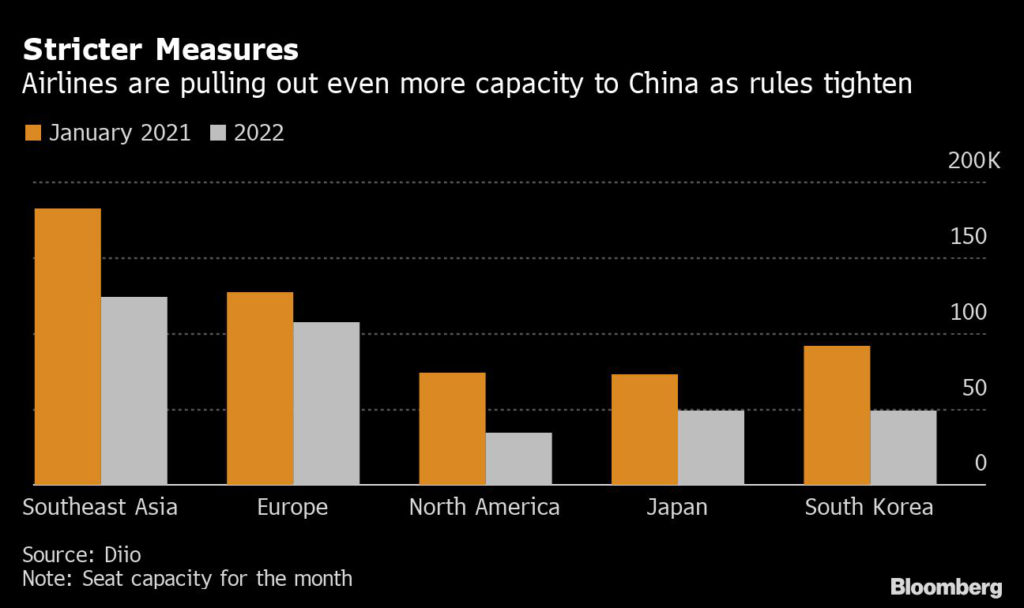
China is more cut off from international travel than at any other stage during the pandemic as it tries to stamp out Covid with tight controls on movement. Airlines from key markets have reacted by slashing services from already low levels, with fewer than 500 inbound China flights scheduled this week versus about 10,000 this time two years ago.
China Covid Cases (9:03 a.m. HK)
The country reported 143 new local confirmed infections Thursday, including 98 in Henan province, 34 in Tianjin city, eight in Xi’an, two in Shanghai and one in Zhongshan, according to the National Health Commission. China also reported four new local asymptomatic cases Thursday, including 3 in Shanghai and 1 in Tianjin.
U.K. Set to Abandon Covid Passes (8:14 a.m. HK)
Health Secretary Sajid Javid has decided Covid-19 certification is no longer needed as the Omicron wave subsides in the U.K., the Times reports, citing an unidentified government source. There was always a very high threshold for the policy of requiring proof of vaccination or a negative test to enter large events in England, and it appears that within a couple of weeks that threshold will no longer be met, according to the government source.
South Korea Extends Help to Small Businesses (7:51 a.m. HK)
The country is set to ease curbs on private gatherings for three weeks starting Jan. 17 in the lead-up to the Lunar New Year early February. The government will allow up to six people, from the current 4, Prime Minister Kim Boo-kyum said Friday.
The government plans to allocate extra budgetary support to small business owners and merchants hit by the spread of the coronavirus, and a proposal will be presented to lawmakers before the Lunar New Year holidays later this month, Kim said. While officials prepared to ease private gathering rules, they said closing hours for cafes and restaurants would remain unchanged at 9 p.m.
New South Wales Infections to Plateau (7:37 a.m. HK)
Covid infections in New South Wales, Australia’s most populous state, should start hitting a plateau next week, though it would be at a relatively high level of patients in hospitals and intensive care units, the state’s deputy secretary for health, Susan Pearce, told reporters Friday.
Hospitalization rates are significantly lower with omicron strain infections compared with delta, and hospital stays are shorter, she added. There are 2,525 Covid cases admitted to hospitals, including 184 people in intensive care. There were 29 deaths in the latest reporting period, the highest since the start of the pandemic. The vast majority of young people admitted to ICU with Covid are unvaccinated, the state’s chief health officer Kerry Chant said.
Canada to Bar Entry of Unvaccinated Truckers (6:42 a.m. HK)
Canada is standing by its plan to impose a vaccine requirement on all truckers entering from the U.S. starting Saturday, despite worries it could undermine supply chains and damage the economy. In a statement Thursday, Prime Minister Justin Trudeau’s government confirmed plans to deny entry into the country of unvaccinated truckers if they’re foreign nationals. Meanwhile, unvaccinated Canadian drivers will lose an exemption from testing and quarantine requirements.
U.S. Nurses Protest Worsening Workplaces (5:25 p.m. NY)
Chicago nurses joined colleagues across the country Thursday to protest against working conditions that they say have rapidly deteriorated as hordes of Covid-19 patients push hospitals to the limit.
The protests, organized by National Nurses United, a labor union boasting 175,000 members nationwide, was part of a jam-packed day of action across 11 U.S. states and Washington, D.C. today “to demand the hospital industry invest in safe staffing, and to demand that President Biden follow through on his campaign promise to protect nurses and prioritize public health,” according to the union. In Chicago, members are still working and the action was part of their bargaining process, but other branches are striking.
Delta, American Cut Regional Flights (5:17 p.m. NY)
Delta Air Lines Inc. and American Airlines Group Inc. are cutting regional flights over the next few months due to pilot shortages, extending a lingering effect from the early days of the coronavirus pandemic.
Delta has cut back by as much as 25% for the first half of this year, the Atlanta-based carrier said on an earnings call Thursday. American has dropped 580 March flights at its wholly owned Piedmont Airlines and an undisclosed number this month and next at regional partners SkyWest Inc. and Mesa Air Group Inc.
Colorado Needs Hospital Capacity: Governor (4:26 p.m. NY)
In his state of the state address Thursday, Colorado Governor Jared Polis said he will propose a three-year plan to “stabilize our health-care workforce.”
Colorado’s hospital capacity was pushed to the brink during last year’s wave of the deadly delta variant, and state official last week issued an order permitting emergency medical services to ration care as ambulance crews fall ill with the omicron variant.
“We can’t let our society and our economy be impacted by hospital capacity,” Polis said. Colorado’s positivity rate is 30%, the highest of the pandemic, state health officials reported Wednesday.
Boston Sewage Suggests Omicron Peak (4:18 p.m. NY)
The surge in infections may have hit a peak in the Boston area amid a steep decline of viral signals in wastewater.
Data from Boston-based Biobot Analytics, a startup that monitors Covid levels in sewage, showed that the virus concentration in the city’s wastewater samples is down more than 50% from its recent peak. The drop-off is the most dramatic to date, according to Biobot President and co-founder Newsha Ghaeli, after virus signals shooting up 10 times compared with levels a year ago.
More stories like this are available on bloomberg.com
©2022 Bloomberg L.P.